How Padukone’s 1980 Win Changed Indian Sport
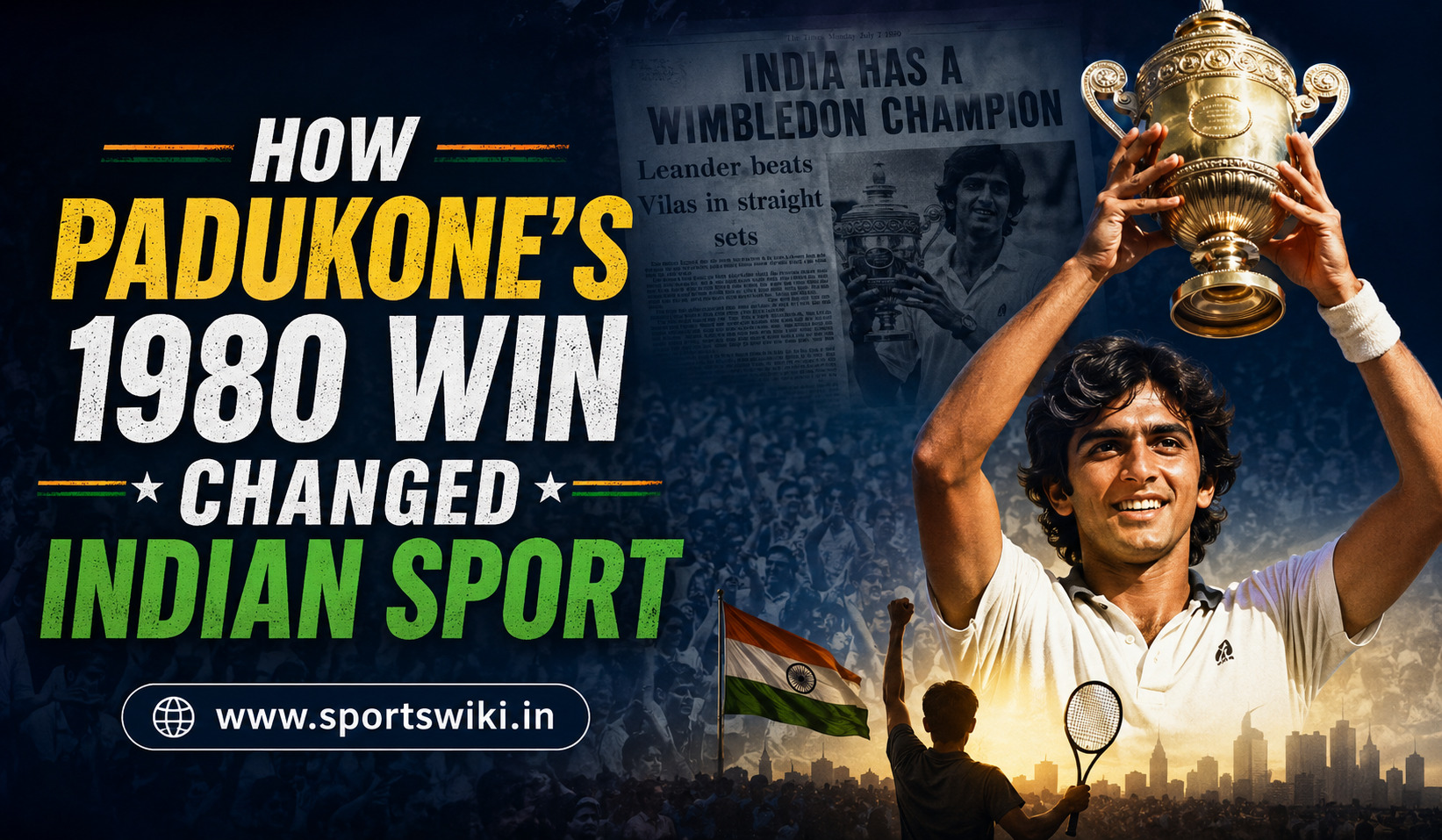
On March 23, 1980, at Wembley Arena, a 24-year-old from Bangalore beat a two-time defending champion 15-3, 15-10 in a final that lasted barely half an hour. Prakash Padukone’s All England Championship victory sounds modest in the retelling, but it single-handedly proved an Indian could stand at the top of world badminton at a time when the sport belonged almost entirely to Indonesia, China, and Denmark.
More than four decades later, that win is still treated as the founding moment of modern Indian badminton. Here is the full story of how Padukone got there, what actually happened in that final, and why the ripple effects of a single afternoon in London are still shaping Indian sport today.
Who Was Prakash Padukone Before 1980
Padukone was born on June 10, 1955, in Bangalore, into a household already steeped in the sport. His father, Ramesh Padukone, served as secretary of the Mysore Badminton Association, putting a racket in his son’s hand almost as soon as he could hold one.
A Bangalore Upbringing Built Around Badminton
Growing up around organized competitive badminton gave Padukone a head start most Indian players of his generation never had. He turned that early exposure into total domestic dominance, winning the national championship eight consecutive times between 1971 and 1979, an era in which no other Indian player came close to challenging him.
Domestic Dominance and Early International Signs
His first real international breakthrough came in 1978, when he won gold at the Commonwealth Games in Edmonton, Canada. It was a signal that his game could translate beyond India’s borders, though the sport’s true measuring stick, the All England Championship, still felt out of reach. Padukone had already tested himself there, including a quarterfinal loss to Liem Swie King in 1977 and an injury withdrawal in 1979, building toward the breakthrough that arrived the following spring.
The 1980 All England Final That Changed Everything
The All England Championship carried a weight in 1980 that modern tournaments rarely match. Before the BWF launched its own World Championships in 1977, All England functioned as the sport’s unofficial world title, and even after that change it remained the event every top player circled first.
The Road to the Final
Seeded third, Padukone tore through a draw filled with former and future champions. He beat Denmark’s Svend Pri, a former singles and mixed doubles champion, in the quarterfinals, then dismantled top seed Morten Frost Hansen 15-8, 15-10 in the semifinal. That set up a final against Liem Swie King, the Indonesian star who had won the tournament in both 1978 and 1979 and would go on to win it again in 1981.
The Final Itself
Padukone controlled the match from the start, closing it out 15-3, 15-10 without dropping a game anywhere in the tournament. He later described his tactical approach as a subtle game of deception, holding back his stroke just long enough to force King into moving a fraction of a second too late, then countering with a drop shot when King anticipated a toss. It was the first time an Indian had ever won the All England Championship, and it happened in decisive, unambiguous fashion.
Becoming World Number One
Padukone’s 1980 season did not stop at Wembley. He had already beaten Morten Frost at the Denmark Open earlier that year, and after All England he went on to win the Swedish Open, defeating Indonesian legend Rudy Hartono, an eight-time All England champion in his own right. That run of results carried Padukone to the world number one ranking in 1980, making him the first Indian player to top the sport’s rankings at any point in its history.
Why This Win Mattered Beyond Badminton
India’s sporting identity in 1980 revolved almost entirely around cricket and field hockey, team sports with deep colonial-era roots and massive domestic followings. Individual Olympic-style sports barely registered in the national conversation, and badminton in particular was seen as a recreational pastime rather than a legitimate path to global success.
Padukone’s win broke that assumption in a single afternoon. For the first time, a young Indian athlete in an individual sport had beaten the best players in the world on their own turf, without a team around him to share the credit or the pressure. That mattered enormously for how the next generation of Indian parents and young athletes thought about which sports were actually worth pursuing seriously.
Padukone’s Legacy After Retirement
Padukone added a bronze medal at the 1983 World Championships in Copenhagen, becoming the first Indian to medal at that event, before retiring from competitive play in 1991. What came after his playing career arguably shaped Indian badminton even more than his playing days did.
The Academy That Built a Generation
Padukone went on to establish a badminton academy in Bangalore aimed at giving young Indian players the structured, high-level training environment he largely had to build for himself during his own career, often training abroad in Denmark alongside rivals like Morten Frost. That academy became an early blueprint for the kind of dedicated infrastructure Indian badminton had always lacked.
Olympic Gold Quest and Broader Sports Investment
Padukone also co-founded Olympic Gold Quest, an initiative built to provide financial and logistical support to promising Indian Olympic athletes across multiple sports, not just badminton. The project reflected a broader understanding, shaped by his own career, that individual excellence alone was not enough. Athletes also needed funding, coaching access, and long-term institutional support to compete consistently at the highest level.
The Direct Line From Padukone to Today’s Stars
Trace the timeline forward and the connection between 1980 and today’s Indian badminton success becomes impossible to ignore:
- 1980: Padukone becomes the first Indian to win the All England Championship and reaches world number one
- 2001: Pullela Gopichand, inspired directly by Padukone’s breakthrough, becomes the second Indian to win All England, 21 years later
- 2012 to 2020: Saina Nehwal and PV Sindhu turn individual brilliance into consistent Olympic medals
- 2022: India wins its first Thomas Cup team title, proof the sport’s depth now extends across an entire national program rather than one standout player
None of that arrives without a 24-year-old proving in 1980 that it was even possible for an Indian player to reach the very top of the sport.
A Single Match, A Permanent Shift
It is easy to look back at a 15-3, 15-10 scoreline and assume the outcome was inevitable, but nothing about Padukone’s path was guaranteed. He built his game largely through self-directed training and time spent competing in Europe, without the institutional support systems that exist for Indian shuttlers today. His win forced Indian sport to reconsider what was possible outside cricket and hockey, and his post-career work building academies and athlete support programs ensured that possibility turned into a sustained pipeline rather than a one-time fluke. Every Indian badminton star who has followed him owes at least part of their path to that afternoon at Wembley.
Frequently Asked Questions
When did Prakash Padukone win the All England Championship?
Padukone won the All England Championship on March 23, 1980, defeating two-time defending champion Liem Swie King of Indonesia 15-3, 15-10 in the final.
Was Prakash Padukone ever ranked world number one?
Yes, Padukone reached the world number one ranking in 1980, becoming the first Indian player to top the badminton world rankings.
Who was the next Indian to win the All England Championship after Padukone?
Pullela Gopichand became the second Indian to win the All England title in 2001, 21 years after Padukone’s breakthrough win.
What did Prakash Padukone do after retiring from competitive badminton?
Padukone founded a badminton academy in Bangalore to train young Indian players and co-founded Olympic Gold Quest, an initiative supporting Indian Olympic athletes across multiple sports with funding and coaching resources.