Pullela Gopichand’s Coaching Legacy Explained
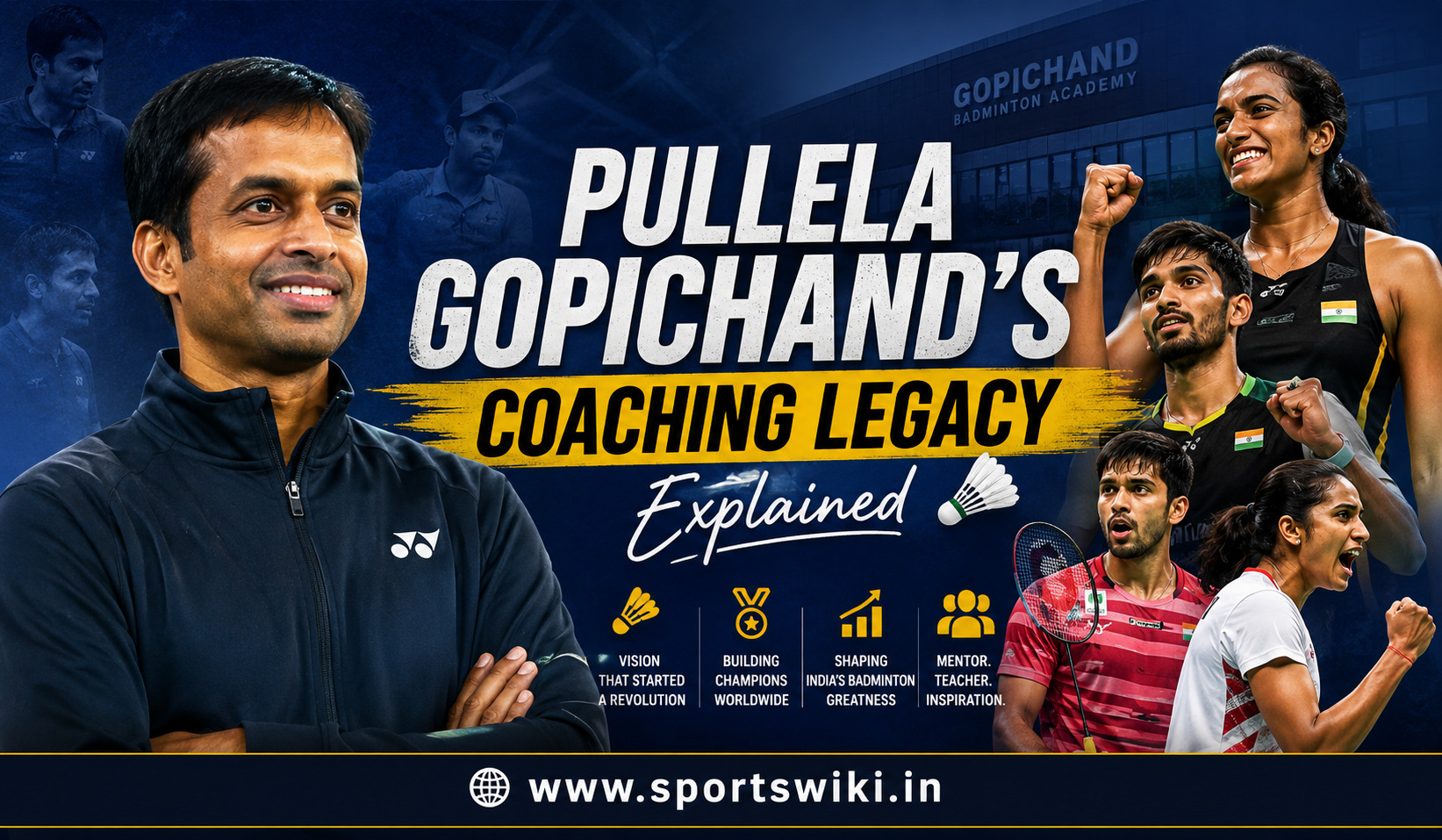
In the 30-year history of the China Open Super Series, only three non-Chinese women have ever won the women’s singles title. Two of them, Saina Nehwal and PV Sindhu, were coached by the exact same man. That single statistic captures what Pullela Gopichand has built better than almost any other fact available: not just individual champions, but a repeatable system for producing them.
Gopichand’s own playing career was strong enough to headline most badminton biographies on its own. But his real legacy is what came after he retired, when he mortgaged his own house to build a training academy that eventually reshaped Indian badminton from the ground up. Here is how he did it.
From All England Champion to Academy Builder
Born on November 16, 1973, in the small village of Nagandla in Andhra Pradesh, Gopichand originally gravitated toward cricket before his elder brother, Rajasekhar, steered him toward badminton at age 11. He trained under coach S.M. Arif in Hyderabad before moving to Bangalore to work at Prakash Padukone’s academy and the Sports Authority of India center under coach Ganguly Prasad, absorbing lessons from the very player whose 1980 All England win had first put India on badminton’s map.
A Player’s Career Cut Short By Injury
Gopichand won his first national championship in 1996 and defended the title five years running through 2000, alongside international results including silver in the team event and bronze in singles at the 1998 Commonwealth Games. Chronic knee injuries eventually forced him to retire from competitive play, cutting short a career that had reached a career-high world ranking of five.
The 2001 All England Win That Echoed Padukone
Before injuries ended his playing days, Gopichand delivered the signature win of his career. At the 2001 All England Open, he beat then-world number one Peter Gade in the semifinals before defeating China’s Chen Hong in the final, becoming only the second Indian ever to win the tournament, 21 years after Prakash Padukone’s original breakthrough. The symmetry was not lost on anyone watching: the man Gopichand had trained under as a teenager was the same man whose record he had just matched.
Building an Academy From Nothing
Rather than simply retire and step away from the sport, Gopichand set out to build the kind of structured training environment India had never had for badminton, one capable of producing champions on a consistent basis rather than relying on the occasional gifted individual.
Mortgaged Houses and a Government Land Grant
The Andhra Pradesh state government, under then-Chief Minister Chandrababu Naidu, allotted Gopichand five acres of land in Hyderabad’s Gachibowli area in 2003. Gopichand began coaching out of the developing site the following year, but funding remained a constant obstacle, and he reportedly mortgaged his own house to keep construction moving. Industrialist Nimmagadda Prasad eventually donated 50 million rupees toward the project, on the explicit condition that the academy produce an Olympic medal for India. The fully built Pullela Gopichand Badminton Academy opened its doors in 2008.
A Coach Willing to Bet on a 14-Year-Old
Even before the physical academy was complete, Gopichand had already identified his first major project. He began coaching Saina Nehwal in 2004, when she was just 14 years old, integrating her into his earliest training group and betting his emerging methodology on a teenager years away from her eventual Olympic bronze medal.
The Roster That Changed Indian Badminton
Over the years, the academy has trained a remarkable share of India’s top international players, including:
- Saina Nehwal, 2012 Olympic bronze medalist and former world number one
- PV Sindhu, two-time Olympic medalist and 2019 World Champion
- Kidambi Srikanth, former world number one and multiple Super Series champion
- Parupalli Kashyap, Commonwealth Games gold medalist
- HS Prannoy and Sai Praneeth, both established fixtures in India’s men’s singles depth
That level of concentrated success from a single academy is rare in any sport, and it reflects a training philosophy built around discipline and fundamentals rather than any single stylistic trademark. The academy’s own stated values, built around grit, respect for time, and refusing shortcuts, show up consistently in how its graduates approach their careers.
National Coach Since 2006: Building a System, Not Just Stars
Gopichand became Chief National Coach for the Indian badminton team in 2006, a role that let him extend his academy’s methods to the country’s broader talent pipeline rather than just the players training directly under him in Hyderabad. That dual role, running a private academy while simultaneously overseeing the national program, gave Gopichand influence over Indian badminton at both the grassroots and elite levels simultaneously, a combination few coaches anywhere in the sport have ever held for this long.
Expanding Beyond Hyderabad
In March 2017, a second Pullela Gopichand Badminton Academy opened in Greater Noida as part of the 40-acre Shahid Vijay Singh Pathik Sports Complex, becoming India’s third high-performance badminton center and the first one based in North India. The expansion reflected a clear strategic goal: identifying and developing talent at the grassroots level well beyond South India, where the original academy’s success had been concentrated.
Recognition and Honors
Gopichand’s contributions have been recognized at the highest levels of Indian sport. He received the Arjuna Award in 1999 for his playing career, the Padma Shri in 2005, the Dronacharya Award in 2009 for his coaching work, and the Padma Bhushan, India’s third-highest civilian honor, in 2014. Few figures in Indian sport have been honored for excellence as both a competitor and a coach within the same career.
Why Gopichand’s Model Still Matters
The clearest evidence of Gopichand’s impact is not any single medal but the sheer consistency of results across nearly two decades. Indian badminton went from producing isolated breakthroughs, Padukone in 1980 and Gopichand himself in 2001, to producing Olympic medalists, World Champions, and Thomas Cup winners on a rolling basis. That shift did not happen by accident. It happened because one former champion decided the sport needed permanent infrastructure rather than individual heroics, and was willing to mortgage his own home to build it.
Frequently Asked Questions
When did Pullela Gopichand win the All England Championship?
Gopichand won the All England Open Championship in 2001, beating Chen Hong of China in the final after defeating then-world number one Peter Gade in the semifinals.
When did Pullela Gopichand’s badminton academy open?
The land for the academy was allotted in 2003, coaching began there in 2004, and the fully built Pullela Gopichand Badminton Academy in Hyderabad opened in 2008.
Which top players has Pullela Gopichand coached?
Gopichand has coached Saina Nehwal, PV Sindhu, Kidambi Srikanth, Parupalli Kashyap, HS Prannoy, and Sai Praneeth, among many other Indian players who have gone on to major international success.
What honors has Pullela Gopichand received?
Gopichand has received the Arjuna Award, the Padma Shri, the Dronacharya Award for coaching, and the Padma Bhushan, India’s third-highest civilian award.