Boxing Scoring Explained: The 10-Point Must System
Five judges, five scorecards, one verdict. At the 2025 World Boxing Championships in Liverpool, Jaismine Lamboria beat Poland’s Julia Szeremeta in the 57kg final. The cards read 30-27, 29-28, 30-27, 28-29 and 29-28. That made it a 4-1 win built on thin margins.
Boxing scoring settles fights like this every week, yet many new fans can’t explain it. This guide covers the 10-point must system in plain English. You’ll see how a round becomes a number, when a knockdown changes the math, and how cards turn into a final result. Along the way, you’ll also learn how to score a fight yourself.
What Boxing Scoring Really Measures
Boxing scoring starts with one simple idea. Judges score every round on its own, then add the rounds together. Because of this, a fighter can lose early and still win the night. Likewise, one strong round can’t erase the others unless it ends the fight.
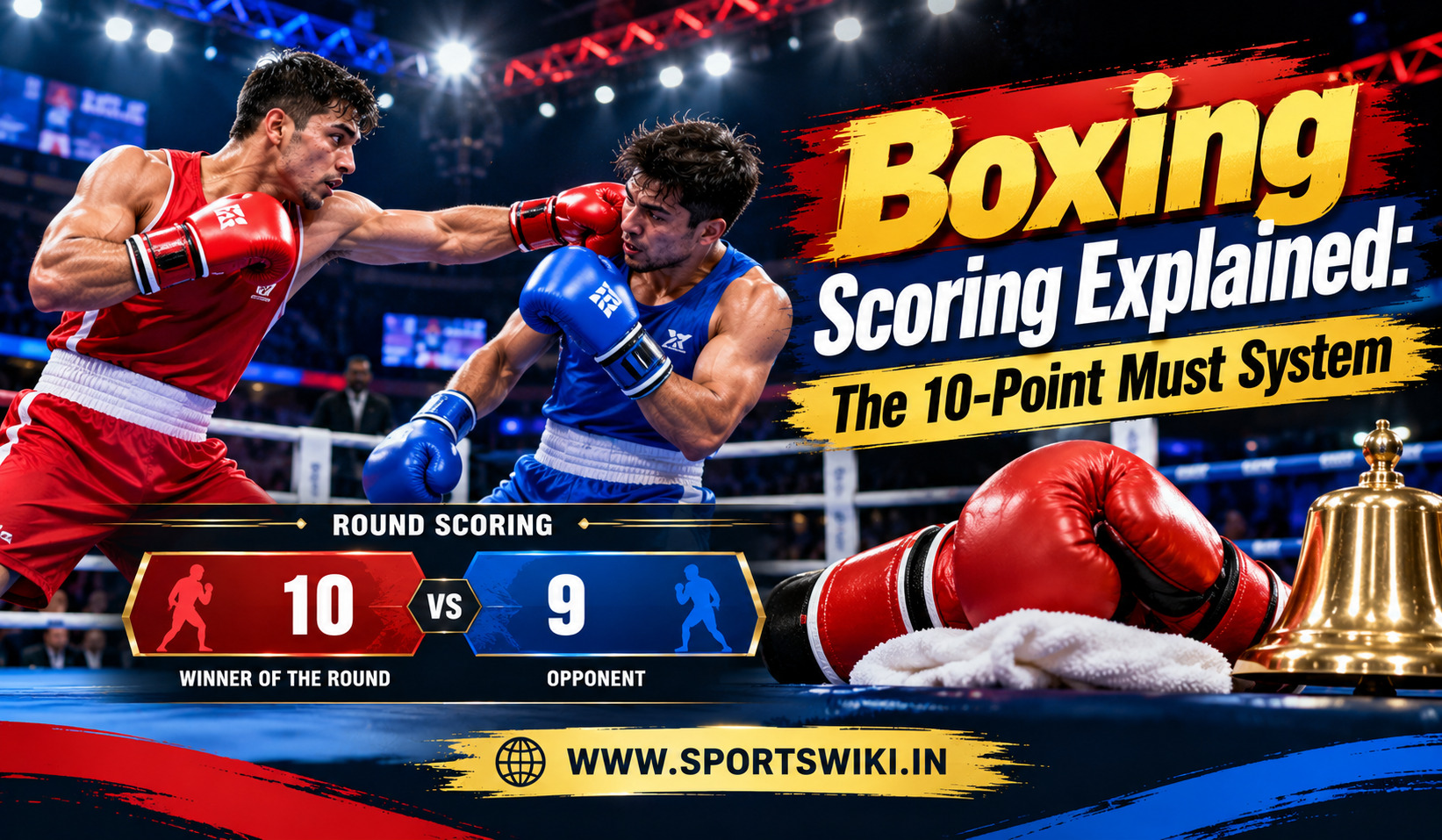
Here’s the core rule of the 10-point must system. The winner of a round must get 10 points. The loser gets 9 or fewer. So a normal round ends 10-9, and a 12-round fight is scored out of 120. A 10-10 round is allowed when a judge sees no winner, yet it’s rare.
The Four Scoring Criteria
Judges don’t simply count punches. Most governing bodies ask them to weigh four things, though the order can differ by region.
- Clean punching: hard, accurate shots that land on the head or body.
- Effective aggression: moving forward and landing, not just chasing.
- Ring generalship: control of the pace, the distance and the middle of the ring.
- Defense: slipping, blocking and making the opponent miss.
Clean punching is usually the first thing judges look at. Still, the other three decide close rounds. For instance, a boxer who lands fewer shots but controls the ring can sneak a round. Meanwhile, a wild brawler who misses a lot rarely earns credit for effort alone. That’s the heart of fair boxing scoring.
How One Round Gets Scored
Most rounds run three minutes, and judges watch every second before they decide. Once the bell rings, they write down the score and reset for the next round. That habit matters, since early momentum can’t carry over. As a result, boxing scoring rewards the work done inside each round, not the reputation of the fighter.
The Standard 10-9 Round
Most rounds are close, and most end 10-9. One fighter lands the better work, so the judge gives that boxer the 10. Even so, a 10-9 doesn’t mean the loser was bad. It simply means the other fighter did a little more. After enough of these rounds, the small gaps pile up into a clear win.
When a Round Goes 10-8
A 10-8 round is a big swing. Judges usually give it after a knockdown, or after clear and sustained control without one. For example, a boxer dropped by a clean right hand typically loses that round 10-8. That said, judges still weigh everything else that happened in the round. A 10-7 is possible, but it’s rare. It usually takes two knockdowns, or one knockdown plus heavy control.
Point Deductions
Referees can also take points away. Fouls such as low blows, holding or repeated headbutts often earn a warning first. After that, the referee may deduct a point, and the judges subtract it from that round’s total. So a boxer who wins a round 10-9 but loses a point for a foul ends up level at 9-9. To see how referees handle fouls and counts, read our guide to boxing rounds, gloves and knockout rules.
A Worked Example of a Three-Round Card
Numbers make more sense with a real picture. Imagine a three-round amateur bout between Boxer A and Boxer B. Here’s how one judge might score it.
- Round 1: Boxer A lands the cleaner jabs, so the card reads 10-9 for A.
- Round 2: Boxer A drops Boxer B with a right hand, so the card reads 10-8 for A.
- Round 3: Boxer B fights back and wins the round, so the card reads 10-9 for B.
Add it up, and Boxer A leads 29-27. Notice that B won the last round, yet still lost the card. That’s because the knockdown in round two cost B two points, not one. In fact, the knockdown decided the bout on this judge’s card. Of course, the other judges might see round one differently, and that’s where split decisions come from.
Who Does the Boxing Scoring?
Pro fights typically use three judges seated around the ring. Each judge keeps a private scorecard and can’t see the others. The referee runs the fight from inside the ring and usually doesn’t score it. Amateur and Olympic boxing often use five judges instead, as the Liverpool final showed. In that final, four judges backed Lamboria while one saw it 28-29 the other way.
Judges sit at different spots around the ring, so they see punches from different angles. A shot that looks clean from one side can look blocked from another. Still, the rules ask every judge to score what they see, round by round. Major amateur events, including the Olympics, now use the 10-point must system too. Better yet, the scoring stays the same in every division, from flyweight to heavyweight, as our guide to boxing weight classes explains.
Reading the Final Result
When the last bell rings, the cards are added up. Several outcomes are possible, and each has its own name.
- Unanimous decision: every judge picks the same winner.
- Split decision: the judges disagree, such as 2-1 with three judges or 4-1 with five.
- Majority decision: two judges pick a winner and the third scores a draw.
- Draw: the cards add up level, with no winner.
- Technical decision: an accidental foul such as a cut ends the fight, and the cards decide it.
Fights can also end by knockout or stoppage, with no need for the cards. Even so, boxing scoring matters most in close fights. Nikhat Zareen’s 2022 world final win over Thailand’s Jutamas Jitpong is a good example. All five judges picked her, yet the cards read 30-27, 29-28, 29-28, 30-27 and 29-28. Indian fans will find more moments like that in our look at Indian boxers at the World Boxing Championships.
Why Close Rounds Spark Arguments
Not every round has a clear winner. In a tight three minutes, two honest judges can disagree. One may favor the busier fighter, while another prefers the cleaner counterpunches. Because of this, split cards happen even when nobody’s cheating.
Still, a big gap between cards deserves questions, since it can hint that a judge missed the action. Fans also watch from different angles than judges do. Television replays show punches the ringside view can hide. That said, replays aren’t what judges see live, so a little patience helps. Good boxing scoring is about the best honest read of the action in real time.
Common Scoring Mistakes New Fans Make
Most confusion comes from a few habits. Once you spot them, you’ll read fights far better.
- Counting only punches thrown: volume matters less than clean, landed shots.
- Giving extra weight to the last round: every round carries the same value.
- Treating a knockdown as a fight winner: it wins the round, usually 10-8, not the whole bout.
- Scoring the whole fight in one go: judges score each round alone.
Of these, the last one causes the most trouble. A fan who watches twelve rounds and then picks a winner will miss how the small gaps add up. Judges don’t have that luxury. They commit to a number every three minutes, and that discipline keeps boxing scoring consistent.
How to Score a Fight at Home
Try it on your next fight, and you’ll start to see rounds the way judges do. Here’s a simple routine.
- Watch the full round before you decide anything.
- Note who landed the clean, hard punches.
- Check who set the pace and controlled the ring.
- Give 10 to the round winner and 9 to the other fighter.
- Switch to 10-8 only for a knockdown or total control.
Keep a running total after each round. Resist the urge to even out the card at the end. For instance, handing the loser a late round to make it fair breaks the logic of the system. Since every round stands alone, the math takes care of itself. Meanwhile, your totals will show how close the fight really was.
Amateur and Pro Scoring Compared
The core math is the same in both codes, but the setting changes the feel. Amateur bouts are short, so each round carries more weight. A single 10-8 round in a three-round fight can decide the whole card. In a 12-round pro fight, a fighter has more time to recover from one bad round.
Judge numbers differ too. Pro cards come from three judges, while amateur events often use five. As a result, a split decision in an amateur final can read 4-1 or 3-2, as the Liverpool final did. Either way, the same question guides each judge: who did the better work in this round? That steady focus is why boxing scoring works across both codes.
Key Takeaways
- Round value: the winner gets 10 points and the loser gets 9 or fewer.
- Big swings: a knockdown usually makes a round 10-8, and 10-7 is rare.
- Deductions: a referee’s point deduction comes off the fouling fighter’s round score.
- Judges: pro fights use three judges, while amateur events often use five.
- Results: unanimous, split, majority, draw and technical decisions all come from the cards.
FAQs
What is the 10-point must system in boxing scoring?
It’s a method where the round winner must receive 10 points and the loser gets 9 or fewer.
How many points does a knockdown cost a fighter?
A knockdown usually turns the round into a 10-8 score for the other boxer.
Can a boxing round end 10-10?
Yes, a judge can score a round even, but it rarely happens.
How many judges score a boxing match?
Pro fights typically use three judges, while many amateur events use five.
Does the last round count more in boxing scoring?
No, every round carries the same value on the scorecard.
Conclusion
Boxing scoring looks tricky at first, but the logic is simple. Each round gets its own score, the winner takes 10, and the loser takes 9 or fewer. Knockdowns and fouls move the numbers, and the judges’ cards decide the rest. Once you know the 10-point must system, close fights become easier to follow, and the verdicts start to make sense.