Olympic Swimming Pool Size Explained: Lanes, Length and Lap Counts
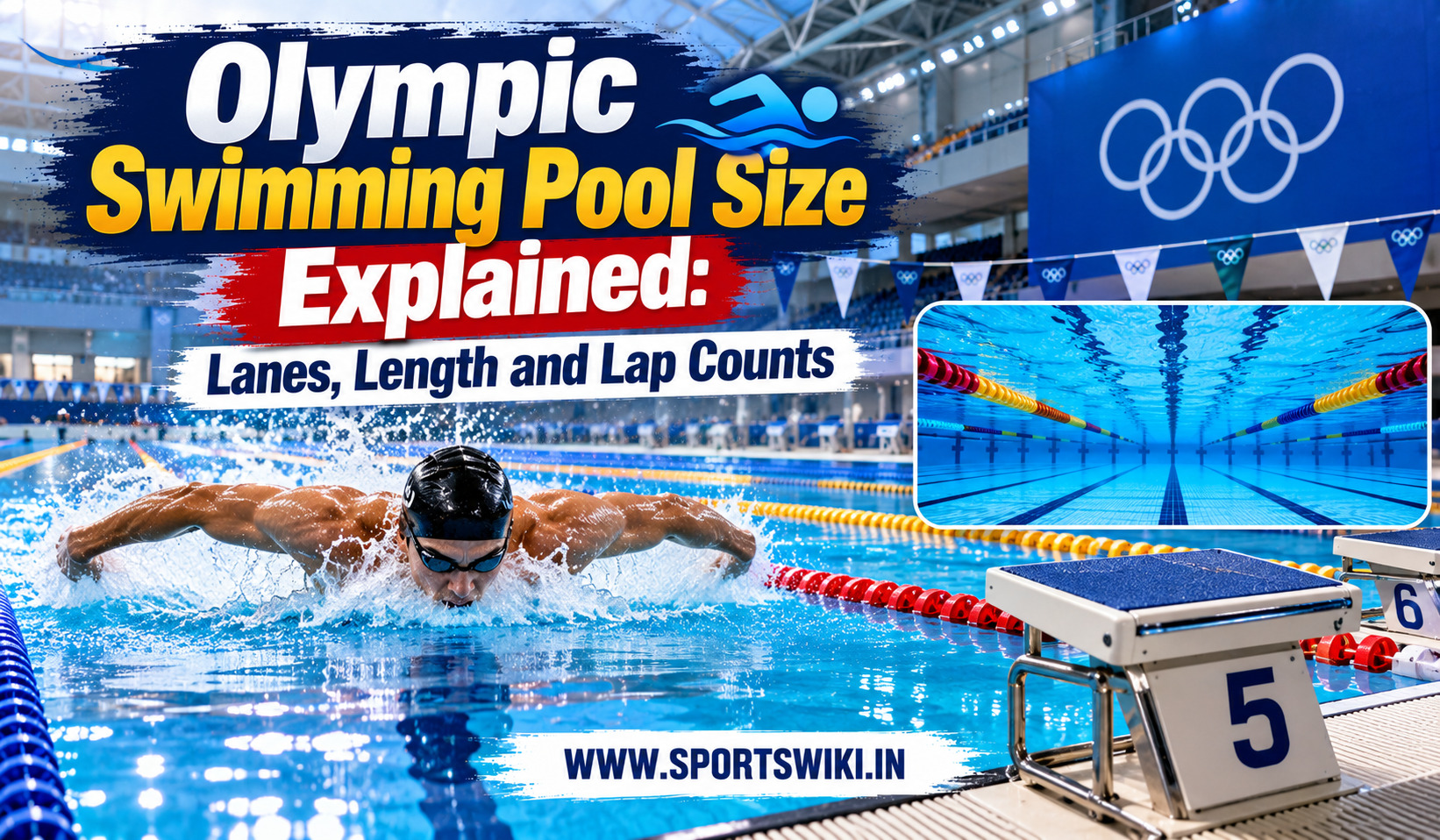
Paris 2024 packed more than 15,000 fans into La Défense Arena for every swimming session. Yet the real star sat in plain sight, a 50-metre pool with ten lanes. Olympic swimming pool size looks simple on paper, but every number has a job. Here’s what those numbers mean, how lap counts work, and why a few centimetres matter.
Olympic Swimming Pool Size: The Official Numbers
So, how big is an Olympic pool? World Aquatics, the sport’s governing body, sets the standard. A pool for the Games measures 50 metres in length, 25 metres in width, and at least 2 metres in depth. At that minimum depth, it holds roughly 2.5 million litres of water.
Length gets the strictest treatment. Touch pads on the end walls record every finish. Because of those pads, World Aquatics allows the pool to run up to 50.030 metres. Even so, a small error in length could wipe out a record swim.
Here’s the quick spec sheet for the 50-metre pool:
- Length: 50 metres
- Width: 25 metres
- Depth: 2 metres minimum, with 3 metres recommended
- Lanes: 10 at the Olympics, each 2.5 metres wide
- Water temperature: 25°C to 28°C
Olympic Pool Lanes: Ten Lanes, Eight Racers
World Aquatics rules ask for 10 lanes at the Olympic Games. World Championships need only eight. That’s why the Olympic pool feels so wide on TV. Each lane is 2.5 metres across, and that spacing keeps swimmers out of each other’s way.
Only eight lanes carry racers in most finals. The outer lanes often work as buffers, which soak up waves before they bounce back. While that sounds minor, it matters at the top level. A calmer pool means cleaner water for the swimmers in lanes one and eight.
Lane Ropes and Floor Markings
A single firmly stretched rope separates each lane. Those ropes run the full length of the pool and anchor into the end walls. Meanwhile, wave-reducing designs help the water settle. Underneath, a dark line marks the centre of every lane.
On the floor, the lane line in a 50-metre pool runs 46 metres. It ends 2 metres from each wall with a 1-metre cross line. That cross mark tells swimmers a wall is close. For backstrokers, who can’t see ahead, extra turn indicators add another layer of help.
Lap Counts: How Many Lengths in Each Race
Now for the question fans ask most. First, a quick note on words. A “length” means one trip across the 50 metres. A “lap” often means a trip down and back, which covers 100 metres. Because people mix these up, it’s safer to count lengths.
Here’s how the lengths stack up for each individual freestyle distance:
- 50 m: 1 length
- 100 m: 2 lengths
- 200 m: 4 lengths
- 400 m: 8 lengths
- 800 m: 16 lengths
- 1,500 m: 30 lengths
Turns follow the same maths. A 100 m race in a 50-metre pool has just one turn. In a 25-metre pool, the same race has three. As a result, long course racing rewards steady pace and strong finishes, while short course racing rewards sharp turns. The 1,500 m, with 30 lengths, includes 29 turns.
Long Course Versus Short Course
World Aquatics tracks world records for both 50-metre and 25-metre pools. Still, the Olympics use the 50-metre version. That’s why a time from a short-course meet can’t replace an Olympic mark. Our guide to Olympic swimming records shows the long course times fans quote most.
Depth, Water Temperature and Wave Control
Depth is the quiet factor. World Aquatics sets a minimum of 2 metres and recommends 3 metres. A deeper pool pushes waves down and away. Because of this, swimmers face less chop, and times can drop.
Water temperature sits between 25°C and 28°C. That range keeps muscles loose without tiring swimmers. Meanwhile, energy-absorbing gutters pull waves off the surface. Touch pads are mandatory, and adjustable starting blocks sit at every lane.
The Paris 2024 Depth Debate
Paris 2024 sparked a loud argument about depth. The pool was a portable one built inside La Défense Arena. Through the first four days, no world records fell. Even so, World Aquatics noted that nine Olympic records came in the first 20 events.
Still, some fans wondered if the pool ran shallow. David Popovici won the men’s 200 m freestyle in 1:44.72. That was the slowest winning time in the event since Sydney 2000. Not everyone agreed on the cause, so the debate never fully settled.
Olympic Swimming Pool Size Versus Training Pools
Most pools you’ll swim in are smaller. Standard pools come in two lengths, 50 metres and 25 metres. Many clubs and schools use the 25-metre version. Although that pool is half the length, it works well for daily practice.
On the other hand, a full 50-metre pool takes real space and money. That’s one reason elite training hubs are rare. Even in India, a place with a growing swim scene, Indian swimmers often travel to find a proper long course pool. Once they race abroad, the longer lengths feel different.
History adds a twist. The first Olympic races took place in natural water. Swimming moved into a pool for the first time at the 1908 London Games. Since then, pool design has changed a lot, yet the 50-metre length has stayed.
Starting Blocks, Touch Pads and Timing
Every lane has its own starting block. Blocks are adjustable and must meet World Aquatics rules. Once the starter’s signal sounds, swimmers dive in. A false start is a rules break, so reaction time matters as much as speed.
At the far end, touch pads sit on the wall in each lane. When a swimmer slaps the pad, the clock stops. Because the pads are mandatory, results are fair to the hundredth of a second. That’s also why the pool’s length gets such close checks.
Backstroke Needs Extra Help
Backstrokers can’t see the wall coming. A backstroke turn indicator is required at the pool. Flags hang above the water, a set distance from each end. Swimmers count strokes from the flags to the wall. Even a small error can cost a medal in a close race.
Fast Pool Design: What Makes One Pool Quicker
Engineers talk about “fast pools.” The goal is to keep water as still as possible. Deep water, wide lanes and special gutters all help. As a result, the wake from one swimmer fades before it reaches the next lane.
Think of it like a quiet road. Fewer bumps mean a smoother ride. Likewise, calm water lets swimmers hold their best form. Even a portable pool, like the one at La Défense Arena in 2024, follows the same rules.
Why Pool Size Shapes Swimming Technique
Pool length shapes every stroke. In a long pool, swimmers settle into rhythm and hold form for 50 metres at a time. Because of that, the four swimming strokes feel different from a short course. Turns come less often, and underwater work matters less.
Coaches build whole plans around Olympic swimming pool size. Pace charts break a 200 m into four lengths of about equal effort. Likewise, a 1,500 m swimmer thinks in 30 steady pieces. Counting lengths keeps the mind busy and the body on target.
How to Picture 50 Metres
Numbers can feel abstract, so try a simple comparison. The pool is 50 metres long and 25 metres wide. That’s about 164 feet by 82 feet. Ten lanes sit side by side across that width.
Now picture a 100 m race. Swimmers go down, turn once, and come back. In a 25-metre pool, they’d turn three times. Fewer turns mean fewer chances to gain ground at the wall. That single difference explains why long course times and short course times can’t be compared directly.
Key Takeaways
- Length: An Olympic pool is exactly 50 metres, with room up to 50.030 metres for touch pads.
- Width and depth: It’s 25 metres wide and at least 2 metres deep, with 3 metres recommended.
- Lanes: The Games use 10 lanes of 2.5 metres each, and eight usually carry racers.
- Lap counts: A 1,500 m race covers 30 lengths, and a 100 m race covers two.
- Water: Temperature stays between 25°C and 28°C, and gutters calm the surface.
FAQs
How long is an Olympic swimming pool?
It’s 50 metres long.
How many lanes does an Olympic pool have?
The Olympic Games call for 10 lanes, and eight are usually used for racing.
How deep is an Olympic swimming pool?
The minimum depth is 2 metres, and World Aquatics recommends 3 metres.
How many lengths is the 1,500 m freestyle?
It’s 30 lengths of the 50-metre pool.
How much water does an Olympic pool hold?
At the minimum depth, it holds roughly 2.5 million litres.
Conclusion
Olympic swimming pool size comes down to a handful of exact numbers. The pool is 50 metres long, 25 metres wide, and at least 2 metres deep. Its lanes are 2.5 metres wide, and every race follows a clear lap count. Once you know those figures, the sport’s biggest night makes a lot more sense.