Boxing Weight Classes Explained: Flyweight to Heavyweight
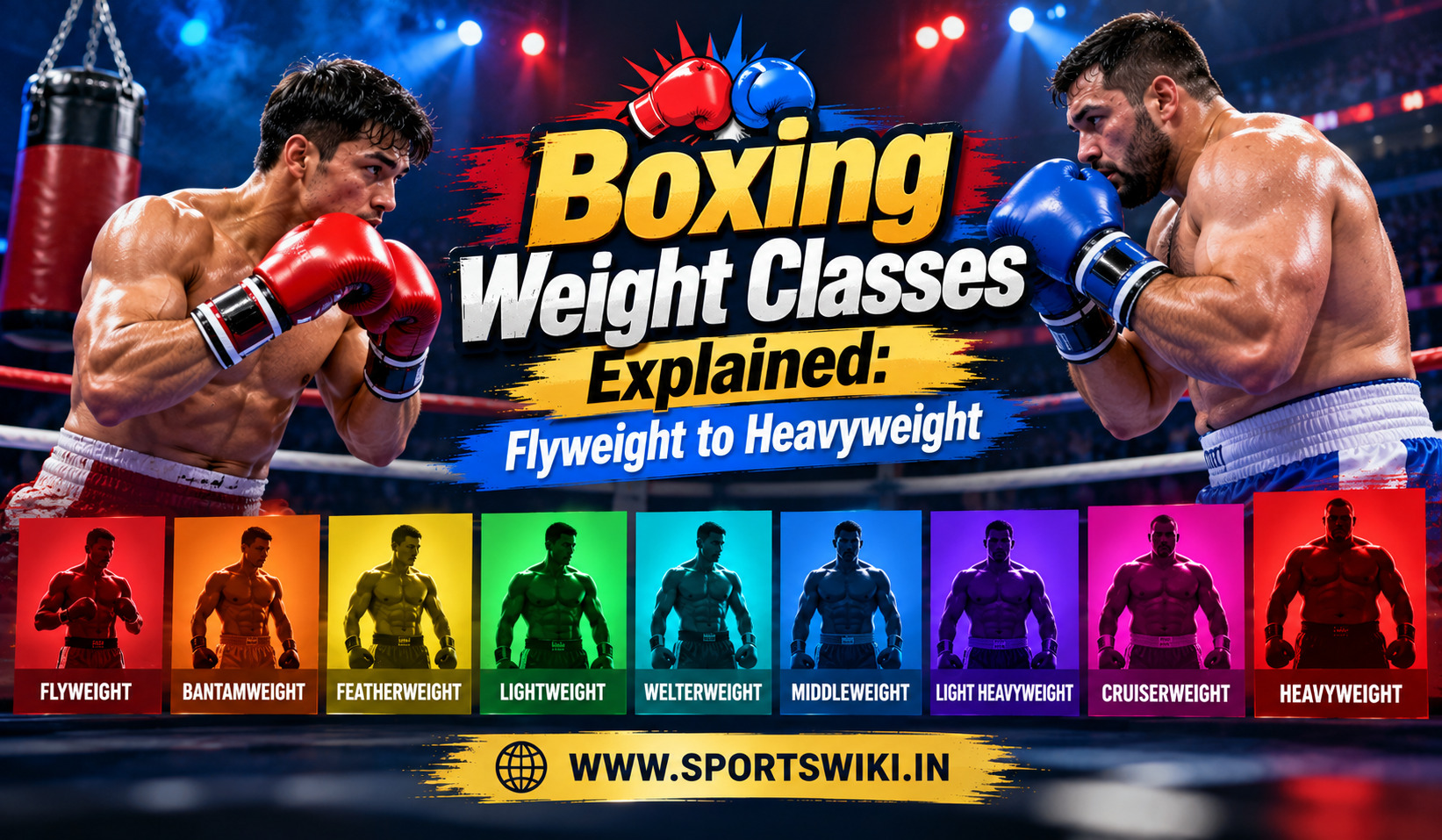
Four Indian medals, four different weights. At the 2025 World Boxing Championships in Liverpool, Minakshi Hooda won gold at 48kg and Jaismine Lamboria took gold at 57kg. Nupur Sheoran claimed silver at 80+kg, and Pooja Rani won bronze at 80kg. One tournament produced four very different body types.
Boxing weight classes explain why. They keep fights fair by matching boxers of similar size. This guide walks through the divisions from flyweight to heavyweight, the Olympic limits, and the weigh-in rules that shape every fight night. You’ll also see how weight changes fighting style, and why cutting weight raises safety questions.
Why Boxing Weight Classes Exist
Size matters in a punching sport. A heavier boxer usually hits harder and absorbs more, so mismatches get dangerous fast. Because of this, boxing weight classes set a ceiling for each division. Every sanctioned fight now follows them, from local shows to world title bouts.
A weight class is simply a range with a top limit. A boxer must weigh at or under that limit at the weigh-in. Pro divisions have names like flyweight or welterweight, while amateur events often use kilograms. So when you hear “57kg,” that’s a limit, not a nickname. Heavyweight is the one division with no upper limit, and that’s why the weigh-in number matters so much.
How to Read Weight Class Names
The names can look confusing at first. Still, a few simple patterns explain most of them. The base names run from minimumweight up to heavyweight. Prefixes then split the gaps between them.
- “Light” means the division sits just below a base class, as in light flyweight.
- “Super” means the division sits just above a base class, as in super bantamweight.
- Names like welterweight and cruiserweight are traditional labels with no prefix.
Once you spot the pattern, the ladder gets easier to remember. For instance, super featherweight sits right above featherweight and right below lightweight. That’s a small step, but it can change a matchup completely. In short, the prefixes simply fill the gaps so fighters have more choice.
The Full Pro Ladder of Boxing Weight Classes
The traditional pro ladder has 17 divisions. Each one sits a few pounds above the last, so fighters can pick the best fit for their frames. The limits below are listed in pounds, with kilograms in brackets. Governing bodies can differ slightly, but these are the standard numbers.
The Lighter Divisions
Smaller fighters usually bring speed and stamina. Rounds at these weights tend to be fast, with lots of movement and combinations. Fans who like technical boxing often start here.
- Minimumweight: 105 lb (47.6 kg)
- Light flyweight: 108 lb (49 kg)
- Flyweight: 112 lb (50.8 kg)
- Super flyweight: 115 lb (52.2 kg)
- Bantamweight: 118 lb (53.5 kg)
- Super bantamweight: 122 lb (55.3 kg)
Flyweight gets a lot of attention in India. Mary Kom won Olympic bronze in the women’s 51kg flyweight class at London 2012. Meanwhile, Nikhat Zareen won the 2022 world title at 52kg in Istanbul. Both stories show how much Indian boxing has built around the lighter end of the scale.
The Middle Divisions
This is where many of the sport’s famous names live. Boxers here mix real power with the speed to keep it landing. Even so, a few pounds can change how a fight plays out.
- Featherweight: 126 lb (57.2 kg)
- Super featherweight: 130 lb (59 kg)
- Lightweight: 135 lb (61.2 kg)
- Super lightweight: 140 lb (63.5 kg)
- Welterweight: 147 lb (66.7 kg)
- Super welterweight: 154 lb (69.9 kg)
- Middleweight: 160 lb (72.6 kg)
Indian fans will notice the link to the amateur game. Jaismine Lamboria’s 57kg title in 2025 sits right at the featherweight mark. Likewise, Vijender Singh won India’s first men’s world medal at 75kg in 2009. That’s close to the middleweight range, though amateur and pro limits don’t match exactly.
The Heavy Divisions
Power takes over at the top of the ladder. A single clean shot can change a fight, and fighters often rely on patience and timing. Because of this, heavier fights can end suddenly.
- Super middleweight: 168 lb (76.2 kg)
- Light heavyweight: 175 lb (79.4 kg)
- Cruiserweight: 200 lb (90.7 kg)
- Heavyweight: over 200 lb (over 90.7 kg)
The WBC also added a bridgerweight division in 2020, for fighters between 200 and 224 lb. Not every body recognizes it, so it’s best seen as an extra option rather than a standard rung. Still, it shows how the sport keeps adjusting its ladder as athletes grow bigger.
How Weight Shapes Fighting Style
Weight doesn’t just set a limit on the scale. It also shapes how boxers move, punch and defend. Lighter divisions tend to feature quick feet, long combinations and steady pressure. Fighters in these classes often throw more punches per round, since they can keep up the pace.
Heavier divisions work differently. Each punch carries more force, so boxers often pick their shots with care. Defense becomes a bigger part of the plan, since one mistake can cost a lot. That said, these are tendencies, not rules. Plenty of light fighters hit hard, and plenty of heavyweights move well. The point is simply that each weight class has its own rhythm, and good fans learn to read it.
Olympic and Amateur Boxing Weight Classes
Amateur boxing uses fewer divisions, and it counts in kilograms. At the Paris 2024 Olympics, the men boxed at 51, 57, 63.5, 71, 80, 92 and over 92 kg. The women boxed at 50, 54, 57, 60 and 66 kg. As a result, some boxers have to move up or down to chase an Olympic spot.
World championships can use a wider list. The 2025 event in Liverpool featured categories such as 48kg, 80kg and 80+kg, which sit outside the Olympic list. That’s why Minakshi Hooda’s gold at 48kg and Nupur Sheoran’s silver at 80+kg were non-Olympic results. They still counted fully as world medals. For the full story of those results, see our guide to Indian boxers at the World Boxing Championships.
Weigh-Ins, Catchweights and Rehydration
In pro boxing, weigh-ins usually happen the day before the fight. Boxers must make the limit on the scale, or they can lose money, a title shot or the bout itself. Once they pass, many fighters rehydrate and eat. In fact, some step into the ring several pounds heavier than their official weight. This is why boxing weight classes and fight-night weight can be two different things.
Sometimes two boxers agree to fight at a weight that sits between divisions. That’s called a catchweight. It’s common when a fighter can’t make the limit, or when a star wants a bigger opponent. However, title fights usually stick to the standard limits. Meanwhile, the four major sanctioning bodies, the WBA, WBC, IBF and WBO, each hand out their own belts in most divisions.
Weight Cutting and Safety
Many boxers drop weight quickly before a weigh-in, often by shedding water. That can help them make the limit, but it also carries risk. A fighter who loses too much water can feel weak, dizzy or slow. Because of this, trainers and doctors watch the process closely.
Some commissions and governing bodies add rules to limit extreme cuts. These can include earlier weigh-ins, hydration checks or limits on how much weight a boxer can regain. Even so, the best protection is a division that suits the fighter’s natural size. When boxers pick the right weight class, they perform better and stay safer. That’s a good reason to follow where a fighter’s career moves next.
Choosing the Right Weight Class
Picking a division is one of the biggest decisions in a boxer’s career. A fighter who competes too light can lose strength, while one who competes too heavy can lose speed. Coaches usually look at natural body weight, height, reach and how easily the athlete makes the limit. Because of this, the best division isn’t always the lowest one a boxer can reach.
Amateurs face an extra layer of choice. They often pick the category that gives the best path to a major event. For example, a boxer may chase a spot in a world championship category that isn’t in the Olympic list. Meanwhile, others move to an Olympic weight to keep that door open. Either way, the decision shapes training, diet and the opponents a boxer will face.
Moving Up and Down the Scale
Boxers often change divisions during their careers. Younger fighters grow, and older ones find it harder to cut weight. Manny Pacquiao is the famous example, as he won world titles in eight divisions. Even so, moving up has a cost. A fighter who steps up will often face opponents who are bigger, stronger and more natural at that weight.
Kit can change with weight too. For example, glove sizes in pro boxing often rise once fighters move above welterweight. You can read more in our guide to boxing rounds, gloves and knockout rules. Scoring doesn’t change between divisions, though. Our explainer on boxing scoring and the 10-point must system works the same from flyweight to heavyweight.
Key Takeaways
- Purpose: boxing weight classes keep fights fair by matching boxers of similar size.
- Pro ladder: the traditional list has 17 divisions, from minimumweight at 105 lb to heavyweight over 200 lb.
- Olympic list: Paris 2024 used seven men’s classes and five women’s classes.
- Weigh-in: boxers must be at or under the limit, usually the day before a pro fight.
- Catchweight: two boxers can agree on a weight between standard divisions.
FAQs
What are boxing weight classes?
They’re weight ranges that group boxers by size so fights stay fair and safer.
How many weight classes are there in pro boxing?
The traditional pro ladder has 17 divisions, from minimumweight to heavyweight.
What is the flyweight limit in boxing?
The pro flyweight limit is 112 pounds, which is about 50.8 kilograms.
What is the heavyweight limit in boxing?
Heavyweight has no upper limit, and it starts above 200 pounds.
What is a catchweight fight?
It’s a bout where both fighters agree to a weight that sits between standard divisions.
Conclusion
Boxing weight classes shape everything from fight styles to career paths. They run from the quick minimumweights at 105 pounds to heavyweights with no top limit. Olympic and world events add their own kilogram lists, and weigh-in rules keep every contest fair. Once you know the ladder, names like flyweight and welterweight stop feeling like jargon. They simply tell you who’s standing in the ring.