Olympic Archery Rules Explained: Scoring, Distance and Target Size
Seventy metres away, the gold ring on an Olympic target measures just 12.2 centimetres across. One arrow in that circle scores 10, and one arrow outside it can end a medal run. That’s the pressure behind every match.
Olympic archery rules look simple on a scoreboard, yet the set system confuses many new fans. This guide covers distance, target size, scoring and how matches are won. You’ll also see how teams and mixed teams shoot, and what changes when compound archery joins the Games in 2028.
What Olympic Archery Rules Cover
Olympic archery rules apply to five medal events at the moment. Men and women each have an individual event and a team event. A mixed team event, added at Tokyo 2020, completes the list. Archery returned to the Games in 1972, and team events followed in 1988.
Only recurve bows are used at the Olympics today. Compound archery is set to join through a mixed team event at Los Angeles 2028, which will bring the total to six medals. We compare the two bow types in our guide to recurve vs compound archery.
Distance and Target Size in Olympic Archery
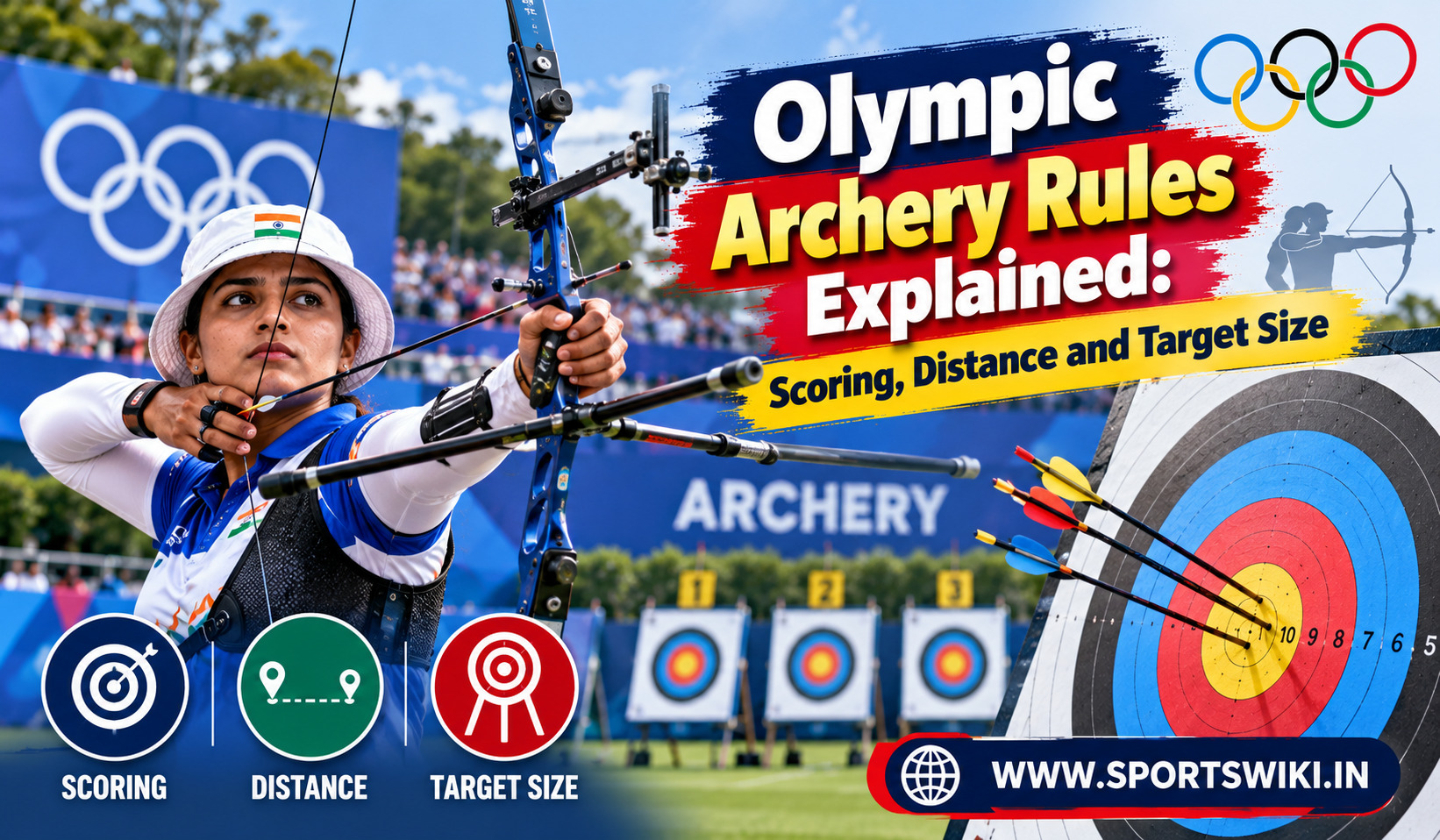
Every Olympic archer shoots at a target 70 metres away. The target face is 122 centimetres wide, and it carries ten scoring rings. The gold 10-ring in the centre measures 12.2 centimetres. Because of this, a tiny error in aim or a puff of wind can turn a 10 into an 8.
The Rings and Their Colours
The face uses five colours, and each colour covers two rings. Scores run from 1 on the outside to 10 in the middle.
- Gold: 10 and 9 points
- Red: 8 and 7 points
- Blue: 6 and 5 points
- Black: 4 and 3 points
- White: 2 and 1 points
A smaller inner ring sits inside the gold, and it’s known as the X. It helps settle ties in ranking. Meanwhile, an arrow that touches a line scores the higher value. Judges at the target make that call after each end.
The Ranking Round and Seeding
Before matches begin, every archer shoots a ranking round. Each archer fires 72 arrows at 70 metres, so the highest possible score is 720. Arrows are shot in ends of six, with a set time limit for each end. Four minutes per end is a common standard at world events.
The scores decide the bracket. The top seed meets the lowest seed, so a strong ranking round buys an easier early path. Team and mixed team seedings combine individual scores. That’s why one poor day in ranking can hurt a whole country’s draw.
How the Set System Works
Head-to-head matches don’t add up total scores. Instead, archers compete for set points. Each set is a mini-match, and a bad set doesn’t haunt you for the rest of the day.
Individual Matches
Archers shoot sets of three arrows each, taking turns. The higher set score earns two set points. If the scores match, each archer gets one point. The first archer to reach six set points wins the match. The best possible score in a set is 30.
Team Matches
Each team has three archers. A set uses six arrows, with two from each archer. The winning team gets two set points, and a tie gives one each. The first team to five set points wins. A 4-4 tie leads to a shoot-off.
Mixed Team Matches
A mixed team has one man and one woman. They shoot sets of four arrows, two each. The set points work the same way as in the team event, and the first side to five wins.
Shoot-Offs and Tiebreaks
Some matches end level. In an individual match, a 5-5 tie sends both archers to a shoot-off. Each archer fires a single arrow, and the arrow closest to the centre wins. Because of this, a shoot-off can turn on a few millimetres.
Nerves matter most here. The crowd goes quiet, the clock runs, and the archer has one chance. Even so, the best archers treat it like any other arrow. They rely on routine, steady breathing and a repeatable draw.
Reading a Scoreboard
Imagine an individual match that starts with a 28-27 set. The first archer leads 2-0 in set points. Next comes a 29-29 set, so each archer gets one point, and the score is 3-1. A third set ends 27-28, so the score becomes 3-3.
Notice how a single 10 changes the picture. A 29 against a 28 gives two points, while a 29 against a 29 gives one each. That’s why top archers chase perfect tens and avoid risky shots. Unlike compound events, which add up scores, the recurve format punishes a bad set only once.
Shooting Order and Time Limits
Order matters in match play. The higher seed usually chooses who shoots first in the opening set. After that, the archer who’s trailing shoots first in the next set. In individual sets, the two archers alternate arrows, so each one watches the other fire. That rhythm adds pressure, since a 10 from your rival demands a 10 in reply.
Time limits keep the show moving. In head-to-head matches, each archer gets 20 seconds per arrow. A clock counts down beside the target, and an arrow shot late can lose its score. Because of this, archers train to shoot in a steady routine. They don’t rush, but they don’t wait for a perfect feeling either.
A Match From Start to Finish
Picture a quarterfinal between two archers. They walk to the line, and the clock starts for the first set. Each fires three arrows, and the judges read the scores. The winner of the set takes two points, and the match moves on.
By the fourth set, someone may need one more win. That archer can lock the match by taking a single set from there. Meanwhile, the other archer must win every set to survive. As a result, the last two sets are often the most tense. If the match reaches 5-5, the shoot-off decides everything with one arrow each.
Wind adds another layer. At 70 metres, a light gust can push an arrow several rings off line. Archers watch flags and ribbons near the target to read it. Still, the rules give no extra time for bad weather, so adjusting quickly is part of the skill.
Common Mistakes New Fans Make
A few misunderstandings come up again and again. Clearing them up makes every match easier to enjoy.
- Adding up total scores: recurve matches use set points, not cumulative totals.
- Thinking a 10 is always the target: a steady 9 can still win a set.
- Forgetting the tie rule: equal set scores give one point to each archer.
- Missing the team format: team sets use six arrows, not three.
Once you avoid these traps, the scoreboard stops being confusing. You’ll spot when an archer needs a 10 and when a safe 9 is enough. In fact, that kind of reading is half the fun of watching the sport.
Equipment in Olympic Archery
Olympic archers use recurve bows with a sight and stabilizers. They draw the string with their fingers and don’t use a mechanical release. The sight doesn’t magnify, so success depends on form, not gadgets. As a result, small changes in stance or grip can shift every arrow.
Archery isn’t the only precision sport at the Games. Shooters also chase tiny targets, and our guide to 10m air rifle rules and scoring shows how decimals decide medals. Fans following Asia’s biggest events can also read about Indian shooters at the Asian Games.
Key Takeaways
- Distance: every Olympic archer shoots from 70 metres.
- Target: the face is 122 centimetres wide, and the 10-ring measures 12.2 centimetres.
- Ranking: 72 arrows give a maximum score of 720.
- Individual match: first to six set points wins, with three arrows per set.
- Team match: first to five set points wins, with six arrows per set.
FAQs
How far is the target in Olympic archery?
The target stands 70 metres from the shooting line.
How big is an Olympic archery target?
The face is 122 centimetres wide, with a 12.2-centimetre gold 10-ring.
How does the set system work in Olympic archery rules?
The higher set score earns two set points, and a tie gives one point to each archer.
How many arrows are in an individual set?
Each individual set has three arrows per archer.
Is compound archery in the Olympics?
Not yet, but a compound mixed team event is set for Los Angeles 2028.
Conclusion
Olympic archery rules come down to a few simple numbers. The target sits 70 metres away, the face measures 122 centimetres, and the set system decides every match. Teams and mixed teams follow the same pattern with different arrow counts. Once you know those numbers, every end becomes easier to follow, and every tie-breaking arrow feels like a thriller.