Martina Navratilova Total Titles: An Unbreakable 354
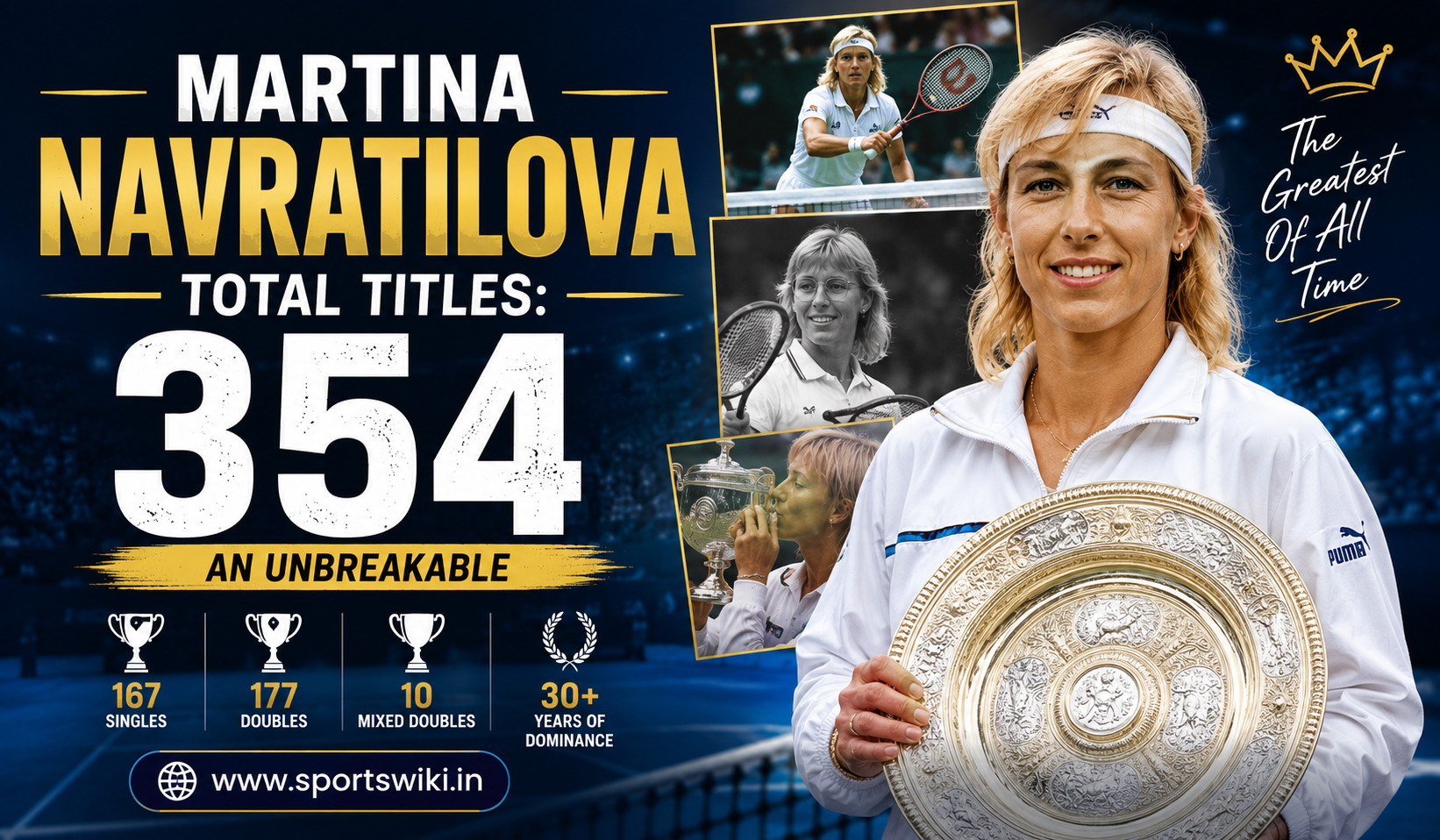
Nobody in the history of tennis, man or woman, has filled a trophy cabinet the way Martina Navratilova did. When you add up singles, doubles, and mixed doubles, Martina Navratilova total titles reach a staggering 354, a number so large it feels almost fictional. This is the story of how she got there, and why nobody has come close since.
Breaking Down The Martina Navratilova Total Titles Count
Before getting into the highlight reel moments, it helps to actually see the math behind the legend. The full picture of Martina Navratilova total titles is built from three separate columns, and each one alone would be a career worth celebrating.
- 167 singles titles, the most by any player in the Open Era
- 177 doubles titles, also an Open Era record
- 10 mixed doubles titles, capped off by a win weeks before her 50th birthday
Add those three numbers together and you get 354 career titles, a figure that still stands as the benchmark for total tennis dominance. For context, Billie Jean King, one of the greatest champions the sport has ever produced, finished with around 175 total titles. Navratilova doubled that. Not improved on it. Doubled it.
This is not a record built on longevity alone, though her 32-year professional career certainly helped. It is a record built on a level of consistency that borders on unreasonable. She turned pro in 1975 and did not fully step away from competitive tennis until 2006.
Singles Dominance: 167 Titles And A Grand Slam Resume To Match
The singles side of the Martina Navratilova total titles ledger is where most casual fans start, and for good reason. Winning 167 singles titles means she was hoisting trophies at a pace most players only dream about during a single golden season, let alone across an entire career.
Her singles win-loss record sits at 1,442 wins against just 219 losses, a win percentage north of 86 percent. Think about that in practical terms. If you flipped a coin every time Navratilova stepped on court, it landed in her favor roughly six times out of seven.
Wimbledon Supremacy: Nine Singles Crowns
No conversation about her Wimbledon singles titles total can skip the number nine. She won Wimbledon in 1978, 1979, then again from 1982 through 1987, and once more in 1990. Six of those wins came in a row between 1982 and 1987, a streak that broke a record held since the 1920s by Suzanne Lenglen.
Grass suited her serve-and-volley game the way a fastball pitcher thrives on a mound built for velocity. She read the court, closed space at the net, and turned rallies into short, violent exchanges that favored her instincts over her opponent’s patience.
The Golden Streak Of 1983-84
Between Wimbledon 1983 and the US Open 1984, Navratilova won six consecutive Grand Slam singles titles, matching a mark set decades earlier by Maureen Connolly and Margaret Court. During that same stretch she also produced a 74-match winning streak, still the longest in women’s tennis history. Chris Evert, her fiercest rival, later admitted that facing Navratilova during this period felt like walking into a buzzsaw.
Doubles Mastery: 177 Titles That Redefined Teamwork
If singles made her famous, doubles made her nearly untouchable. Her 177 doubles titles is not just a career-best number, it is an all-time Open Era record that includes 31 Grand Slam doubles championships, more than any player in history.
The Partnership With Pam Shriver
Much of that doubles success came alongside Pam Shriver. Together they won 79 titles as a pairing, including a 109-match winning streak that stretched across two full seasons. Their chemistry on court was less about matching styles and more about trust. Navratilova covered the net like a wall, and Shriver’s reach and reflexes closed off anything that snuck past.
The 1987 US Open captured this perfectly. Navratilova won the singles title, teamed with Shriver for the women’s doubles crown, and then paired with Emilio Sanchez to win mixed doubles too. A clean sweep of all three categories in one tournament, something almost nobody else has managed.
Mixed Doubles And The Late-Career Miracle
The smallest number in the Martina Navratilova total titles tally, 10 mixed doubles titles, might be the most remarkable in terms of pure storytelling. Her final mixed doubles title came at the 2006 US Open, just weeks before she turned 50 years old. That made her the oldest player in tennis history to win a Grand Slam title of any kind.
Picture a 49-year-old stepping onto a US Open court against players young enough to be her daughters, and still finding a way to win. That is not a farewell tour moment. That is a competitor who simply refused to accept that age should end anything.
Comparing Navratilova’s 354 Titles To Tennis Rivals
To really understand how far ahead Navratilova sits, it helps to line her up against other legends of the sport. Chris Evert, her longtime rival, retired with 157 career titles across singles and doubles. Steffi Graf finished with over 100 singles titles but did not chase doubles nearly as aggressively. Serena Williams, for all her Grand Slam brilliance, finished with a total title count well under half of Navratilova’s mark once mixed doubles are factored in.
Here is a simple side-by-side to put the Open Era tennis record in perspective:
- Martina Navratilova – 354 total titles (167 singles, 177 doubles, 10 mixed)
- Billie Jean King – roughly 175 total titles across all categories
- Margaret Court – 64 Grand Slam titles, though her overall career total title count is harder to verify due to incomplete pre-Open Era records, so this figure should be treated with caution
- Chris Evert – 157 career titles, primarily built on singles dominance
That gap between first and second place is not a narrow margin. It is closer to a different sport entirely. Modern fans comparing this to something like Novak Djokovic’s Grand Slam count or Serena’s major haul are looking at a different kind of record. Those numbers measure peak dominance at the biggest events. Navratilova’s 354 measures pure, relentless volume across an entire career and two disciplines at once.
Why The 354 Title Record May Never Be Broken
Modern tennis has changed in ways that make a number like this almost impossible to chase down today. Top singles players rarely commit to a full doubles schedule anymore. Scheduling, physical strain, and prize money structures push elite players toward specialization rather than the all-format approach Navratilova embraced.
A few reasons this record looks safe for the foreseeable future:
- Tour scheduling now discourages singles stars from playing full doubles draws
- Career length has shortened for many top players compared to Navratilova’s 32 years on tour
- Physical demands of modern power tennis make triple-category dominance far riskier on the body
- Prize money incentives reward deep singles runs far more than doubles depth
Coco Gauff or Iga Swiatek could rack up an extraordinary singles resume over the next decade, and that would still leave them nowhere close to touching all three categories the way Navratilova did. The record is not just about talent. It is about a level of commitment to every format of the sport that simply does not exist in today’s tennis calendar.
FAQ: Martina Navratilova Total Titles
How many total titles did Martina Navratilova win?
Martina Navratilova won 354 total titles across her career, combining 167 singles titles, 177 doubles titles, and 10 mixed doubles titles.
Is Martina Navratilova’s title record still standing?
Yes. No player, male or female, has come close to matching her combined singles and doubles title count in the Open Era.
How many Grand Slam titles did Navratilova win?
She won 59 Grand Slam titles overall, made up of 18 singles majors, 31 women’s doubles majors, and 10 mixed doubles majors.
Why is Navratilova’s doubles record often overlooked?
Casual fans tend to focus on singles achievements since majors get the most media attention. Her 177 doubles titles, including 31 Grand Slam doubles crowns, actually outnumber her singles total and represent one of the most dominant doubles careers ever recorded.