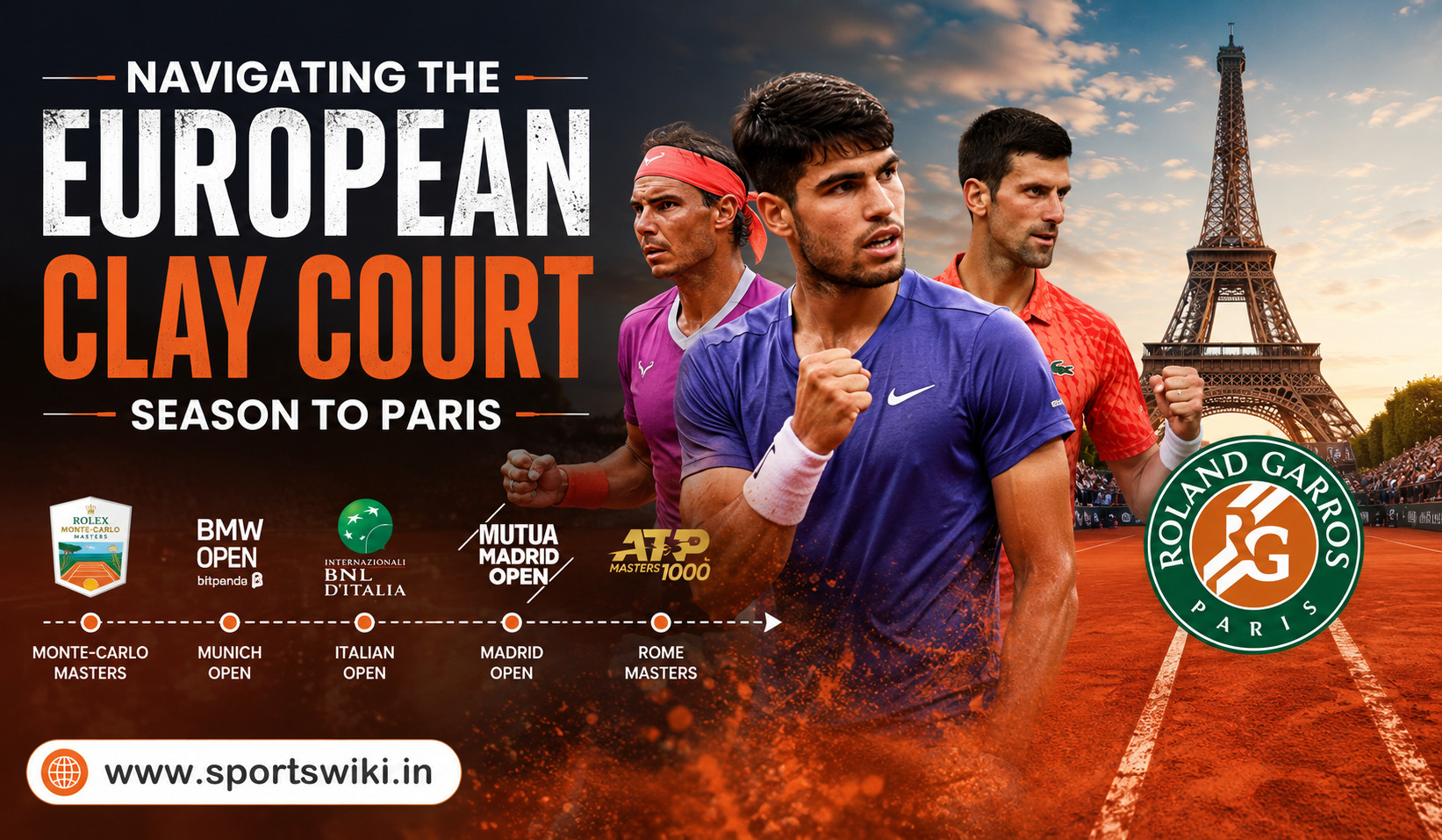
Navigating The European Clay Court Season To Paris
Jannik Sinner walked into the 2026 French Open on a 30-match winning streak, having swept all three clay Masters events in a row. Two weeks later he was gone in the second round, cramping in the Paris heat after leading by two sets and a break. That collapse is the single clearest proof that the European clay court season rewards dominance and punishes survival in almost equal measure.
Mapping The European Clay Court Season
The stretch of tennis between the hard court spring and Roland Garros is unlike anything else on the calendar. Six to seven weeks of red clay, shifting altitudes, and accumulating fatigue, all building toward the one tournament every clay specialist actually wants to win.
The Opening Stretch: Monte-Carlo, Barcelona, Munich
The European clay court season traditionally opens with the Monte-Carlo Masters in early April, the first big statement event of the swing. From there, the tour splits, with the Barcelona Open drawing many of the top clay specialists while Munich runs the same week as a smaller alternative for players managing their schedules more cautiously. This opening stretch sets the tone. Players who find their footing early on clay tend to carry that rhythm forward, while those still searching for their timing often struggle to catch up later.
The Heavy Middle: Madrid And Rome
Madrid and Rome form the most physically demanding portion of the entire swing. Both are Masters 1000 events with 96-player draws, and both arrive back to back with barely a week separating them. Madrid’s high altitude makes the ball fly faster than at almost any other clay event, forcing players to adjust their timing dramatically, only to fly to Rome days later and adjust all over again to a slower, heavier surface. Jannik Sinner’s 2026 run through this stretch was historic. He became the first player to win five consecutive Masters 1000 titles, sweeping Monte-Carlo, Madrid, and Rome to complete his run and his Career Golden Masters in the same stretch.
The Final Tune-Ups: Geneva And Lyon
In the final week before Roland Garros, smaller ATP 250 events in Geneva and Lyon give players one last chance to sharpen their form or, for those who skipped the bigger events, simply find their legs on clay before the majors begin. These tournaments rarely produce the sport’s biggest headlines, but they matter enormously for players trying to time their peak form for the second week of a Grand Slam rather than a Tuesday afternoon in April.
Why This Stretch Is So Hard To Survive Physically
Clay tennis is uniquely draining. Points last longer, rallies extend further, and the surface itself absorbs pace, meaning players have to manufacture their own power on nearly every shot rather than relying on the court to do part of the work. Add in rising spring temperatures across Spain, Italy, and France, and the cumulative physical toll becomes enormous well before Roland Garros even begins.
A few reasons this particular stretch of the calendar tends to break players down:
- Back-to-back Masters events in Madrid and Rome offer almost no recovery window between two physically demanding tournaments
- Altitude and surface-speed swings between cities force constant readjustment, which adds hidden strain beyond what the scoreline shows
- Rising temperatures through late April and May mean matches often get more physically taxing as the swing progresses, not less
- Players chasing ranking points across multiple events rarely get a true rest week before the two-week grind of a major begins
By the time Roland Garros arrives, the players who looked most dominant during the European clay court season are often running on fumes rather than fresh legs.
The 2026 Cautionary Tale: Sinner’s Collapse
No recent example captures this danger better than what happened to Jannik Sinner at the 2026 French Open. After sweeping Monte-Carlo, Madrid, and Rome, he arrived in Paris as the overwhelming favorite, riding a 30-match winning streak and chasing the one major missing from his career resume. In the second round, facing world number 56 Juan Manuel Cerundolo, Sinner raced to a 6-3, 6-2, 5-1 lead, one game from a routine victory.
Then his body gave out. Playing in unusually hot Paris conditions, Sinner began cramping, lost 18 straight points at one stage, and eventually fell in five sets after needing medical attention on court. It marked his earliest Grand Slam exit since 2023 and snapped his long winning streak in stunning fashion. Sinner himself said afterward that he woke up that morning already feeling unwell, struggling with dizziness and low energy before he even stepped on court.
This was not a case of poor form or a bad matchup. It was the accumulated cost of weeks of elite-level clay tennis catching up with him at the worst possible moment. Toni Nadal, Rafael Nadal’s longtime coach, called the collapse “truly strange and incomprehensible” in the moment, but viewed against the backdrop of the full clay swing, it reads less like a mystery and more like a warning about exactly how brutal this stretch of tennis really is.
How Injuries Reshape The Whole Season
Sinner’s story is only half the picture. Carlos Alcaraz, the two-time defending Roland Garros champion heading into 2026, never even got the chance to defend his title. A wrist injury forced him out of Rome, then Roland Garros itself, removing the tournament’s most successful recent champion from the draw entirely.
That absence changed everything about how the tournament played out. With both Sinner and Alcaraz out of contention by the second round, the path opened for Alexander Zverev, who went on to win his first career Grand Slam title in a five-set final against Flavio Cobolli, ending years of near misses in major finals. It was a reminder that the European clay court season does not just test who plays the best tennis. It tests who can still be standing, healthy and sharp, when the tournament that actually matters most finally arrives.
What It Takes To Peak At The Right Moment
Given how many players get chewed up by this stretch of the calendar, the ones who consistently peak at Roland Garros tend to share a few specific habits.
- Selective scheduling – choosing which smaller events to skip rather than chasing every available ranking point during the swing
- Surface-specific recovery planning – building in extra rest around the Madrid-to-Rome turnaround specifically, given how physically taxing that back-to-back stretch is
- Heat and conditioning preparation – training for the kind of extreme temperatures Roland Garros regularly produces in late May and early June
- Willingness to lose early matches during the swing – treating results in Monte-Carlo or Munich as secondary to arriving at Roland Garros fresh
- Listening to the body’s warning signs – something Sinner himself pointed to afterward, noting that grand slam tournaments often include a day or two where a player simply does not feel right
Rafael Nadal’s clay dominance for nearly two decades was built on more than just talent. It relied on exactly this kind of careful physical management across a brutal six-week stretch, something the current generation is still learning to balance against the temptation to chase every available title along the way.
FAQ: European Clay Court Season
What tournaments make up the European clay court season?
The swing typically includes the Monte-Carlo Masters, Barcelona Open, Munich, the Madrid Open, the Italian Open in Rome, and smaller tune-up events in Geneva and Lyon before Roland Garros begins.
Why is the clay season considered so physically demanding?
Clay rallies tend to last longer than on other surfaces, and the swing packs several major tournaments, including two back-to-back Masters 1000 events in Madrid and Rome, into a compressed six to seven week window with limited recovery time.
What happened to Jannik Sinner at the 2026 French Open?
Sinner arrived as the heavy favorite after sweeping the entire clay Masters series, but suffered a physical collapse against Juan Manuel Cerundolo in the second round, losing after leading by two sets, reportedly due to cramping and fatigue in hot conditions.
How did Carlos Alcaraz’s absence affect the 2026 French Open?
The two-time defending champion withdrew before the tournament due to a wrist injury, removing him from contention entirely and opening the draw for players like eventual champion Alexander Zverev.