The Four Swimming Strokes Explained: Freestyle, Butterfly, Backstroke & Breaststroke
Caeleb Dressel won the 100 m butterfly at the Tokyo Olympics in 49.45 seconds on 31 July 2021. That time still stands as the world record. It shows what the four swimming strokes can look like at full speed. Most fans know the names. Fewer know the rules that separate one stroke from another, and those rules decide medals and disqualifications. Let’s walk through each stroke, what the officials watch for, and how the strokes combine in medley races.
The Four Swimming Strokes at a Glance
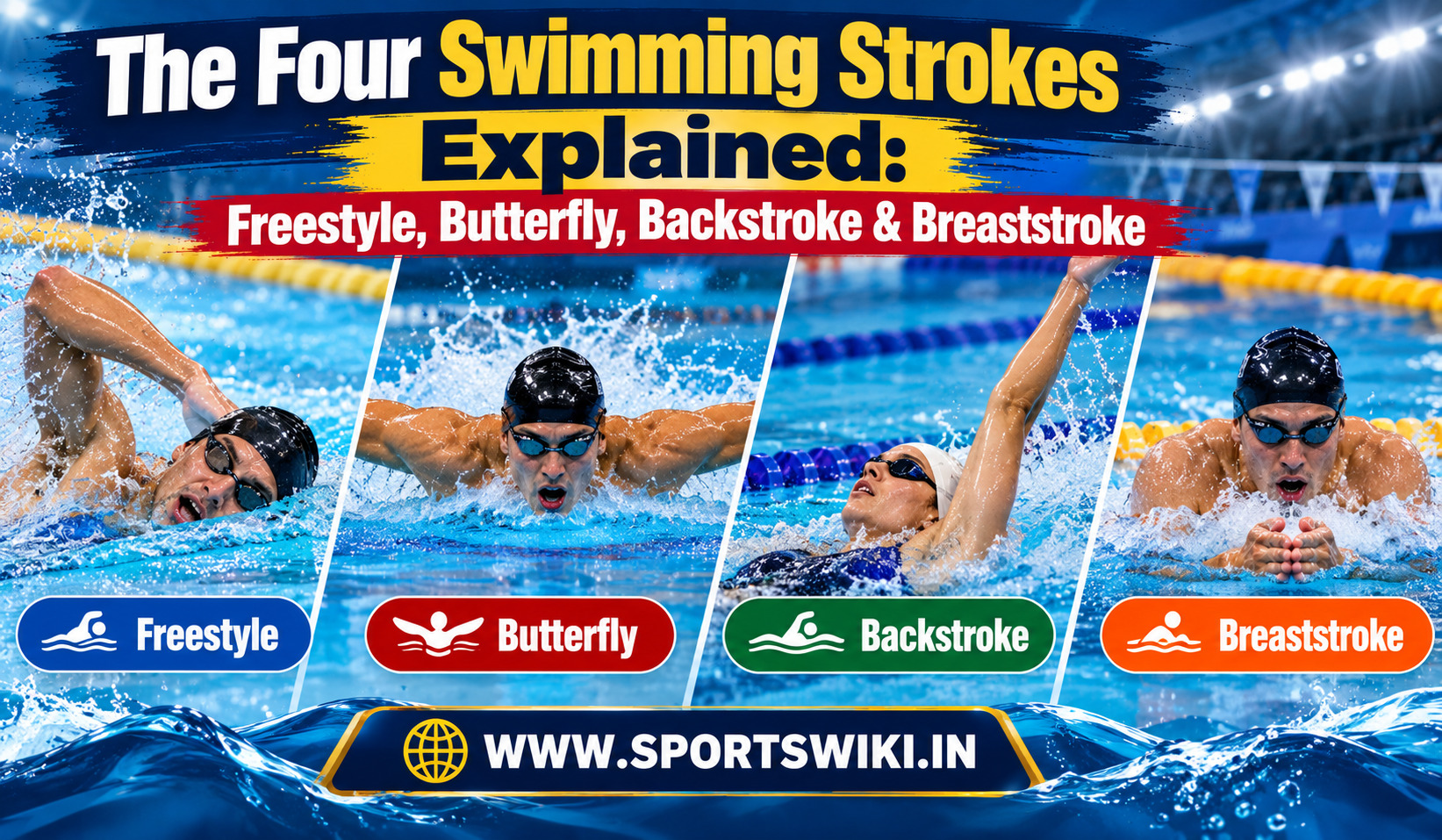
Competitive swimming uses four strokes: freestyle, backstroke, breaststroke, and butterfly. World Aquatics, the sport’s governing body, writes the rules for each one. Each stroke has its own arm action, kick, start and turn. Judges on the pool deck watch for breaks in those rules.
Here’s a quick way to tell them apart:
- Freestyle: swimmers choose their own style, and nearly everyone uses front crawl.
- Backstroke: swimmers stay on their backs for the whole race, apart from the turn.
- Breaststroke: arms and legs move together in a frog-style pattern.
- Butterfly: both arms sweep over the water at once, with a dolphin kick.
Before we dig in, one more point. Some strokes allow a one-hand touch at the wall, while others demand two hands. We’ll flag that for each stroke below.
Freestyle: The Fastest of the Four Swimming Strokes
Technically, freestyle means “any style.” The rules let a swimmer use whatever stroke they like. In practice, front crawl wins every time because it’s the quickest. Alternating arms and a steady flutter kick drive the swimmer forward.
The rules are short and clear. Some part of the swimmer must touch the wall at every turn and at the finish. A swimmer’s head must break the surface by the 15-metre mark after a start or turn. Pushing off the lane rope or the pool floor is not allowed. A one-hand touch at the wall is enough.
Freestyle Speed on the Record Sheet
Freestyle also owns the sport’s marquee sprints. Cameron McEvoy of Australia swam 20.88 in the men’s 50 m freestyle on 20 March 2026. Kate Douglass of the United States clocked 23.19 in the women’s 50 m on 15 August 2026. Both are world records, set in a 50-metre pool.
Distance races belong to freestyle too. The longest event, the 1,500 m, covers 30 lengths of the pool. Our look at Olympic swimming pool size explains how that maths works.
Backstroke: Racing Blind From the Wall
Backstroke is the only stroke that starts in the water. Swimmers grip the wall facing it, then push off backward. From there, they must stay on their backs. Leaving that position is a rules break, except during the turn.
That turn has strict timing. A swimmer may roll toward the stomach, but must start the turn right after rolling over. The arm pull and the wall touch must flow in one motion. Meanwhile, the head must break the surface by 15 metres after the start and after each turn. As a result, backstrokers rely on markers above the pool to count their strokes.
Backstroke Records to Know
The numbers show how fast backstroke can be. Thomas Ceccon of Italy holds the men’s 100 m record at 51.60, set on 20 June 2022. Regan Smith of the United States owns the women’s mark of 57.13, from 18 June 2024. Meanwhile, Aaron Peirsol’s 1:51.92 in the men’s 200 m has stood since 31 July 2009.
At the finish, a swimmer must touch the wall while on the back. A single hand does the job. Because of this, backstroke finishes can look like a lunge for the wall.
Breaststroke: The Most Detailed Rulebook
If rules were a language, breaststroke would be the longest sentence. Many experts call it the most closely policed stroke. Arms and legs must move in sync, and both sides of the body must work at the same time. The kick looks like a frog’s.
Several moves are banned. Flutter kicks, scissor kicks and butterfly kicks during the stroke all break the rules. There’s one exception. After the start and after each turn, a swimmer gets a single butterfly kick before the first breaststroke kick. Taking more than that is a common disqualification.
Two Hands at the Wall
At every turn and at the finish, breaststrokers must touch the wall with both hands at once. The hands must hit level with each other. Even so, a swimmer can touch at, above or below the surface of the water. This rule keeps the stroke honest from the first length to the last.
Adam Peaty of Great Britain still holds two long course marks. He swam 25.95 in the men’s 50 m on 25 July 2017, and 56.88 in the men’s 100 m on 21 July 2019. On the women’s side, Lilly King set the 100 m record of 1:04.13 on 25 July 2017.
Butterfly: Power Over Two Arms
Butterfly grew out of breaststroke in the 1950s, which explains why the two share so many rules. Both arms must move together, and they come forward over the water at the same time. Legs move together too, in a dolphin-style kick. A breaststroke kick is not allowed.
After a start or a turn, a swimmer may take one or more leg kicks and one arm pull under the water. That pull must bring the swimmer to the surface. Of course, two arm pulls under the surface is a disqualification. At the wall, both hands must touch together, just like in breaststroke.
Butterfly at the Top of the Sport
Few events have stirred more drama than butterfly lately. Gretchen Walsh of the United States swam 54.33 in the women’s 100 m on 2 May 2026. In July 2026, Canada’s Summer McIntosh went 2:01.65 in the 200 m. That beat a mark from 2009 held by China’s Liu Zige at 2:01.81. As for the men, Kristóf Milák of Hungary holds the 200 m record at 1:50.34, set on 21 June 2022.
Medley Races: Where All Four Swimming Strokes Meet
Medley races ask swimmers to use all four strokes in one event. In the individual medley (IM), the order is butterfly, backstroke, breaststroke, then freestyle. In the medley relay, four swimmers each take one stroke. The relay order is backstroke, breaststroke, butterfly, and freestyle.
Turns between strokes follow the finish rules for the stroke just completed. For example, moving from butterfly to backstroke needs a two-hand touch. Moving from backstroke to breaststroke needs a touch while on the back. In the IM, “freestyle” means any stroke other than the three before it.
Léon Marchand of France owns two long course IM records. He swam 4:02.50 in the 400 m on 23 July 2023. Then he clocked 1:52.69 in the 200 m on 30 July 2025. On the women’s side, Summer McIntosh holds both IM marks. The full table of those marks sits in our guide to Olympic swimming records.
Which Stroke Should Beginners Learn First?
For most learners, freestyle comes first. It builds comfort in the water and basic breathing. After that, backstroke is a natural next step, since the face stays clear of the water. Breaststroke follows for many swimmers because its slow rhythm helps with timing.
Butterfly usually comes last. It asks for strong shoulders and good timing. Even so, plenty of young swimmers learn a basic dolphin kick early on. Indian swimmers have shown that strong strokes can start from small steps. Srihari Nataraj is a backstroke specialist, and Sajan Prakash is a butterfly specialist. You can read their stories in our piece on Indian swimmers.
Common Rule Breaks Fans Should Know
Disqualifications often surprise casual viewers. Here are the usual culprits, grouped by stroke:
- Freestyle: not touching the wall at a turn or finish, or staying under past the 15-metre mark.
- Backstroke: leaving the back before the turn, or failing to surface by 15 metres.
- Breaststroke: more than one butterfly kick after the start or turn, or a one-hand touch.
- Butterfly: using a breaststroke kick, or touching with one hand.
- Medley: swimming the strokes in the wrong order.
A false start is also a rules break in every stroke except the backstroke, which has its own in-water start. Because the margins are so thin, officials review every close finish.
Key Takeaways
- Freestyle: any style is allowed, front crawl is nearly universal, and the head must break the surface by 15 metres.
- Backstroke: swimmers stay on their backs, and a one-hand touch ends the race.
- Breaststroke: it has the most detailed rulebook, with one butterfly kick allowed after the start and turns.
- Butterfly: it grew from breaststroke in the 1950s, and it needs a two-hand touch.
- Medley order: the IM goes fly, back, breast, free, while the relay goes back, breast, fly, free.
FAQs
What are the four swimming strokes?
They are freestyle, backstroke, breaststroke and butterfly.
Which of the four swimming strokes is fastest?
Freestyle is the fastest of the four, and front crawl is the style almost everyone uses.
What is the order of strokes in an individual medley?
The order is butterfly, backstroke, breaststroke and then freestyle.
Which strokes need a two-hand touch at the wall?
Breaststroke and butterfly both need a two-hand touch, while freestyle and backstroke need only one.
What’s the difference between butterfly and breaststroke?
Butterfly uses a dolphin kick with both arms over the water, while breaststroke uses a frog kick with arms under the surface.
Conclusion
The four swimming strokes share one pool, but each plays by its own rules. Freestyle gives freedom, backstroke tests balance, breaststroke tests precision, and butterfly tests power. Once you know the rules, every race becomes easier to follow, and every record swim means more.