What Is Fencing? Foil, Épée and Sabre Rules Explained
Fifteen touches, nine minutes and a strip just 14 metres long. That’s all it takes to decide a knockout bout at the Olympics. So, what is fencing? It’s a combat sport in which two athletes score by hitting each other with a blunt blade. A machine then confirms most hits.
Because three different weapons share the sport, newcomers often feel lost. Because of this, this guide explains foil, épée and sabre in plain terms. Along the way, it covers scoring, the right-of-way rule and team events. Since rules can change, everything below reflects reports as of October 2026.
What Is Fencing? The Sport in Brief
Fencing has featured at every modern Olympic Games since 1896. Two athletes stand on a narrow metal strip called a piste. They advance, retreat, attack and defend, all while trying to land a touch. Because the sport moves so fast, many fans call it physical chess.
For safety, every fencer wears a mask, a padded jacket and a glove. In foil and sabre, a metallic jacket called a lamé also covers the valid target. Meanwhile, a wire called a body cord links the fencer to the scoring box. As a result, when the blade hits the target, lights flash and a buzzer sounds.
The Strip and the Commands
The strip measures 14 metres long and 1.5 to 2 metres wide. Because fencers start at set lines, they move back and forth along it. Stepping off the back end can even cost a touch. That’s why footwork is the first skill every beginner learns.
In short, the referee controls the pace with simple calls. First, fencers salute, then take the “en garde” stance. Next comes “ready”, and finally “fence”, which starts the action. Once a touch lands, the referee halts the bout and explains the decision.
The Three Weapons at a Glance
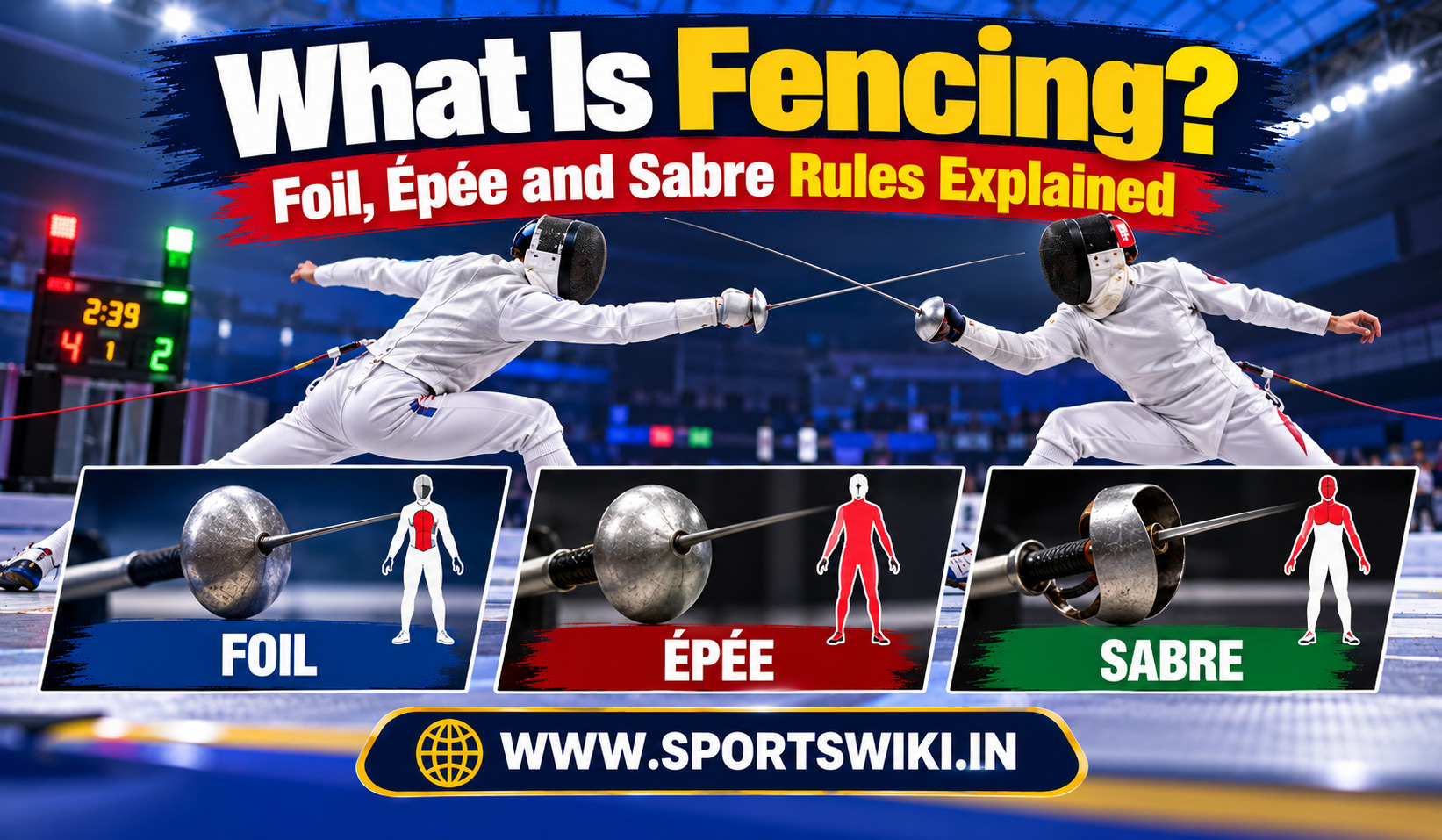
Each weapon has its own blade, target and rules. Foil has a flexible, rectangular blade and scores only with the tip. Épée, meanwhile, has a stiffer blade and also scores with the tip. Sabre, meanwhile, has a lighter blade and scores with the edge or the tip.
Because the weapons differ, the sport feels very different from one to another. For example, foil is precise and technical, and épée is cautious and patient. Sabre, by contrast, is fast and explosive. Here’s a quick summary of the three:
- Foil: Tip only, torso as the target, and right of way applies.
- Épée: Tip only, the whole body as the target, and no right of way.
- Sabre: Tip or edge, the body above the hips as the target, and right of way applies.
Foil Rules Explained
In foil, the valid target is the torso, including the back. Because the arms, neck, head and legs aren’t part of it, many hits don’t count. A touch counts only if the tip hits with enough force to press the button. If the tip lands elsewhere, a white light shows an off-target hit.
Foil also uses right of way, sometimes called priority. Since only one fencer can score during an action, priority matters. The fencer who starts an attack with the arm extending usually earns it. However, the defender can win it back by blocking the blade, which is called a parry. A reply, called a riposte, then follows.
Épée Rules Explained
Épée has the largest target of all three weapons. In fact, the whole body is valid, from head to toe. Only the tip scores, and it needs enough force to register. Because the target is huge, fencers often aim for the hand or foot, which sit closest to the opponent.
Épée has no right of way. So if both fencers hit within a tiny time window, both score a point. As a result, the weapon feels patient and tactical. For this reason, many fans find épée the easiest weapon to follow, since the first valid touch simply counts.
Sabre Rules Explained
Sabre targets everything above the hips, including the head and arms. Because the target mirrors an old cavalry rider on horseback, the head and arms count. A touch counts with the front edge, the last third of the back edge or the tip. As a result, sabre feels lightning quick.
Sabre also uses right of way. Because attacks are so fast, referees watch closely for who started first. A short break happens when one fencer reaches eight touches. Then the bout resumes until someone reaches 15.
Scoring, Time and Bout Formats
Knockout bouts go to 15 touches. They last up to nine minutes, split into three periods of three minutes. Between periods, fencers get a one-minute break. If neither reaches 15, the higher score after the last period wins.
Early rounds, meanwhile, use pools. In a pool bout, the first fencer to reach five touches wins, or the leader after three minutes. Because pools decide seeding, results in this phase shape the knockout draw. Even a strong fencer can face a tough opponent early if the pool goes badly.
Team events work differently. Because each team has three fencers and a substitute, depth matters. Teams fence nine bouts, and each bout runs until the team’s score rises by five. So the first team to 45 points wins. In fact, a team can pull off a relay-style comeback late in the match.
Basic Moves Every Fan Should Know
A few terms come up in every commentary. For instance, a lunge is a long forward step with a straight arm, used to reach the target. Next, a parry is a defensive block, and a riposte is the counterattack that follows. Finally, the fleche is a running attack, popular in foil and épée.
Because these moves flow together, a single exchange can last only a second or two. Even so, each one follows a clear logic. Once a fencer feints, the opponent reacts, and the real attack comes in the gap. That’s why watching fencing live is such a fast, rewarding experience. Still wondering what is fencing’s hardest skill? Many coaches say it’s timing, since a split second decides every touch.
Fencing in India
India’s fencing profile has grown in recent years. For instance, Bhavani Devi became the country’s first fencer at the Olympics, competing at Tokyo 2020. Then, in 2026, she headlined a 20-member Indian squad at the Asian Games. Although she was knocked out in the round of 16, she remains the face of the sport.
Overall, India’s campaign at Aichi-Nagoya ended without a medal. Even so, the men’s foil team had secured qualification for the Games, which was a notable step. To see how another combat sport scores points, read our guide to taekwondo rules and scoring.
Equipment and Safety
Fencing looks risky, but the gear makes it very safe. The mask has a strong mesh and a bib that protects the neck. The jacket and breeches use tough fabric that blades can’t easily pierce. Because the blades are blunt and flexible, serious injuries are rare. So what is fencing’s safety record like? Very good, thanks to strict equipment checks before every event.
The scoring box adds another layer of fairness. Since it registers hits within a tiny time window, it removes most arguments. Electronic scoring appeared in épée first, then in foil, and later in sabre. As a result, referees now focus on right of way and safety instead of spotting touches by eye.
Fencing and Other Combat Sports
Fencing uses a blade, while judo, taekwondo and karate use the body. Because of that, training and tactics differ completely. For a side-by-side view of the unarmed arts, you can read karate vs judo vs taekwondo. To learn how grips and throws work, start with our explainer on what is judo.
Key Takeaways
- Bout length: Knockout bouts go to 15 touches, with three three-minute periods.
- Foil target: The torso, including the back, with right of way in force.
- Épée target: The whole body, with no right of way.
- Sabre target: Everything above the hips, with right of way and a break at eight touches.
- Team events: Three fencers and a substitute, with the first team to 45 points winning.
FAQs
How many touches win a fencing bout?
A knockout bout is won by the first fencer to reach 15 touches.
Which weapon has the biggest target?
Épée has the biggest target, since the whole body is valid.
What is right of way in fencing?
Right of way decides who scores when both fencers hit at once in foil and sabre.
How long is a fencing match?
Individual knockout bouts last up to nine minutes, split into three periods of three minutes.
Did India win a fencing medal at the 2026 Asian Games?
No, India’s fencing campaign at the 2026 Asian Games ended without a medal.
Conclusion
So, what is fencing? It’s a fast, tactical duel in which athletes land clean touches with foil, épée or sabre. Once you know each weapon’s target and the right-of-way rule, bouts become much easier to follow. Because India’s squad keeps growing, fencing is a sport worth watching closely.