Javelin Throw Rules and Measurement Explained
Jan Železný of the Czech Republic threw a javelin 98.48 metres in Jena on 25 May 1996. That mark still stands as the men’s world record. Behind every huge throw sits a tight rulebook. Javelin throw rules decide whether a monster effort counts or becomes a foul. Here’s how the event works, from the runway to the tape measure, and why the javelin changed shape in 1986.
Javelin Throw Rules: What Makes a Legal Throw
The basics sound simple. The athlete must hold the javelin by its grip and throw it overhand, over the shoulder or upper arm. Slinging it from the side is out. Even so, plenty of styles fit inside that one rule.
Two limits shape the run-up. Throwers may not turn completely around, and they may not start with their back to the throwing direction. That’s why you never see a spin-style javelin throw. Meanwhile, the tip must land first, and the javelin must come down inside the sector.
Staying Behind the Arc
Foot faults end more throws than most fans realise. A thrower must stop behind the arc at the end of the runway. Leaving the runway before the javelin lands is also a foul. As a result, athletes learn to brake hard after the release.
The Javelin Itself: Weight, Length and Grip
World Athletics sets the specifications for the implement. Men and women throw different javelins, and the difference is clear at a glance. The men’s javelin is longer and heavier. Here are the key numbers:
- Men’s length: 2.6 to 2.7 metres
- Men’s minimum weight: 800 grams
- Women’s length: 2.2 to 2.3 metres
- Women’s minimum weight: 600 grams
- Grip width: about 150 millimetres, wrapped in cord
The grip sits at a set spot along the shaft. For men, it’s 0.9 to 1.06 metres from the tip. For women, it’s 0.8 to 0.92 metres. Because the grip is fixed, the thrower can’t slide it to a better position. The rules protect fairness, so every athlete starts from the same equipment standard.
The Runway, the Arc and the Sector
The throw starts on a runway. It’s 4 metres wide and at least 30 metres long. At the far end sits a curved line, the throwing arc, with a radius of 8 metres. Athletes build speed along the runway, then plant and release at the arc.
After release, the javelin must land inside a 28.96° sector. The sector is centred on the middle point of the arc. Lines on the grass mark the edges. If the tip’s first touchdown falls outside those lines, the throw is a foul. Of course, a long throw that drifts wide earns nothing.
How Javelin Measurement Works
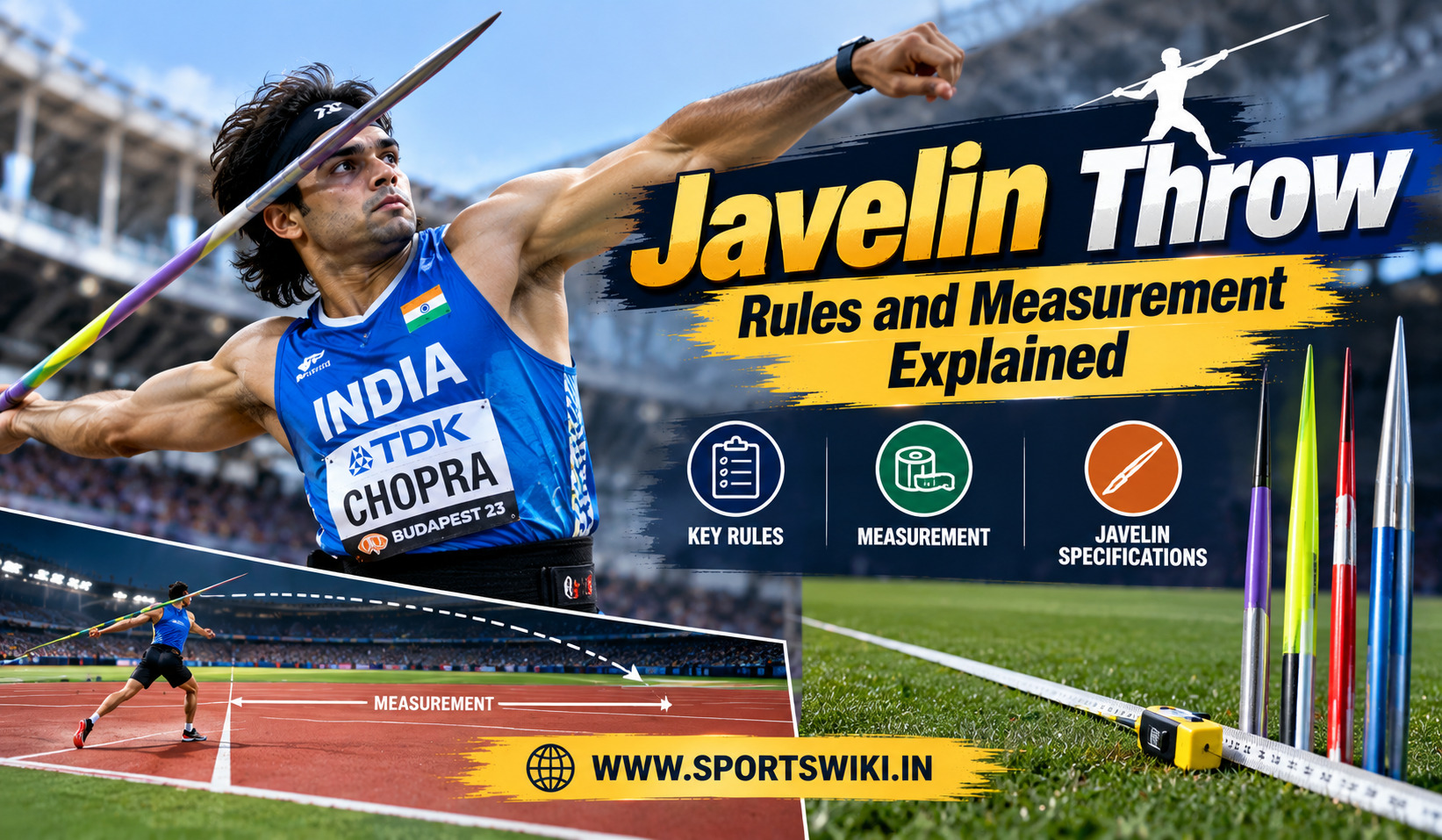
Measurement follows the landing mark, and the tip is the key. Officials measure from the arc to the point where the tip first touched the ground. They don’t measure to the tail or the shaft. A flat landing, where the tail touches first, is not a valid throw.
Distances are rounded down to the nearest centimetre. So a throw of 88.249 metres is recorded as 88.24. That rule favours no one, yet it can swing a close contest. Ties are broken by each athlete’s second-best throw.
Why Tip-First Landings Matter
Judges need a clean, clear mark. A tip-first landing gives them one. In the past, flat landings caused arguments over whether attempts counted. That history ties directly into the 1986 redesign, which we cover below.
How a Javelin Competition Works
Each athlete gets one attempt per round. Most competitions run three to six rounds. The longest legal throw wins. In large fields, everyone throws in the first three rounds. After that, only the top eight, plus anyone who meets a minimum distance, continue.
So the early rounds matter as much as the finish. A foul on the first throw puts real pressure on the next one. Meanwhile, throwers often save their biggest effort for the late rounds. That plan only works if they survive the cut.
Why the Javelin Changed in 1986
Safety and fairness drove the biggest rule change in the sport’s history. Flat landings had become common. They caused disputes over whether attempts counted. At the same time, Uwe Hohn’s 104.80 m throw raised alarms, because throws past 100 metres were hard to stage safely inside a stadium.
The fix took effect on 1 April 1986 for the men’s javelin. Designers moved the centre of gravity forward by 4 centimetres. They also cut the surface area in front of that point and added area behind it. Because of this, the javelin turns into the wind and lands point-first far more often.
What the Change Did to Distances
Flight distances dropped by roughly 10 per cent. Every record was reset under the new design. Hohn’s 104.80 m and Petra Felke’s 80.00 m were the marks standing before the reset. The women’s javelin got its own redesign in 1999.
A later ban closed another loophole. From late 1991, modifications that added tail drag were banned. These included holes, rough paint and dimples. Marks made with them were removed from the record books. For example, Seppo Räty’s 96.96 m from 1991 was nullified.
Javelin World Records and Olympic Marks
Two Czech throwers hold the world records. Jan Železný owns the men’s mark of 98.48 m, set in Jena on 25 May 1996. Barbora Špotáková holds the women’s mark of 72.28 m, set in Stuttgart on 13 September 2008.
On the women’s side, Osleidys Menéndez of Cuba threw 71.53 m at Athens 2004. That was one centimetre short of her own 2001 world record. Records in this event stand for years, because the rules leave little room for equipment tricks.
Javelin Throw Rules and India’s Rise
Indian fans know these rules well, thanks to one athlete. Neeraj Chopra’s personal best is 90.23 m, set in Doha on 16 May 2025. Our guide to Neeraj Chopra’s career covers every medal behind that number.
Understanding the rules also helps when you compare events. The javelin shares a field with other implements, and each one has its own circle, sector and cage. For a side-by-side look, read our piece on the differences between throwing events. Likewise, our breakdown of the long jump, triple jump and high jump shows how the jumping events handle fouls and measurement.
Common Fouls Fans Should Know
Most invalid throws come from a short list of mistakes. Knowing them makes live commentary much easier to follow. Here’s the checklist:
- Wrong style: the javelin isn’t held by the grip or isn’t thrown overhand.
- Turning back: the thrower turns completely around or starts with their back to the throw.
- Early exit: the athlete leaves the runway before the javelin lands.
- Outside the lines: the tip lands outside the 28.96° sector.
- Flat landing: the tail touches down before the tip.
A foul still uses up an attempt. In a six-round final, that can end a medal chance fast. On the other hand, a thrower who lands every attempt legally keeps real options open. Consistency often beats one lucky effort.
Why the Runway Is Built the Way It Is
The runway is at least 30 metres long for a reason. Throwers need room to build speed and shift into the throwing position. Most of the javelin’s flight distance comes from that speed, plus a clean release angle. A short runway would cut both.
The 8-metre arc at the end also keeps things safe. It gives officials a clear line to judge from. Because the sector is centred on the arc’s middle point, every landing is judged against the same reference. That keeps measurement consistent, whichever side of the sector the javelin lands on.
Key Takeaways
- Legal throw: the javelin goes overhand, tip first, inside a 28.96° sector.
- Equipment: men throw 800 g and 2.6 to 2.7 m; women throw 600 g and 2.2 to 2.3 m.
- Measurement: officials measure from the arc to the tip’s mark and round down to the centimetre.
- 1986 redesign: the centre of gravity moved forward by 4 cm, and distances fell by about 10 per cent.
- World records: Jan Železný holds 98.48 m, and Barbora Špotáková holds 72.28 m.
FAQs
How is a javelin throw measured?
Officials measure from the arc to the spot where the tip first landed, rounded down to the nearest centimetre.
How heavy is a javelin?
The men’s javelin weighs at least 800 grams, and the women’s weighs at least 600 grams.
Does the javelin have to land tip first?
Yes, the tip must be the first part to touch the ground, or the throw is not valid.
Who holds the men’s javelin world record?
Jan Železný of the Czech Republic holds it with 98.48 metres, set on 25 May 1996.
Why was the javelin redesigned in 1986?
Flat landings and safety fears over 100-metre throws led to a design that lands point-first more often.
Conclusion
Javelin throw rules look strict because they have to be. A legal throw is overhand, tip first and inside the sector, and every distance is rounded down to the centimetre. Add the 1986 redesign, and you can see how the sport protects both fairness and safety. Once you know these rules, every record attempt becomes easier to follow.