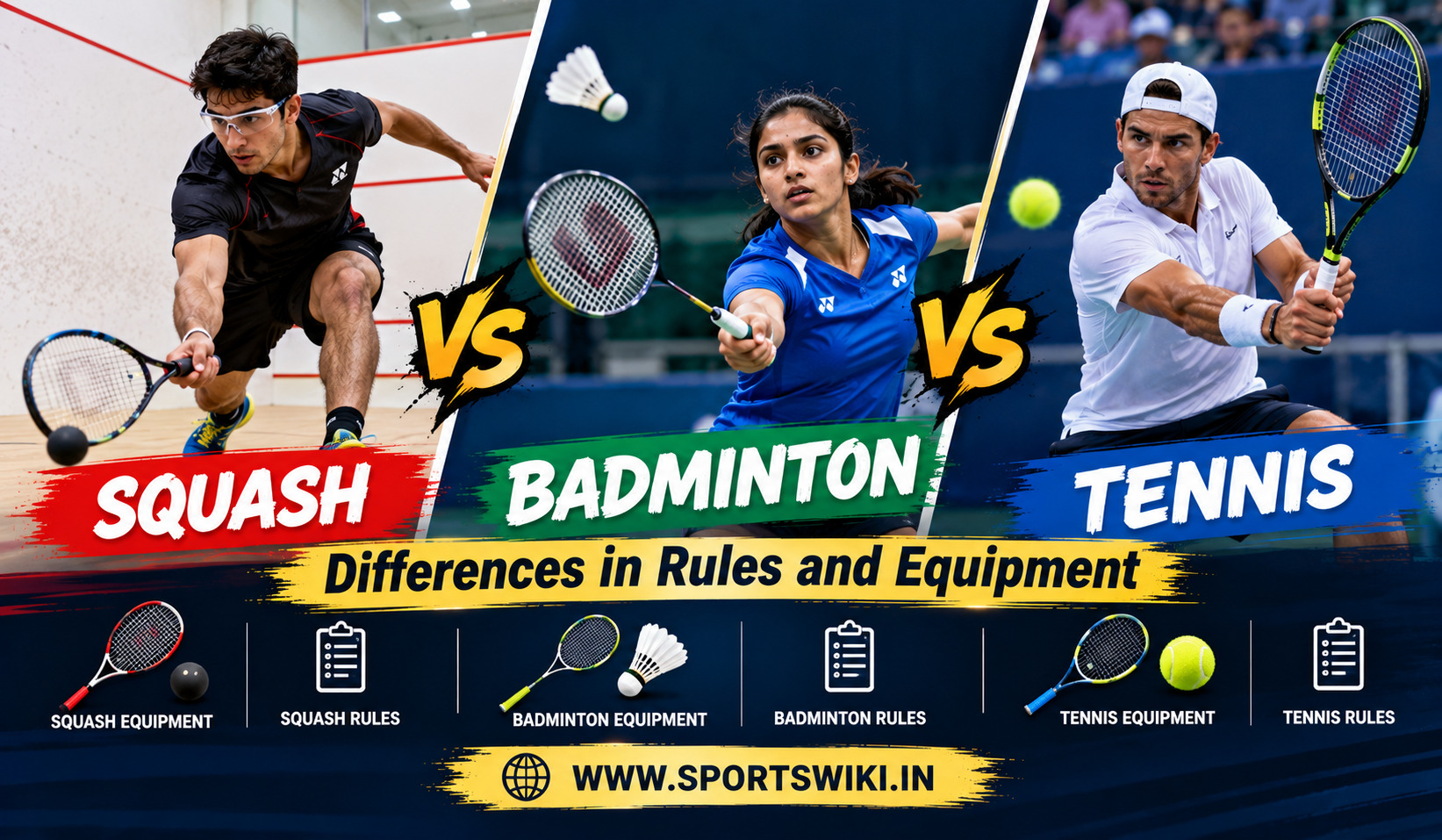
Squash vs Badminton vs Tennis: Differences in Rules and Equipment
A squash court is about 9.75 metres long, while a tennis court runs 23.77 metres from baseline to baseline. That gap alone shows how different these racket sports feel. So when fans ask about squash vs badminton vs tennis, the answer starts with space, then spreads to rules and kit.
Because squash is joining the Olympic programme in 2028, more people are comparing it with sports they already know. Because the details can get confusing, this guide covers courts, equipment, scoring and playing style in plain terms. Along the way, you’ll see which sport might suit you best. Even if you’ve only played one of the three, the differences will make sense quickly.
Squash vs Badminton vs Tennis: The Big Picture
All three sports use a racket, a small flying or bouncing object and a marked court. However, that’s where the similarities end. Squash is played indoors in an enclosed box, and both players hit the ball against a shared front wall. Badminton and tennis, meanwhile, use a net to split the court between two sides.
The object being hit changes everything, too. For instance, squash uses a small rubber ball, badminton uses a feathered shuttle, and tennis uses a felt-covered ball. As a result, each sport rewards different skills. Squash demands quick turns and tactical patience, while badminton asks for sharp reactions. Tennis, by contrast, blends power with endurance on a much bigger court.
Court Size and Layout
Space is the first big divider. A squash court is the smallest of the three, yet its walls keep the ball in play. While badminton sits in the middle, tennis has by far the biggest footprint. Because the distances differ, so do the movement patterns. Here are the key numbers side by side.
| Sport | Length | Width | Net |
| Squash | 9.75 m | 6.4 m | None |
| Badminton | 13.4 m | 6.1 m (doubles) | About 1.55 m at the posts |
| Tennis | 23.77 m | 8.23 m singles, 10.97 m doubles | 1.07 m at the posts |
Notice the net column. Squash is the only sport here with no net at all, so both players crowd the same space. That means contact and blocked shots are part of the game, which is why referees use let and stroke calls. For a full rules breakdown, read our explainer on what is squash.
Surfaces vary a lot as well. Tennis is played on grass, clay or hard courts, and each one changes the bounce. Since badminton and squash are mostly indoor, wind and weather rarely matter. In squash, the walls even take over the role that the net plays elsewhere.
Rackets, Balls and Shuttles
Rackets look similar at first glance, but the rules differ. For instance, a squash racket can be up to 686 millimetres long, and a badminton racket up to 680 millimetres. Tennis rackets, by contrast, are usually larger-headed and heavier, since players need power to drive a ball across a long court. As a result, a swing feels very different in each sport.
The projectile matters even more. A squash ball is hollow rubber, about 40 millimetres across, and its coloured dots show how much it bounces. Because pros want longer rallies, they use the double yellow dot, the slowest option. A tennis ball, on the other hand, is bigger, between 6.54 and 6.86 centimetres across, and covered in felt.
A badminton shuttle is a different thing altogether. In fact, it has 16 feathers on a rounded cork base and weighs between 4.74 and 5.50 grams. Because of that drag, a shuttle slows down fast after a smash. Still, the opening speed can be startling. So a ball or shuttle that behaves so differently shapes how each sport is coached.
Scoring and Match Format
Scoring is where beginners get lost. Squash and badminton both use rally scoring, which means every rally awards a point. While squash games go to 11 and most professional matches are best of five, badminton games go to 21 and matches are best of three. Both need a two-point lead, although badminton caps a game at 30.
Tennis, however, is the odd one out. Points run 15, 30, 40 and game, and players win games to take a set. Once a set reaches 6–6, a tiebreak settles it. Matches are best of three sets, or best of five at some major events. So a tennis match can run far longer than a squash or badminton match.
Here’s a quick way to remember it. Squash is a sprint to 11, badminton is a sprint to 21, and tennis is a long staircase of games and sets. Of course, individual matches can break those patterns. A tight squash game can drag on at 10–10, and a tennis set can end 6–0 in minutes.
Playing Style and Physical Demands
Squash is a constant chase in a small box. Because players lunge, recover and change direction every second or two, fitness is crucial. Since the opponent shares the same space, tactics matter as much as power. So smart players use length, drops and angles to drag the other person around the court. That’s why a squash rally can feel like a physical chess game.
Badminton is built on speed and timing. Smashes, drops and net shots follow each other in flashes, and the shuttle rarely touches the floor. For that reason, players need fast wrists and explosive footwork. Tennis, meanwhile, mixes long baseline rallies with big serves and net play. Because of the larger court, stamina and shot power become central.
Even so, no sport here is easy on the body. Squash and badminton punish quick stops and twists, while tennis tests the shoulder and legs over long matches. Still, each can be adapted for beginners with softer balls, lighter rackets and shorter games. After all, enjoyment matters more than the numbers. Coaches often suggest starting with short sessions, because technique breaks down quickly when a player is tired. Even so, regular play builds the fitness that all three sports demand, and most newcomers improve fast once they find a rhythm.
Olympic Status and the Indian Link
The three sports have very different Olympic histories. For instance, tennis appeared at the first modern Games in 1896, was dropped after 1924 and returned in 1988. Badminton, in contrast, became a medal sport at Barcelona in 1992. Squash, meanwhile, finally arrives in Los Angeles in 2028 with men’s and women’s singles draws of 16 players. To see the format in full, read our guide to squash at the 2028 Olympics.
India has a strong link to each sport. Badminton star PV Sindhu won Olympic silver in 2016 and bronze in 2020, which lifted the sport’s profile nationwide. Meanwhile, tennis has produced Grand Slam doubles champions, and squash is now rising fast. In fact, Indian squash players returned from the 2026 Asian Games with two singles silvers and three bronzes. Our look at the top Indian squash players shows who made that happen.
Which Sport Suits You?
Here’s a personal take, clearly framed as an opinion. Anyone who loves tactics and tight spaces will find squash hard to beat. Players who enjoy fast reactions and quick rallies, on the other hand, will feel at home in badminton. Meanwhile, long contests and outdoor courts make tennis the better fit for others.
Cost and access matter too. Because squash needs an indoor court, it can be harder to find in smaller towns. Badminton halls are common in India, while tennis courts are available in many clubs. As a result, many beginners start with whichever sport is nearest. That’s a perfectly good plan, and many players switch later.
Key Takeaways
- Court size: Squash is the smallest at 9.75 metres by 6.4 metres, while tennis is the largest at 23.77 metres long.
- Net: Squash has no net, while badminton and tennis both split the court with one.
- Scoring: Squash goes to 11, badminton to 21, and tennis uses points, games and sets.
- Equipment: Squash uses a rubber ball, badminton a feathered shuttle and tennis a felt-covered ball.
- Olympics: Badminton joined in 1992, tennis returned in 1988, and squash debuts in 2028.
FAQs
Which is the hardest of the three sports?
Each is demanding in its own way, and the answer depends on whether you value speed, tactics or endurance.
Does squash have a net?
No, squash has no net because both players hit the ball against the same front wall.
How are points scored in badminton compared with squash?
Both use rally scoring, but badminton games go to 21 points and squash games go to 11.
Is squash an Olympic sport?
Squash makes its Olympic debut at the Los Angeles Games in 2028.
Which sport has the biggest court?
Tennis has the biggest court, measuring 23.77 metres long.
Conclusion
Squash vs badminton vs tennis comes down to space, scoring and style. While squash is compact and tactical, badminton is fast and light, and tennis is big and enduring. Because squash is heading to the Olympics, more fans will test all three. Whichever one you try first, you’ll quickly see why these racket sports each have loyal followers around the world.