Women’s Asia Cup 2026 Teams, Groups and Tournament Format
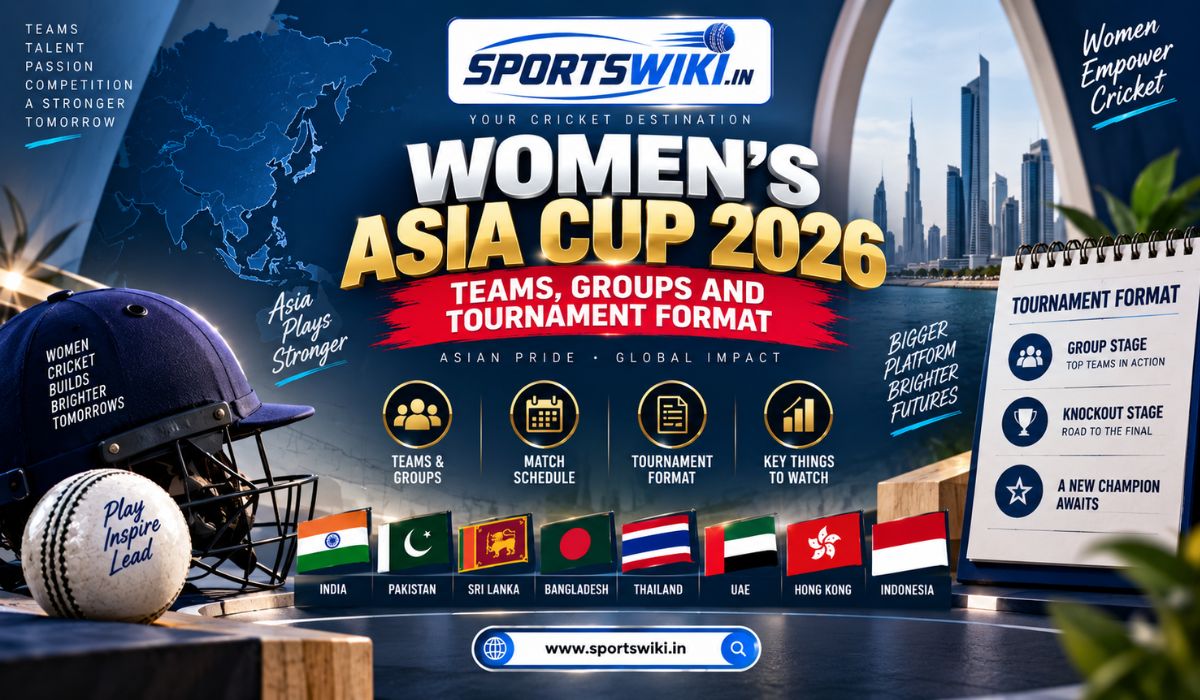
The Women’s Asia Cup 2026 has brought together eight teams for the 10th edition of one of the most important tournaments in Asian women’s cricket. The competition is being played in the T20I format in the United Arab Emirates, with all matches taking place at the Dubai International Cricket Stadium.
The tournament began on August 28 and features 15 matches in total. The eight participating teams were divided into two groups of four, with each team playing three group-stage matches. The top two teams from each group progress to the semi-finals, creating a four-team knockout stage before the final on September 13.
With the group stage now complete, India, Pakistan, Sri Lanka and Bangladesh have qualified for the semi-finals. India finished first in Group A, Pakistan second, Sri Lanka topped Group B and Bangladesh finished second.
Eight Teams Competing in the Women’s Asia Cup 2026
The eight teams taking part in the 2026 tournament are India, Pakistan, Sri Lanka, Bangladesh, Thailand, Hong Kong, China, United Arab Emirates and Indonesia.
The lineup combines established Asian cricket nations with developing teams that are gaining valuable experience at the international level. India are the most successful side in Women’s Asia Cup history, while Sri Lanka entered the tournament as defending champions after winning their first title in 2024.
The participation of teams such as Thailand, Hong Kong, China, UAE and Indonesia also reflects the continued expansion of women’s cricket across the region. For these teams, playing against stronger opponents provides an opportunity to gain experience and develop players for future international competitions.
Group A Teams
Group A consisted of India, Pakistan, Thailand and Hong Kong, China.
India Women
India entered the competition as one of the strongest favourites. Led by Harmanpreet Kaur, they also have experienced players such as Smriti Mandhana, Shafali Verma and Deepti Sharma.
India have a remarkable record in the Women’s Asia Cup and entered the 2026 edition as the tournament’s most successful team. Their squad combines experienced international players with younger options, giving them considerable depth in both batting and bowling.
India completed the Group A stage unbeaten, winning all three matches and finishing first with six points. Their victories over Thailand, Hong Kong and Pakistan also gave them an outstanding net run rate.
Pakistan Women
Pakistan were the second major side in Group A. Captained by Fatima Sana, they entered the competition hoping to challenge India and progress to the knockout stage.
Their squad includes experienced players such as Muneeba Ali, Nashra Sundhu, Sadia Iqbal and Tuba Hassan.
Pakistan finished second in Group A after winning two of their three matches. Their bowling attack was particularly impressive against Hong Kong, with Nashra Sundhu producing a six-wicket haul.
Thailand Women
Thailand have become an increasingly familiar team in Asian women’s cricket. Their squad includes captain Naruemol Chaiwai, Nannapat Koncharoenkai, Natthakan Chantham and experienced all-rounder Chanida Sutthiruang.
They entered the tournament looking to compete with the more established teams in Group A.
Thailand won one of their three group matches and finished third in the group with two points. Although they did not qualify for the semi-finals, their campaign provided another opportunity to compete against some of the region’s leading sides.
Hong Kong, China Women
Hong Kong, China completed Group A alongside India, Pakistan and Thailand.
Captain Natasha Miles led a squad containing players including Maryam Bibi, Mariko Hill, Chan Ka Ying and Nannapat Chaihan.
Hong Kong faced a difficult group because they had to play against both India and Pakistan, but the tournament provided valuable international experience. They finished the group stage without a win.
Group B Teams
Group B featured defending champions Sri Lanka, Bangladesh, hosts United Arab Emirates and Indonesia.
Sri Lanka Women
Sri Lanka entered the competition as defending champions after winning the 2024 Women’s Asia Cup.
Captain Chamari Athapaththu led a strong squad that also included Harshitha Samarawickrama, Vishmi Gunaratne, Kavisha Dilhari and Sugandika Kumari.
Sri Lanka were among the leading contenders before the tournament began and justified those expectations during the group stage. They won all three matches and finished at the top of Group B with six points.
Their unbeaten campaign means they remain one of the strongest candidates to reach the final.
Bangladesh Women
Bangladesh were another important team in Group B.
Nigar Sultana Joty captained a squad that included Nahida Akter, Sharmin Akter Supta, Rabeya Khan, Marufa Akter and Ritu Moni.
Bangladesh won two of their three group matches and finished second behind Sri Lanka. Their final group match against UAE was particularly important because a victory secured their place in the semi-finals.
They now face India in the first semi-final.
United Arab Emirates Women
The UAE entered the tournament as hosts and had the opportunity to play in familiar conditions at the Dubai International Cricket Stadium.
Esha Oza captained the UAE squad, with players such as Heena Hotchandani, Theertha Satish, Suraksha Kotte and Vaishnave Mahesh also included.
UAE finished third in Group B after winning one of their three matches. Their victory came against Indonesia, while they lost to Sri Lanka and Bangladesh.
Although they did not reach the knockout stage, their participation against stronger teams was an important experience for the developing side.
Indonesia Women
Indonesia were the other team in Group B.
Captain Nanda Sakarini led a squad that included Kadek Winda Prastini, Desi Wulandari, Ni Kadek Ariani and Sofia Velic.
The tournament represented an important opportunity for Indonesia to compete at this level. They faced Bangladesh, Sri Lanka and UAE during the group stage.
Indonesia did not record a victory, but their participation gave their players exposure to international T20 cricket against several experienced Asian teams.
How the Group Stage Worked
The tournament format was relatively straightforward.
Each group contained four teams. Every team played the other three teams in its group once, meaning each side had three opportunities to earn points.
A win was worth two points, while a defeat provided no points. If teams finished level on points, net run rate became an important factor in determining their positions.
After all group matches were completed, the top two teams from each group advanced to the semi-finals.
This structure meant that every match carried significance. With only three group games available, a team could not afford a prolonged run of poor results.
Qualification for the Semi-Finals
The top two teams from Group A and Group B qualified for the knockout stage.
India finished first in Group A, followed by Pakistan. Sri Lanka topped Group B, while Bangladesh took second place. The final Group B qualification spot was decided when Bangladesh defeated UAE by 34 runs in the final group match.
The final semi-final lineup therefore became:
India Women vs Bangladesh Women
Sri Lanka Women vs Pakistan Women
India and Sri Lanka entered the knockout stage unbeaten, while Pakistan and Bangladesh progressed after winning two group matches each.
India vs Bangladesh Semi-Final
The first semi-final is scheduled for September 10 and brings together India and Bangladesh.
India qualified as Group A winners after winning all three of their matches. Bangladesh finished second in Group B after collecting four points.
India enter the match with strong momentum, but Bangladesh have enough experience to make the contest competitive. Their qualification itself demonstrated their ability to handle pressure, particularly in their final group match against UAE.
The semi-final will decide the first finalist of the 2026 Women’s Asia Cup.
Sri Lanka vs Pakistan Semi-Final
The second semi-final is scheduled for September 11.
Sri Lanka finished first in Group B with a perfect record, while Pakistan finished second in Group A.
Sri Lanka have the advantage of being defending champions and will be looking to continue their unbeaten campaign. Pakistan, however, possess a dangerous bowling attack and have already demonstrated their ability to dominate an opposition batting lineup.
The winner will advance to the September 13 final.
What Happens After the Semi-Finals?
The two semi-final winners will meet in the final on September 13.
There is no third-place playoff listed in the tournament structure, so the competition moves directly from the semi-finals to the championship match.
The final will determine the 2026 Women’s Asia Cup champion and will bring the 15-match tournament to a conclusion.
Why the Tournament Format Matters
The two-group structure provides a balance between league competition and knockout cricket.
During the group stage, teams have multiple opportunities to recover from a defeat. However, once the semi-finals begin, one loss ends a team’s campaign.
This makes finishing in the top two essential, but finishing first also provides a potentially favourable knockout pathway based on the group standings.
The format also ensures that every team plays a minimum of three matches. This is particularly useful for developing teams because they receive several opportunities to compete rather than being eliminated after one poor performance.
The Importance of Net Run Rate
Net run rate can become extremely important in a short group-stage tournament.
Because each team plays only three matches, two teams can easily finish with the same number of points. When that happens, net run rate can determine which side progresses.
India’s Group A campaign is a good example of how large victories can strengthen a team’s position. Their wins over Thailand and Hong Kong produced substantial margins and helped them finish with an excellent net run rate.
Teams therefore need to think beyond simply winning. A convincing victory can become valuable later if qualification comes down to a comparison of net run rates.
A Tournament Featuring Different Levels of Experience
One of the interesting aspects of the 2026 Women’s Asia Cup is the combination of established teams and developing sides.
India, Sri Lanka, Pakistan and Bangladesh have extensive experience in major international competitions. At the same time, Thailand, Hong Kong, China, UAE and Indonesia are continuing to develop their women’s cricket programmes.
This mixture creates different types of contests throughout the tournament. Matches between established teams can have direct knockout implications, while games involving emerging teams provide opportunities for players to test themselves against higher-ranked opposition.
The Asia Cup therefore serves both as a championship competition and as an important development platform for women’s cricket in Asia.
Defending Champions Sri Lanka Face a New Challenge
Sri Lanka’s position as defending champions adds another storyline to the tournament.
They won their first Women’s Asia Cup title in 2024 after defeating India in the final. They returned in 2026 with the goal of becoming the first team to successfully defend the title since the competition began.
Their unbeaten group-stage performance has put them in a strong position.
However, Pakistan now stand between Sri Lanka and another final. A single knockout defeat would end their attempt to retain the championship.
India Remain the Team With the Most Titles
India’s history gives them another important advantage.
They entered the 2026 edition as the most successful team in Women’s Asia Cup history, having won the tournament seven times. Their experience in this competition is therefore greater than that of any other side.
That does not guarantee success, particularly in T20 cricket where one outstanding performance can change a match quickly.
Still, India’s combination of tournament history, experienced players and strong group-stage form makes them one of the leading contenders for the 2026 trophy.
Women’s Asia Cup 2026 Format in Perspective
The 2026 Women’s Asia Cup has followed a simple but competitive structure: eight teams, two groups, three matches per team in the group stage, followed by semi-finals and a final.
Group A brought together India, Pakistan, Thailand and Hong Kong, China, while Group B featured Sri Lanka, Bangladesh, UAE and Indonesia.
After the group stage, India and Pakistan emerged from Group A, while Sri Lanka and Bangladesh advanced from Group B.
The tournament has now reached the stage where experience, consistency and the ability to perform under pressure matter more than previous results. India will meet Bangladesh in the first semi-final, while Sri Lanka will face Pakistan in the second.
With the final scheduled for September 13, the Women’s Asia Cup 2026 now has only one question left to answer: which of the four remaining teams will lift the trophy?
The group-stage format has provided every team with an opportunity to compete, while the knockout system ensures a dramatic finish. For fans, the remaining matches promise a combination of rivalry, tactical battles and high-pressure T20 cricket as the tournament moves toward its conclusion.