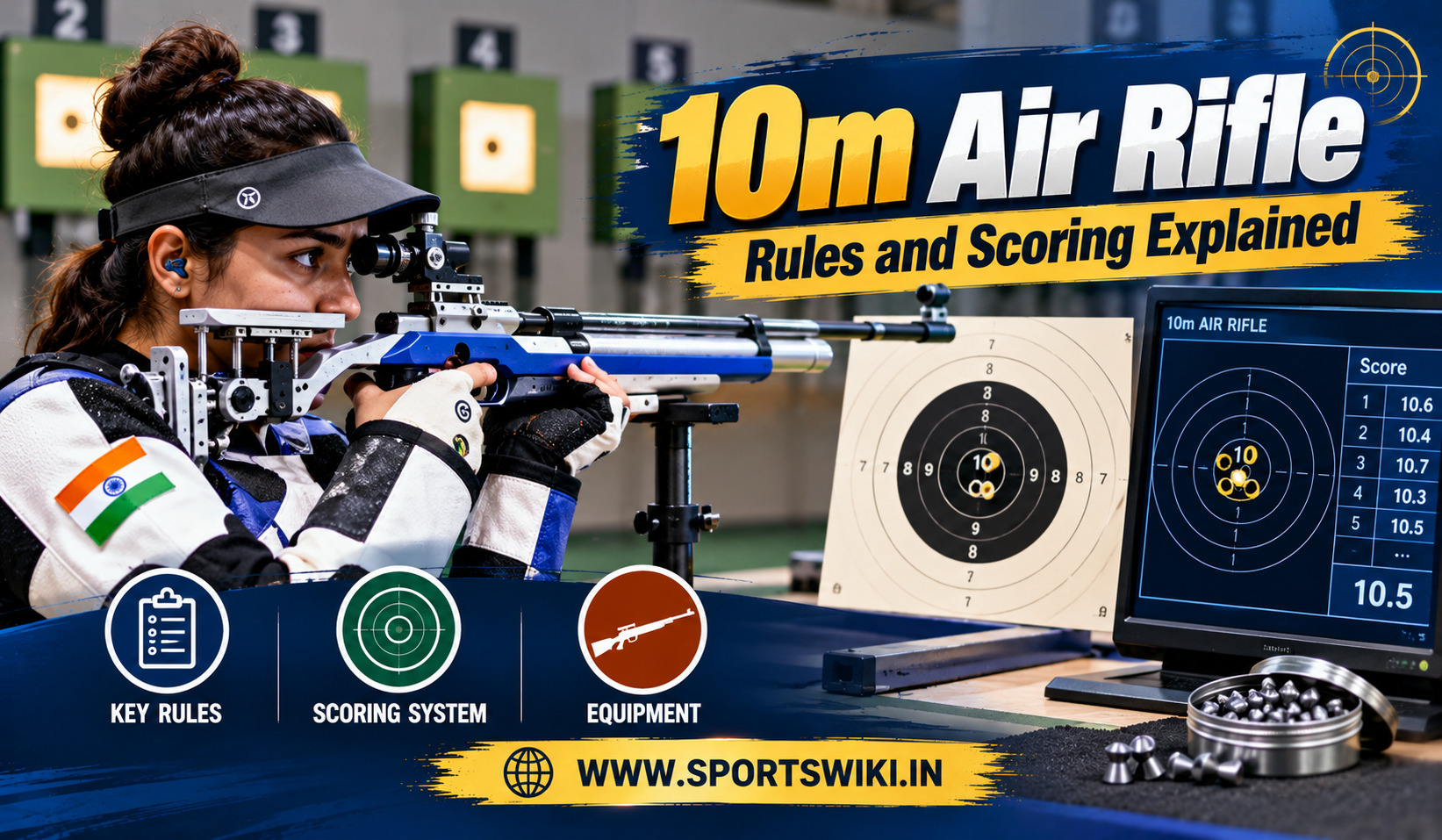
10m Air Rifle Rules and Scoring Explained
A perfect qualification score in 10m air rifle is 654.0. That’s 60 shots at 10.9 each, a near-impossible mark. Even so, elite shooters now score well above 630. At that level, a medal can turn on a tenth of a point.
The 10m air rifle rules look technical at first, but the idea is simple. Shooters fire at a tiny target from 10 metres, and every shot gets a decimal score. This guide explains the rifle, the target, the qualification round and the 24-shot final. You’ll also see why one shot can change the whole podium.
What 10m Air Rifle Rules Cover
The event is run by the International Shooting Sports Federation, or ISSF. Shooters stand and fire at a bullseye target 10 metres away. The rifle fires a 4.5 mm pellet, and its weight can’t go above 5.5 kg. Individual air rifle first appeared at the Olympics in Los Angeles in 1984, with separate rankings for men and women.
Since 2018, men and women follow the same format. Before that, women fired 40 shots in qualification, while men fired 60. Now both fire 60. That change makes the 10m air rifle rules equal across the board, and it gives the same maximum score of 654.0 for everyone.
The Rifle and the Pellet
Air rifles use compressed air, not gunpowder. A pre-charged cylinder or an external lever supplies the power. The pellets are match-grade and shaped like a small hourglass, which is why they’re called diabolo pellets. ISSF rules require non-magnifying diopter and globe sights, so shooters can’t use a telescope.
- Calibre: 4.5 mm (.177 inch)
- Maximum rifle weight: 5.5 kg
- Distance: 10 metres
- Position: standing
- Sights: non-magnifying diopter and globe
Because of these limits, the rifle itself doesn’t decide the winner. Most top shooters use very similar equipment. Instead, the edge comes from balance, breathing and a calm trigger finger.
The Target and Decimal Scoring
The target has ten rings, and the centre is tiny. The 10-ring is about half a millimetre wide, which is smaller than a pinhead. Electronic targets read each shot and report the score instantly. Major events, including the Olympics, use these systems.
Decimal scoring splits each ring into ten parts. A shot can score anything from 0.0 up to 10.9. Qualification now uses decimals too, so a 10.9 means a shot hit almost dead centre. As a result, ties are much rarer than they were under whole-number scoring.
The Qualification Round
Each shooter fires 60 shots in 75 minutes. That works out to about 75 seconds per shot, which sounds generous until nerves arrive. Shooters must also manage their rhythm and loading time. The highest possible score is 654.0.
The top eight shooters advance to the final. Everyone else is out, even if they missed by a tenth. Qualification scores don’t carry forward, so the final starts from zero. Because of this, a shooter who just scraped in has the same chance as the top seed.
The 24-Shot Final
The final has two stages, and the drama builds with each shot. Finalists shoot 24 shots in total, with a maximum score of 261.6. Every shot counts, since the scores start fresh.
The First Ten Shots
Shooters fire two series of five shots. Each series has a time limit of 250 seconds. Nobody is eliminated yet, so the aim is to build a cushion. Even so, a poor series can leave a shooter chasing the rest of the match.
The Elimination Phase
After the first ten shots, the final moves to single shots. Each shot has a limit of 50 seconds. The lowest-scoring shooter drops out after shot 12. After that, the lowest-ranked shooter is eliminated every two shots. The last two shooters fight for gold with shots 23 and 24.
That format is brutal and thrilling. A shooter can lead for most of the final and still lose on the last pair. Meanwhile, a shooter in sixth place can climb back with a few strong shots.
Time Limits and Conduct
Shooters must follow strict timing rules. Each shot has to be fired within the allowed period, and a late shot can lose its score. Range officers also check equipment before the event. They make sure the rifle weight, sights and clothing meet ISSF limits.
Clothing rules matter too. Shooting jackets and trousers can’t give an unfair support advantage. Shooters aren’t allowed to lean on anything or use a rest. As a result, the sport stays a pure test of balance and control. That fairness is why results are respected across the shooting world.
The Mixed Team Event
Mixed team air rifle pairs one man and one woman from the same country. Each shooter fires 30 shots, so the team fires 60 in total. The qualification format is similar to the individual event. Top teams then move into medal matches.
The mixed team event rewards balance. A strong partner can cover a weaker day, but both shooters need to be steady. Because of this, coaches often pick pairs who handle pressure in similar ways. It’s also one of the most watched events in shooting, since the scoring is easy to follow.
Why Decimals Decide Medals
Whole-number scoring used to create many ties. A shooter who landed a 10 anywhere inside the ring got the same score as one who hit dead centre. Decimals changed that. Now the shot nearest the middle gets the highest value, so close shots separate the field.
Consider two finalists on the last shot. One scores 10.3, and the other scores 10.7. That gap of 0.4 decides gold. Moments like that explain why shooters train for years on tiny details. Records reflect this precision, too. As of the Paris 2024 season, the men’s qualification record stood at 637.9 and the final record at 254.5, both held by China’s Sheng Lihao.
Famous Indian Moments in Air Rifle
India’s best-known air rifle moment came at Beijing 2008. Abhinav Bindra won the 10m air rifle title there, which became India’s first individual Olympic gold. His win put air rifle on the map for Indian fans. Since then, the event has grown into one of the most followed in the country.
More recently, Indian shooters have been regular medal contenders at the Asian Games. At the 2026 Games in Aichi-Nagoya, Elavenil Valarivan won silver in the women’s 10m air rifle. Himanshu Dhillon took silver and Rudrankksh Patil won bronze in the men’s event. You can read the full story in our look at Indian shooters at the Asian Games.
How Air Rifle Compares With Other Precision Sports
Air rifle shares one thing with archery: both punish small errors. Archers shoot at a 12.2-centimetre gold ring from 70 metres. Air rifle shooters aim at a dot smaller than a grain of rice from 10 metres. Still, the two sports use different scoring. Our guide to Olympic archery rules explains the set system, while air rifle sticks to straight totals.
Bow sports also split into styles. Recurve and compound archers use different gear and formats, and our comparison of recurve vs compound archery covers that. Air rifle has no such split, which keeps the event simple to follow.
Common Mistakes New Fans Make
Newcomers often misread the scoreboard. A few quick fixes make it easier to follow.
- Thinking 10 is the top score: decimals run up to 10.9 on each shot.
- Assuming qualification scores carry over: the final starts again from zero.
- Expecting the leader to stay safe: an elimination can end a lead in two shots.
Once you know these points, the live scores make sense. You’ll see why a shooter on 10.2 is happy and one on 9.8 is worried. In short, every tenth of a point tells a story.
Key Takeaways
- Distance and calibre: shooters fire a 4.5 mm pellet at a target 10 metres away.
- Qualification: 60 shots in 75 minutes, with a maximum score of 654.0.
- Final: 24 shots, with a maximum score of 261.6, starting from zero.
- Elimination: the lowest shooter drops out after shot 12 and then every two shots.
- Scoring: decimals up to 10.9 per shot decide the closest results.
FAQs
How many shots are in a 10m air rifle final?
The final has 24 shots, starting with two five-shot series.
What is the maximum score in 10m air rifle qualification?
The maximum is 654.0, from 60 shots at 10.9 each.
How big is the 10m air rifle bullseye?
The 10-ring is roughly half a millimetre wide.
Do qualification scores carry into the final?
No, finalists start again from zero.
Who won India’s first individual Olympic gold in air rifle?
Abhinav Bindra won the 10m air rifle gold at Beijing 2008.
Conclusion
The 10m air rifle rules reward patience, balance and nerve. Shooters fire 60 qualification shots, and the top eight move into a 24-shot final that starts from zero. Decimal scores up to 10.9 make every shot count, and eliminations raise the pressure every two shots. Once you know the format, a medal race becomes easy to read, and every tenth of a point feels important.