Grand Slam Record vs Titles: True Tennis Dominance
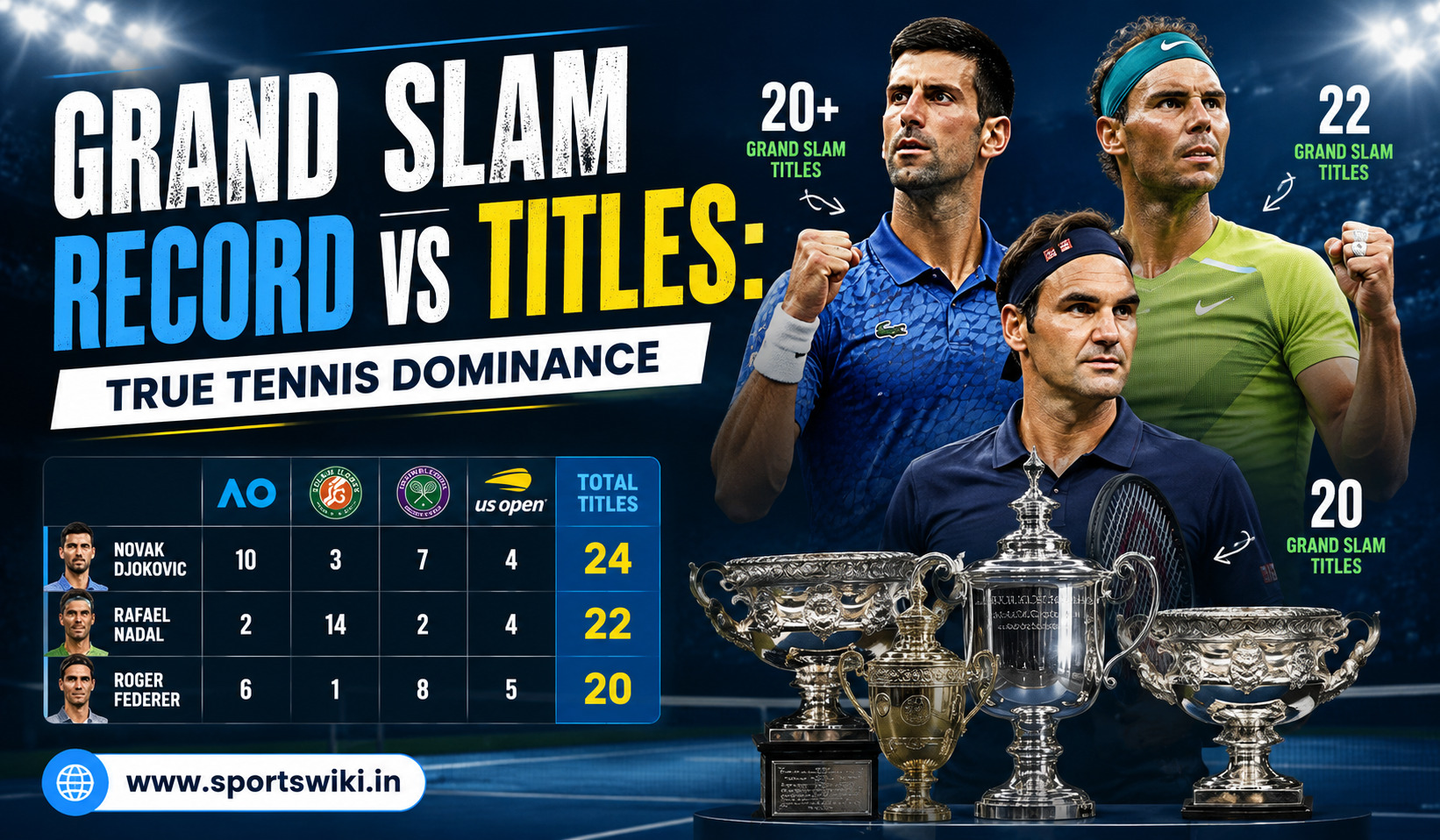
Novak Djokovic has won 24 Grand Slam titles. Jimmy Connors won 109 ATP career titles. Ask ten fans which number matters more and you will get ten different answers, and honestly, that argument is not going away anytime soon.
The Grand Slam record has become the default shorthand for greatness in men’s and women’s tennis. Every time a player closes in on a major final, commentators start doing the math out loud, comparing them to Federer, Nadal, Serena, or Court. But total career titles tell a different story, one about consistency, longevity, and grinding through 250-level events in cities nobody remembers the following year. Both numbers matter. They just measure different things, and mixing them up leads to some pretty lazy GOAT arguments.
Why The Grand Slam Record Gets All The Attention
Grand Slams are the four tournaments everyone actually watches: the Australian Open, French Open, Wimbledon, and US Open. They are best-of-five for the men, two weeks long, played in front of packed stadiums, and broadcast globally in a way a Tuesday match at the Swiss Indoors never will be.
That visibility is exactly why the Grand Slam record dominates casual conversation. A player could win 40 smaller titles and still lose the narrative battle to someone with 20 majors and nothing else. It is not fair, exactly, but it is how the sport gets remembered.
The Physical And Mental Toll
Winning a major means surviving seven best-of-five matches back to back, often against players who have been building their whole season around peaking for that one fortnight. Rafael Nadal’s 14 French Open titles are the clearest example of what specialized dominance looks like. He did not just beat clay-court specialists occasionally, he beat them almost every single time, for close to two decades, on the sport’s most physically punishing surface.
That is a different kind of pressure than showing up at a smaller event where the draw is thinner and the crowd is a fraction of the size.
Total Titles: The Quiet Measure Of Consistency
Here is where things get interesting. Total career titles reward a player for showing up week after week, year after year, and actually winning, not just competing. Federer finished his career with 103 ATP titles. Nadal sits at 92. Djokovic has been chasing that same territory for years, though the exact live number is worth double-checking before you print it, since these totals move every few weeks during an active season.
Jimmy Connors still holds the all-time men’s record with 109 titles, a number from a different tennis era entirely, when the calendar was packed with more smaller events and players competed far more often per season than they do today. Comparing Connors directly to a modern player is a bit like comparing a boxer from the 1970s who fought 20 times a year to a modern champion who fights three times a year. The eras simply do not play by the same schedule.
What Total Titles Actually Reward
Total titles measure things a Grand Slam count cannot:
- Durability across different surfaces, climates, and tournament levels
- Week-to-week motivation, since smaller titles do not carry the same prestige or prize money
- Adaptability, because a player racking up titles on hard court, clay, and grass has to keep adjusting their game constantly
- Depth of dominance, beating not just the best four or five rivals in a major final, but a rotating cast of dangerous floaters in smaller draws
A player who wins 90-plus titles has proven they can beat good players on a random Thursday in a half-empty arena, not just when the whole tennis world is watching.
Comparing Eras: Why Raw Numbers Lie A Little
Margaret Court’s 24 Grand Slam singles titles stood as the all-time record for decades before Djokovic matched it in 2023 and moved past it in 2024. But a meaningful chunk of Court’s total came from the Australian Open in the 1960s and early 1970s, when the field was thinner and travel made it harder for international stars to make the trip. That does not erase her achievement, but it does mean stacking her total directly next to Serena Williams’ 23 majors, earned against a truly global, professionalized tour, requires some context.
Same logic applies on the men’s side. Comparing Connors’ title count from an era with a denser tournament calendar to a modern player competing in a leaner, more physically demanding season is not really an apples-to-apples exercise.
This is the trap a lot of fans fall into. Raw numbers feel objective, but tennis has changed enough across decades that the same number means different things depending on when it was earned.
Badminton Offers A Useful Parallel
Tennis is not the only racket sport wrestling with this exact debate. In badminton, Lin Dan’s Olympic and World Championship record gets weighed constantly against players who racked up more Super Series and World Tour titles but never quite matched his big-stage résumé. The same tension exists: peak-moment brilliance versus sustained weekly output. If you follow both sports, the parallel is almost uncanny, and it suggests this is not just a tennis quirk, it is a pattern across any sport with a tiered tournament structure.
The GOAT Debate: Why Neither Number Settles It Alone
Anyone claiming the Grand Slam record alone settles the greatest of all time debate is ignoring half the picture. Anyone claiming total titles settles it is doing the same thing from the other direction.
Federer’s case leans heavily on longevity, five straight Wimbledon titles from 2003 to 2007, a level of shot-making that redefined what elegant tennis could look like, and a title count that stayed near the top for nearly two decades. Nadal’s case leans on unmatched dominance on one surface and a fighting spirit that turned five-set matches into personal statements. Djokovic’s case leans on head-to-head records against both of them, the most weeks at world number one, and now the outright Grand Slam lead.
None of those cases work using a single stat. They all need context, era, surface, rivals beaten, and yes, total titles, layered together.
A Simple Way To Think About It
Picture two chefs. One has three Michelin stars at one restaurant and nothing else. The other runs six solid, well-reviewed restaurants across the city without ever hitting three stars. Who is the better chef? It genuinely depends what you value, peak brilliance under the harshest possible judging, or proven ability to deliver quality consistently across very different kitchens. Tennis dominance works the same way.
What This Means For Fans And Fantasy Players
For fans building narratives around tennis dominance, it helps to track both numbers side by side rather than picking one and ignoring the other. For fantasy tennis players specifically, total titles and current form often matter more week to week than career Grand Slam counts, since fantasy scoring rewards consistent output across the whole calendar, not just four marquee events.
A few things worth tracking if you want the fuller picture:
- Grand Slam finals reached, not just won, since that shows sustained peak performance
- Title conversion rate at smaller events, since some players are notoriously bad at closing out finals
- Head-to-head records against era-defining rivals
- Performance across all four surfaces, not just their strongest one
FAQ
Does winning more Grand Slams automatically make a player the greatest of all time?
Not automatically. It is the single most visible stat, but era, competition depth, and total career titles all factor into a fair GOAT comparison.
Who holds the most career titles in men’s tennis history?
Jimmy Connors holds the all-time record with 109 titles, a mark set across a much busier tournament calendar than today’s tour.
Is the Grand Slam record more important in women’s tennis than men’s?
It carries similar weight, though Margaret Court’s era-specific total makes direct comparisons to modern players like Serena Williams more complicated than a simple number-versus-number look.
How does badminton handle a similar debate?
Badminton fans often weigh Olympic and World Championship success against total Super Series and World Tour titles, mirroring the same peak-versus-consistency argument seen in tennis.