History of Tennis: From Royal Courts to Grand Slams
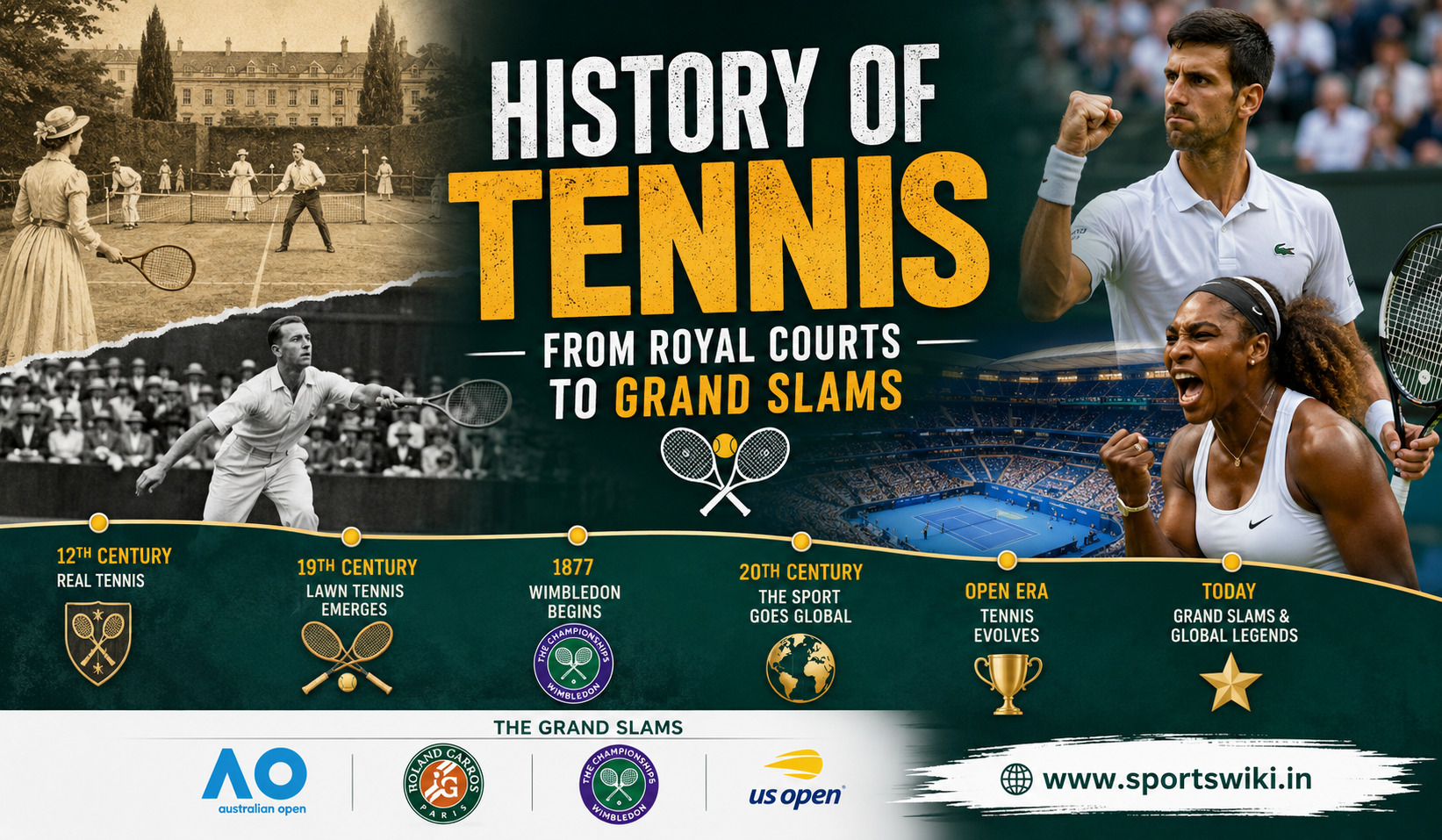
Before there were baseline rallies and 140-mile-per-hour serves, tennis was played indoors by French monks who hit a ball with the palm of their hand. That game had almost nothing in common with what Novak Djokovic or Iga Swiatek play today, yet the entire history of tennis traces back to it. Understanding how the sport got from a monastery courtyard to Centre Court says a lot about why the modern game looks the way it does.
The Origins: Jeu de Paume and Royal Courts
Tennis’s earliest known ancestor is jeu de paume, French for “game of the palm,” played in monastery courtyards as far back as the 12th century. Players struck the ball with their bare hand across a rope or net strung between walls. It eventually became popular among French nobility, who built indoor courts specifically for the game, and gloves gradually gave way to wooden paddles, which then evolved into strung rackets.
By the 16th century, jeu de paume had spread through European royal courts, including England, where it became known as real tennis, sometimes called royal tennis. Henry VIII was reportedly an enthusiastic player, and several real tennis courts from that era still exist and remain in use today. This version of the game, however, was played indoors on an oddly shaped court with walls in play, nothing like the open rectangular court most fans recognize now.
The Birth of Lawn Tennis
The version of tennis played today owes its existence to a British army officer, not a royal court.
Major Wingfield’s Patent
In 1873, Major Walter Clopton Wingfield introduced a new outdoor game he called sphairistike, later shortened to lawn tennis, and patented it the following year. His version was played on a grass court shaped like an hourglass, narrower at the net than at the baselines, and used rules that borrowed heavily from real tennis and badminton, sports that were already established in Victorian England.
Standardizing the Rules
Wingfield’s court shape and scoring quickly got refined by clubs and associations eager to formalize the game. The All England Croquet Club in Wimbledon added lawn tennis courts in 1875, and within a couple of years the rectangular court shape still used today had replaced Wingfield’s original hourglass design. This standardization mattered enormously, because it meant clubs across the country, and eventually across the world, were finally playing by the same rules.
The Grand Slam Tournaments Take Shape
Once the rules stabilized, the sport needed marquee events to grow around, and those events still anchor the calendar more than a century later.
Wimbledon Leads the Way
The All England Club hosted the first Wimbledon Championships in 1877, making it the oldest tennis tournament in the world. The inaugural event featured only a men’s singles draw and was played on grass, a surface choice that remains Wimbledon’s defining identity even now, in a sport where most other major tournaments have long since moved to hard courts or clay.
The US, France, and Australia Follow
The US National Championships, now known as the US Open, began in 1881. The Australian Championships followed in 1905, and the French Championships trace back to 1891, though that event was originally open only to French club members before eventually opening to international players and later moving to the Stade Roland Garros in 1928. Together, these four tournaments eventually became known as the Grand Slam events, the sport’s most prestigious prizes, though the term “Grand Slam” itself only gained widespread use decades later.
The Open Era Changes Everything
For most of the 20th century, tennis had a strange divide that shaped who could actually compete at the biggest events.
Amateurs Versus Professionals
Grand Slam tournaments were restricted to amateur players for decades, while a separate professional circuit existed for players who earned money from the sport. This split meant some of the best players in the world, once they turned professional, were barred from competing at Wimbledon or the US Championships, which created an odd gap between “amateur champion” and “best player alive.”
1968 and the Start of the Open Era
That divide finally ended in 1968, when the Grand Slam tournaments opened their draws to both amateurs and professionals, marking the beginning of what is now called the Open Era. This single change reshaped the sport’s competitive landscape, allowing every top player to compete against every other top player at the events that actually mattered most. Rod Laver, who had already won a calendar-year Grand Slam as an amateur in 1962, went on to repeat that feat in 1969 during the Open Era, a double achievement no other man has managed since.
Key Milestones That Shaped Modern Tennis
A handful of moments after the Open Era began had an outsized effect on how the sport looks and feels today.
- Billie Jean King’s advocacy led to the founding of the WTA in 1973 and helped push for equal prize money at Grand Slam events, a fight that continued for decades afterward at individual tournaments.
- The tie-break was introduced at major tournaments in the early 1970s, ending marathon sets and giving matches a more predictable structure for both players and broadcasters.
- Equipment changes, particularly the shift from wooden rackets to graphite composites through the 1970s and 1980s, dramatically increased power and changed playing styles across the sport.
- Television coverage expanded the sport’s global audience from the 1970s onward, turning stars like Björn Borg, John McEnroe, and later Steffi Graf into household names well beyond tennis’s traditional fan base.
FAQ: History of Tennis
What is the oldest tennis tournament in the world?
Wimbledon, first held in 1877 by the All England Club, holds that distinction and remains the only Grand Slam tournament still played on grass.
Who invented modern lawn tennis?
Major Walter Clopton Wingfield introduced the game in 1873 under the name sphairistike, later shortened to lawn tennis, and patented the rules the following year.
What was the Open Era and why did it matter?
Starting in 1968, the Open Era allowed both amateur and professional players to compete in Grand Slam tournaments together, ending a divide that had previously kept many of the sport’s best players out of its biggest events.
Where did tennis originally come from?
Tennis traces back to jeu de paume, a handball-style game played in French monasteries as early as the 12th century, which later evolved into real tennis among European royalty before eventually developing into modern lawn tennis in the 1870s.