Clay vs Grass vs Hard Court Tennis: How Surfaces Change the Game
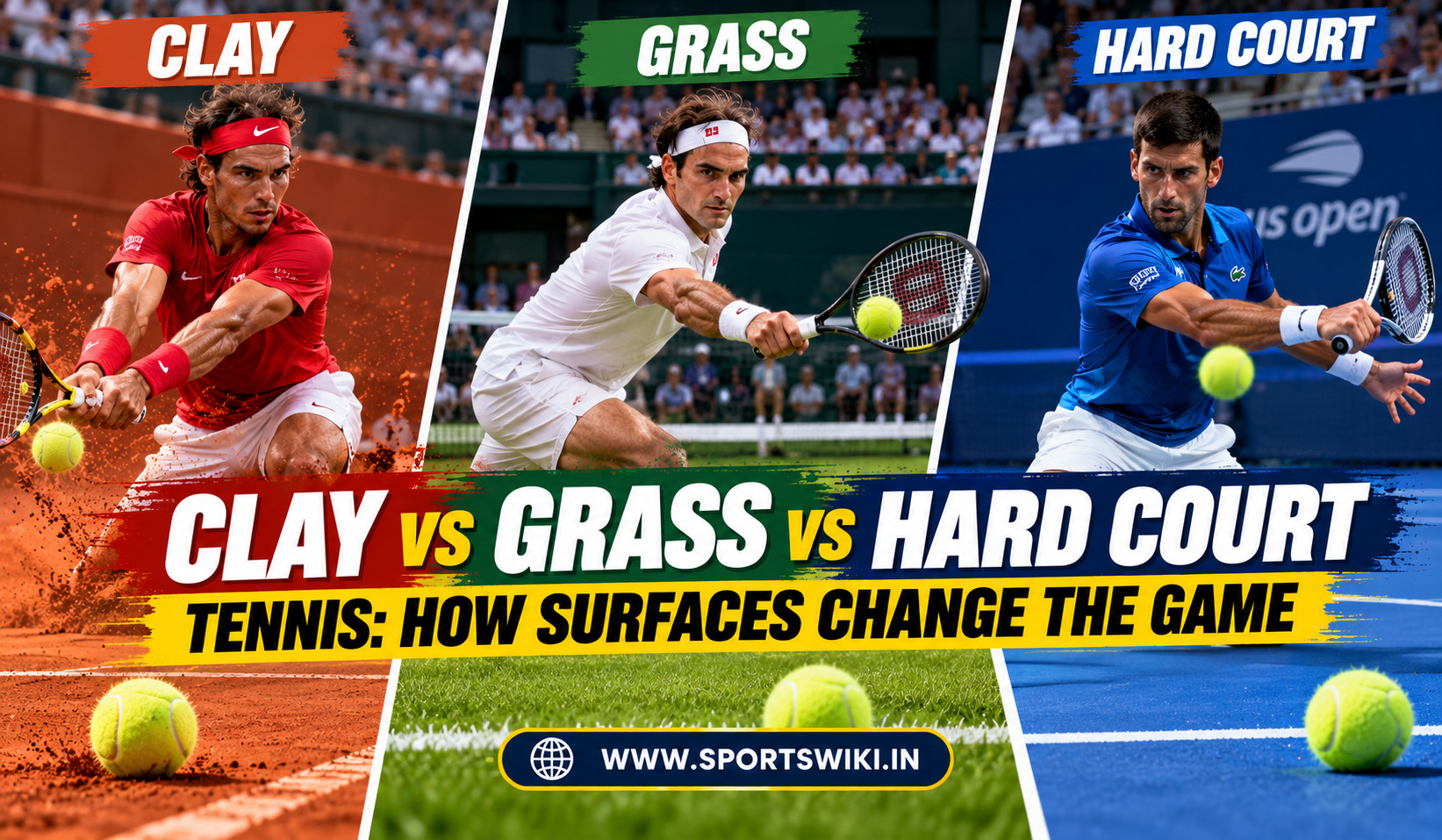
Consider this: Rafael Nadal won the French Open 14 times. Pete Sampras won 14 Grand Slam titles but never the French Open. Yet that gap isn’t luck. Instead, it comes from the surface under the players’ feet. So how does clay vs grass vs hard court tennis differ, and why do champions rise with the court? Here’s a clear guide to speed, bounce and style.
Clay vs Grass vs Hard Court: The Big Picture
First, tennis is played on three main surfaces at the top level. Clay is the slowest, while grass is the fastest. Meanwhile, hard courts sit in the middle, with a high and steady bounce. Because the ball behaves differently on each one, players must change their game from week to week.
Meanwhile, the International Tennis Federation rates court speed in five categories. They run from slow to fast, so every court can be placed on a scale. Because of that scale, most artificial courts sit between categories two and four. Even so, perceived speed also depends on balls, weather and wear. So the clay vs grass vs hard court debate is never just about the material.
Clay Courts: Slow Pace and High Bounce
How Clay Plays
First, clay courts are made from crushed brick, shale or stone. Because the surface grips the ball, it slows the ball down. As a result, the ball bounces high, and rallies last longer. Meanwhile, players slide into shots, which calls for special shoes and good footwork. Meanwhile, the soft surface absorbs more shock, so movement feels easier on the body.
Big hitters often struggle here, because their power fades. By contrast, players with heavy topspin and strong stamina thrive. That’s why Nadal, who won 14 of his 22 majors at Roland Garros, became known as the King of Clay. Another reason is patience, since clay rewards players who construct points rather than end them in two shots.
Where Clay Matters
Notably, the French Open is the only Grand Slam played on clay. It has used clay since 1928. Many top events in Europe also use it in the spring, so the clay season leads into Roland Garros. Meanwhile, green clay, also called Har-Tru, is a faster variant that’s common in the United States.
Grass Courts: Fast, Low and Unpredictable
How Grass Plays
Meanwhile, grass is the oldest surface in tennis. In fact, Major Walter Clopton Wingfield invented a version of lawn tennis around 1873 and 1874. It was played on grass. Today, the ball skids on grass, so it stays low and moves fast. Because the bounce can vary, players need quick reactions. In other words, even a small error in footwork can cost a point.
For years, serve-and-volley stars such as Pete Sampras and John McEnroe excelled here. Meanwhile, Roger Federer won eight Wimbledon titles, and Martina Navratilova won nine. In addition, players with flat, penetrating shots also gain an edge. Because the ball sits low, slice shots can stay hard to attack.
Wimbledon’s Special Place
Wimbledon is the only Grand Slam still played on grass. Since it began in 1877, it’s the oldest tennis tournament in the world. Also, players must wear completely flat-soled shoes to protect the lawn. Then, in the early 2000s, Wimbledon changed its grass mix to 100% perennial ryegrass, which changed how players moved. Weather also plays a role, since the pace shifts with rain and wear.
Hard Courts: The Balanced Surface
Meanwhile, hard courts are built from asphalt or concrete with an acrylic top layer. Because they’re the most common surface in the world, they sit between clay and grass in speed. Even so, the bounce is high and consistent. So shots are easier to predict than on grass, and they run faster than on clay.
Notably, two Grand Slams use this surface. In fact, the US Open moved to hard courts in 1978, and the Australian Open followed in 1988. Because both events start and finish the Grand Slam year, hard courts shape much of the season. Likewise, indoor hard courts host the ATP Finals in Turin. For more on that event, see our guide to the ATP Finals 2026.
For instance, Novak Djokovic has won 10 Australian Open titles. That shows how well a complete game works here. Meanwhile, all-court players with strong serves and solid returns do best. So that balance explains why hard-court specialists are rare, since the surface suits almost every style.
Clay vs Grass vs Hard Court: Speed and Bounce at a Glance
Still, comparing the three side by side helps. Here’s how clay vs grass vs hard court tennis breaks down.
- Clay: slowest speed, highest bounce, long rallies
- Grass: fastest speed, lowest bounce, short points
- Hard: medium to fast speed, high and consistent bounce
Because of these differences, coaches build plans around the court. For example, a player may add topspin for clay and flatter shots for grass. Meanwhile, hard courts suit players who mix both. So understanding clay vs grass vs hard court tennis gives you a clear view of why styles clash.
Why Clay vs Grass vs Hard Court Changes the Ball
The material under the ball explains most of the gap. Clay absorbs energy, so the ball slows after it lands and then jumps high. Grass is soft and slippery, so the ball skids low and fast. Meanwhile, hard courts have a firm acrylic layer on top of concrete or asphalt, so little energy is lost. As a result, the ball bounces high and keeps its pace.
Conditions matter too. Heat makes the ball fly faster, while damp air slows it down. Because balls wear as a match goes on, the pace changes from set to set. Some players also say balls matter more than courts when it comes to speed. So the clay vs grass vs hard court question always has a few moving parts.
Famous Players in the Clay vs Grass vs Hard Court Debate
History gives plenty of examples. Nadal is the clay giant, while Gustavo Kuerten also built his name on that surface. On grass, Federer and Sampras ruled Wimbledon for years. Meanwhile, Djokovic proved that one player can win big on every surface. He owns 24 majors in total.
Sampras shows the other side of the story. Because his game relied on speed, he never won the French Open despite 14 majors overall. In contrast, a heavy-topspin player may find grass harder. So specialists often come from the style they play, not just the surface they like.
How Players Adapt in Clay vs Grass vs Hard Court Swings
Because of that, the calendar forces fast change. After the French Open on clay, players move to grass within a few weeks. So that switch is among the most demanding in the sport. Then, after Wimbledon, the tour heads to North America for the hard-court summer, which ends with the US Open.
However, modern tennis has also become more uniform. Today, most players use aggressive baseline tactics on every surface. Still, the surface can change the details. For instance, a heavy topspin forehand works better on clay, while a big serve gains value on grass. So even in a more uniform game, the court still matters.
Clay vs Grass vs Hard Court in the 2026 Season
Meanwhile, this year offers a neat example. First, Alexander Zverev won the French Open on clay and the US Open on hard courts. Then Jannik Sinner won Wimbledon on grass, while Carlos Alcaraz won the Australian Open on hard courts. So three different men took the four majors, and each surface produced a different winner.
Meanwhile, Alcaraz missed two majors through injury, which also shaped the season. Even so, the results show how a varied calendar rewards versatility. For the full list of 2026 champions, read our guide to Grand Slam tournaments. Together, those results show how clay vs grass vs hard court tennis shapes every title race.
Court Speed and Scoring
In addition, surface affects how scores read. On fast courts, servers hold more often, so sets can reach tie-breaks. On slow courts, rallies run long, so breaks of serve are more common. To see how sets and tie-breaks work, read our explainer on tennis scoring. Because the same rules apply everywhere, the court tells the story behind the numbers.
Key Takeaways
- Clay: Slowest surface, high bounce, used at the French Open since 1928.
- Grass: Fastest surface, low bounce, used only at Wimbledon among the majors.
- Hard court: Balanced speed and a consistent bounce, used at the Australian and US Opens.
- Records: Nadal won 14 French Opens, and Federer won eight Wimbledons.
- Big picture: Clay vs grass vs hard court tennis explains why styles and champions differ.
- 2026: Zverev, Alcaraz and Sinner split the men’s majors across three surfaces.
FAQs
Which tennis surface is the slowest?
Clay is the slowest surface, and it also produces a high bounce.
Which Grand Slam is played on grass?
Wimbledon is the only Grand Slam still played on grass.
Which Grand Slams are played on hard courts?
The Australian Open and the US Open are both played on hard courts.
Why did Pete Sampras never win the French Open?
His serve-and-volley style didn’t translate well to the slow, high-bouncing clay.
What is Har-Tru?
Har-Tru is a type of green clay that plays faster than European red clay.
Conclusion
In short, the court changes everything in tennis. Because clay slows the ball, grass speeds it up and hard courts balance the two, each title feels different. That’s why clay vs grass vs hard court tennis matters so much for fans and players alike. Next time you watch a major, check the surface first, and the style of play will make more sense. Because every court rewards different skills, the best players learn to adjust. In the end, the clay vs grass vs hard court contrast is what keeps the tennis year fresh.