Tennis Scoring Explained: Love, Deuce, Tie-Break and Advantage
Back in 2010, John Isner beat Nicolas Mahut 70-68 in the final set at Wimbledon. In total, the match lasted 11 hours and 5 minutes across three days. Because of that marathon, tennis scoring changed for good. Still, the system looks strange to new fans. So why does a game go 15, 30, 40? And what does love mean? When does a tie-break begin? Here’s a simple guide to tennis scoring, step by step.
Tennis Scoring Basics: Points, Games and Sets
First, tennis scoring works in three layers. Because players win points, points build games, and games build sets, the system stacks up neatly. Then sets decide the match. So every rally matters, but only a few matter most. Once you see the layers, the numbers start to make sense.
How Points Are Called
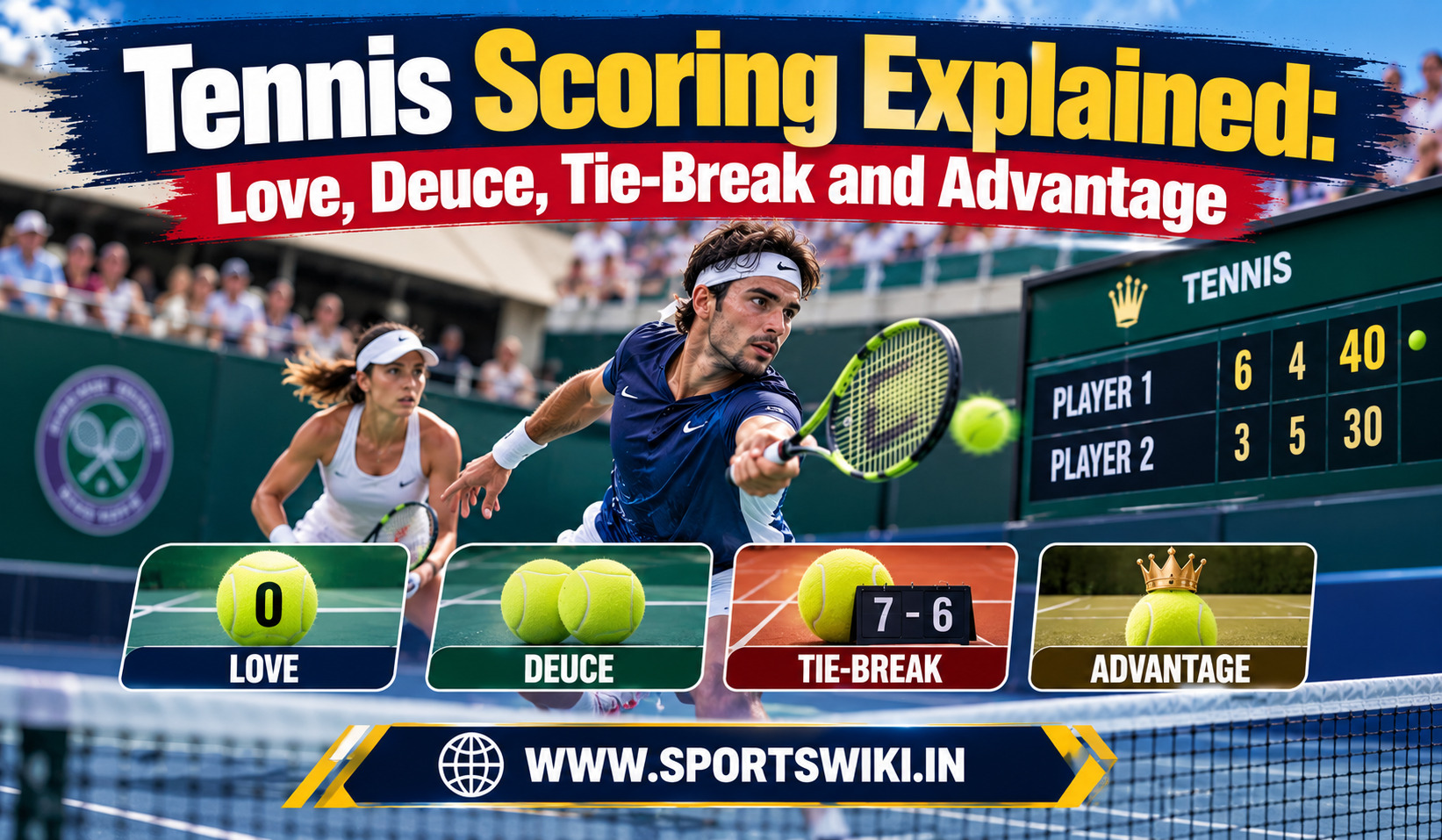
Meanwhile, a game uses an odd count. The first point is 15, the second is 30, and the third is 40. Then the fourth point wins the game. Meanwhile, a score of zero is called love. So a player who leads 30-0 is said to lead “thirty love”. Also, the server’s score is always called first.
So where did the odd numbers come from? Still, one popular theory points to medieval clock faces, where each point moved the hand by 15 minutes. Later, 45 shrank to 40 in speech. Nobody can prove the story, so treat it as a theory. As for love, its origin is also debated.
Deuce and Advantage
However, winning four points isn’t always enough. Because a player must also lead by two points, games can stretch out. So if both players reach 40-40, the score is called deuce. From deuce, the next point gives one player the advantage. Then, if that player wins the following point, the game ends.
If the other player wins instead, the score returns to deuce. Of course, that cycle can repeat many times. So a single game can last a long while. Meanwhile, the server holds “ad-in” if he wins the deuce point, and the returner holds “ad-out” if she wins it. These terms help fans follow tennis scoring on a live scoreboard.
How a Set Works in Tennis Scoring
Next, a set is a race to six games. However, the winner must lead by two games, so 6-4 wins but 6-5 doesn’t. So if the set reaches 6-5, play continues. Then a 7-5 result ends it. At 6-6, a tie-break usually decides the set, and a typical score line then reads 7-6.
That’s why you see scores like 7-6(4). Here, the number in brackets is the loser’s points in the tie-break. Because of that detail, you can tell how close the breaker was. For instance, in the 2025 ATP Finals final, Jannik Sinner beat Carlos Alcaraz 7-6(4), 7-5. So Sinner won the first set in a tie-break, and he took the second with a 7-5 finish.
The Tie-Break Explained
Meanwhile, a tie-break is a mini game played at 6-6. First, players count points as 1, 2, 3 and so on, not 15, 30, 40. The first player to reach seven points wins it, but only with a two-point lead. So 7-5 ends it, while 7-6 doesn’t. Instead, play goes on until one player leads by two.
Also, serving changes in a tie-break. So one player serves the first point. After that, the opponent serves the next two points, and the players then swap every two points. Because they also change ends of the court after every six points, the tie-break feels like its own short match. Because of that rhythm, extra tension builds to tennis scoring.
The 10-Point Tie-Break
Meanwhile, a longer version exists too. It uses the same rules as the seven-point breaker, but the first player to reach 10 points wins. Again, a two-point lead is required. In doubles at the Olympics, for instance, a 10-point tie-break replaces a deciding third set. So you may meet this format in several places.
Best of Three or Best of Five Sets
Finally, matches are decided in sets. So most women’s matches and many men’s events use a best-of-three format. The first player to win two sets takes the match. By contrast, men’s singles at Grand Slam tournaments use best-of-five. In that format, a player needs three sets. For more on those events, see our guide to Grand Slam tournaments.
Because five sets can take hours, stamina matters. Even so, many fans love the drama of a long match. Meanwhile, the ATP Finals use a best-of-three format, so matches there move faster. To see how that event is organised, read our look at the ATP Finals 2026.
How the Final Set Rule Changed
The final set has caused the most debate. Historically, each Grand Slam handled it differently. Wimbledon played a tie-break at 12-12. Meanwhile, the US Open used a regular seven-point breaker at 6-6. Likewise, the Australian Open used a 10-point breaker at 6-6. The French Open had no tie-break at all, so the set simply continued until one player led by two games.
Then came the Isner and Mahut match. Isner won the fifth set 70-68, and the length of that set pushed leaders to act. In March 2022, the Grand Slam Board announced one rule for all four majors. At 6-6 in the final set, players now play a 10-point tie-break. The winner must lead by two or more points. As a result, tennis scoring at the majors is much more consistent.
Key Scoring Terms Every Fan Should Know
Commentators use plenty of shorthand. Because those words come up in every match, a short list helps. Here are the most common ones.
- Ace: A serve the returner can’t touch.
- Break point: A point that lets the returner win the server’s game.
- Hold: A game won by the server.
- Break: A game won by the returner.
- Set point and match point: A point that wins the set or the match.
Break points matter most because serving is such an advantage. Since the server controls the start of each rally, holding serve is the default result. So when a returner wins one game, the set often swings. That’s why a single break can decide 6-4.
Why Tennis Scoring Creates Pressure
Unlike many sports, tennis has no clock. Instead, the scoreboard ends the match, and a player can trail for most of it and still win. Because points aren’t equal, a player can win more points and still lose. For instance, a few big points at 30-40 or in a tie-break can outweigh many easy ones.
That uneven weight is what makes tennis scoring so tense. Meanwhile, players often talk about “big points” for this reason. A break point or set point carries more weight than a routine point at 15-all. As a result, mental strength becomes as important as skill.
Tennis Scoring on Different Surfaces
The scoring rules stay the same on every court. However, the surface changes how long games and sets last. On fast courts, serves win more points, so holds come quickly. On slow courts, rallies run longer, so breaks happen more often. For a deeper look, see our guide to clay vs grass vs hard court tennis.
So the same score line can tell different stories. A 6-4 set on grass may come from a few lucky breaks. Meanwhile, a 6-4 set on clay may reflect long, tough rallies. Because the rules don’t change, the context does the work.
A Quick Example of Tennis Scoring
Imagine a game between a server and a returner. The server wins the first two points, so the score is 30-love. Then the returner wins two points, so it becomes 30-all. The server wins the next point to lead 40-30. Finally, the returner wins the next point, and the game reaches deuce.
From there, either player needs two clear points. If the server wins the next point, he holds advantage. If he wins another, he takes the game. Because the same pattern repeats in every game, the whole match becomes easy to follow. Now apply that pattern to sets, and you can read any scoreboard. Even better, the same logic works for singles and doubles, so you can follow every match on tour. In short, tennis scoring rewards patience, because every point is a small step toward the next game.
Key Takeaways
- Points: A game goes love, 15, 30, 40, then game.
- Deuce: At 40-40, a player must win two points in a row.
- Sets: A set goes to six games with a two-game lead, or a tie-break at 6-6.
- Tie-break: The first to seven points wins, with a two-point lead.
- Final sets: Since 2022, all four majors use a 10-point tie-break at 6-6.
FAQs
What does love mean in tennis scoring?
Love means zero points, so 30-love means the server has 30 and the opponent has none.
What is deuce in tennis?
Deuce is a score of 40-40, so a player must then win two points in a row.
When does a tie-break start?
A tie-break starts when a set reaches 6-6.
How many points win a tie-break?
The first player to reach seven points wins, as long as he or she leads by two.
Why did Grand Slams change the final-set rule?
Leaders wanted consistent rules after matches like Isner and Mahut’s 70-68 final set in 2010.
Conclusion
Tennis scoring looks odd at first, but its logic is simple. Points build games, games build sets, and sets decide the match. Deuce, advantage and tie-breaks add drama, while the 2022 rule change made finals more consistent. Next time you watch a match, follow the layers one by one, and the numbers will click. Once you do, tennis scoring becomes part of the fun.