Evolution of Badminton: Ancient Origins to Modern Rackets
A shuttlecock flying off a stringed frame can reach recorded speeds over 400 kilometers per hour, making badminton history a narrative of rapid acceleration and precise craft. What began as a simple backyard pastime played with wooden paddles has transformed into a high-intensity sport demanding incredible endurance, strategic foresight, and lightning reflexes. Understanding this evolution reveals how a traditional game grew into an international phenomenon.
The Earliest Origins of Shuttlecock Games
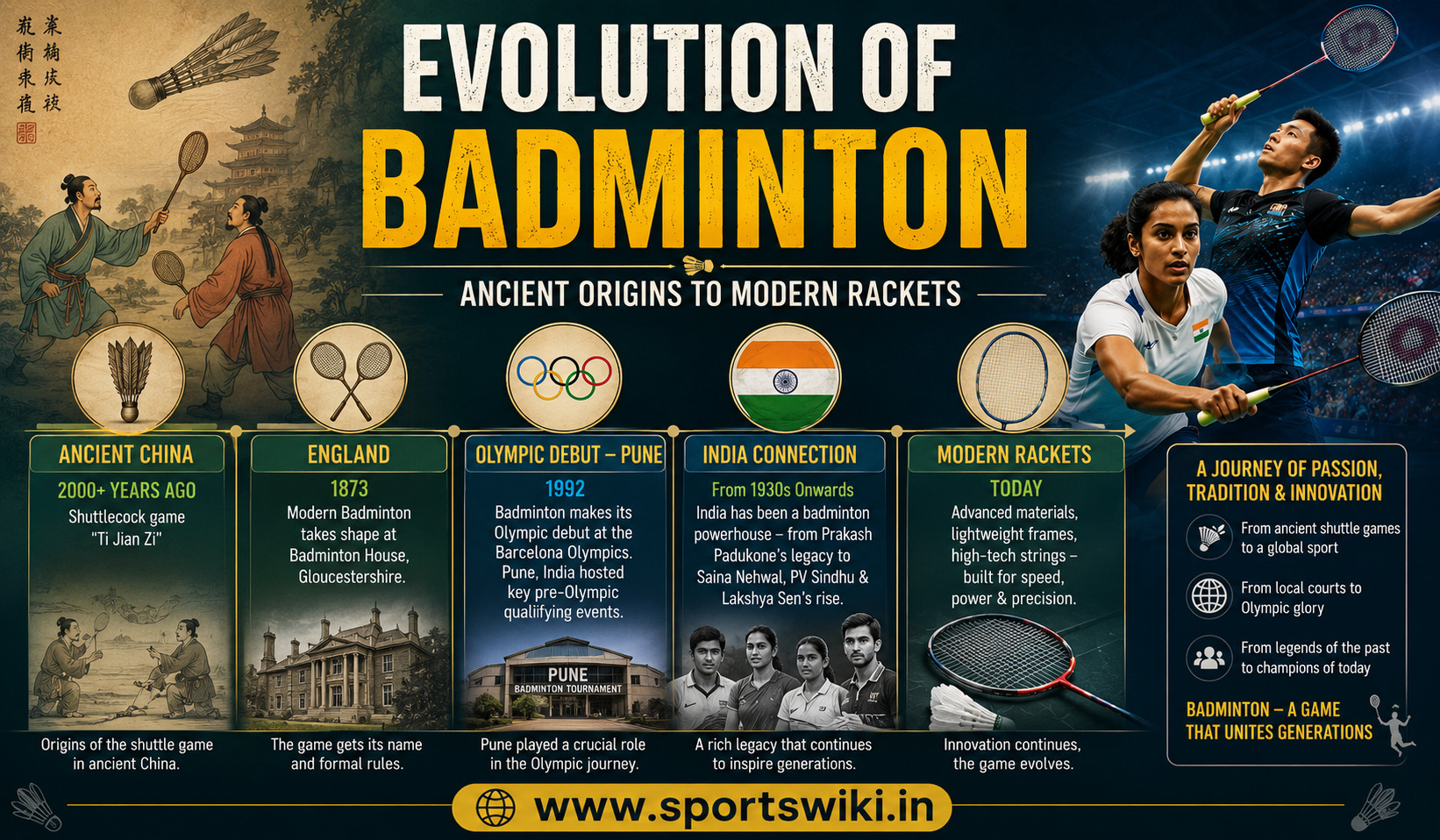
Long before formal rules and structured tournaments existed, people played simple games centered on keeping a feathered object airborne. Ancient civilizations across Europe and Asia enjoyed a pastime known as battledore and shuttlecock. Players used a small wooden paddle to hit a cork stuffed with feathers back and forth. The primary goal was not to score competitive points against an opponent, but rather to sustain a rally for as long as possible.
Children and adults in ancient Greece, China, and India filled their leisure time with these recreational rallies. Similar traditional pastimes emerged independently across regions, such as Hanetsuki in Japan, which people played during traditional New Year celebrations. These early games lacked a central net, boundary lines, or precise scoring criteria, yet they laid the essential foundation for racket control and hand-eye coordination.
From Pune to England: The Birth of Badminton History
The modern version of the game began to take shape during the nineteenth century in British India. British military officers stationed in the city of Pune observed local traditional games and added a net across the playing area. They initially called this court game Pune. Officers created local rules, measured playing spaces, and shifted the objective from friendly cooperation to direct tactical competition.
Returning officers brought these refined rules back to England during the 1870s. The Duke of Beaufort hosted a formal outdoor gathering at his country estate in Gloucestershire, known as Badminton House. Guests thoroughly enjoyed playing the game from Pune on the lawns, and the estate name quickly became synonymous with the sport itself.
The Bath Badminton Club Standards
As popularity expanded, local enthusiasts realized that uniform regulations were essential for organized competition. The Bath Badminton Club formed in 1877 to draft the initial official rulebook. They standardized court dimensions, established official net heights, and restricted maximum player numbers on court.
Official Governing Bodies Take Charge
The Badminton Association of England took over governance in 1893 to publish an updated, comprehensive set of rules. Six years later, in 1899, the inaugural All England Open Badminton Championships took place, establishing the world’s first major open tournament. International interest expanded, leading to the creation of the International Badminton Federation in 1934 to oversee global expansion.
Technical Advances in Rackets and Shuttlecocks
Equipment evolution played a crucial role in altering game speed, shot selection, and overall player physical demands over the decades. Early players used heavy wooden paddles strung with natural gut, which severely restricted stroke velocity and generated heavy wrist fatigue. Modern manufacturing transformed these simple tools into ultra-lightweight precision equipment.
The Shift from Wood to Carbon Fiber
Racket designs progressed significantly through distinct technological eras:
- Solid Wooden Frames: Heavy, rigid frames with large air resistance that forced slow, deliberate rallies.
- Steel and Aluminum Alloys: Introduced around the mid-twentieth century, offering lighter swing weight and better frame durability.
- Graphite and Carbon Composites: Developed in the late twentieth century, providing exceptional flex, structural strength, and high string tension capabilities.
- Nanotechnology Integration: Modern carbon fiber frames weighing under 80 grams that allow players to execute explosive smashes.
Natural Feathers Versus Synthetic Materials
The traditional shuttlecock consists of 16 natural goose feathers fitted into a rounded cork base. Natural feathers deliver unmatched flight stability and steep drop angles, making them the standard choice for professional tournaments. Synthetic nylon shuttlecocks offer far greater durability for casual recreation, though they travel with slightly different aerodynamic trajectories.
Olympic Inclusion and Modern Global Domination
Despite a rich global tradition and growing international popularity, badminton history did not include full Olympic medal status until the late twentieth century. The sport featured as a demonstration event at the 1972 Munich Games and as an exhibition sport at Seoul in 1988.
Official inclusion arrived at the 1992 Barcelona Olympic Games, featuring men’s and women’s singles alongside doubles events. Indonesia dominated that historic tournament, with Alan Budikusuma and Susi Susanti sweeping the individual singles gold medals. Olympic status transformed public awareness and spurred major investments in training facilities across Asia and Europe.
Asian nations such as China, Indonesia, South Korea, and Japan have consistently set international performance standards. However, European powerhouse Denmark maintains a strong presence through elite stars like Viktor Axelsen, demonstrating the global reach of modern competition.
Changing Rules and Scoring System Evolution
Tactical approaches to competitive play transformed dramatically following major rule modifications by the governing body. For decades, players competed under the classic service-point scoring system, where only the serving side could score a point. Games were played to 15 points for men and 11 points for women, often leading to marathon matches lasting over two hours.
The Badminton World Federation implemented the current rally scoring system in 2006 to streamline matches for broadcast audiences. Under this system, every single rally yields a point regardless of who served. Matches follow a best-of-three format played to 21 points, requiring a two-point margin to secure victory.
Key Rule Impact: Rally scoring eliminated passive defensive stalls, forcing athletes to attack consistently from the very first stroke.
This structural shift elevated physical demands on athletes, turning professional matches into relentless tests of speed and endurance. Modern players must execute deep overhead clears, precise net drops, and steep jump smashes while maintaining peak cardiovascular conditioning.
Frequently Asked Questions
What was badminton history originally called?
Before adoption of its modern name, the sport was called Pune in nineteenth-century India. Earlier primitive European and Asian versions were known simply as battledore and shuttlecock.
Where did the name badminton originate?
The sport was named after Badminton House, a historic estate in Gloucestershire, England owned by the Duke of Beaufort. Guests played the game imported from Pune at the estate during the 1870s, popularizing the location’s name.
When did badminton become an official Olympic sport?
Badminton became an official medal sport at the 1992 Barcelona Summer Games. It previously appeared as a demonstration sport in 1972 and an exhibition event in 1988.
Why did the scoring system change in 2006?
The Badminton World Federation introduced the rally scoring system to make matches more predictable in duration, dynamic for television audiences, and exciting for global spectators.