Singles vs Doubles Badminton: Rules, Court Size and Key Differences
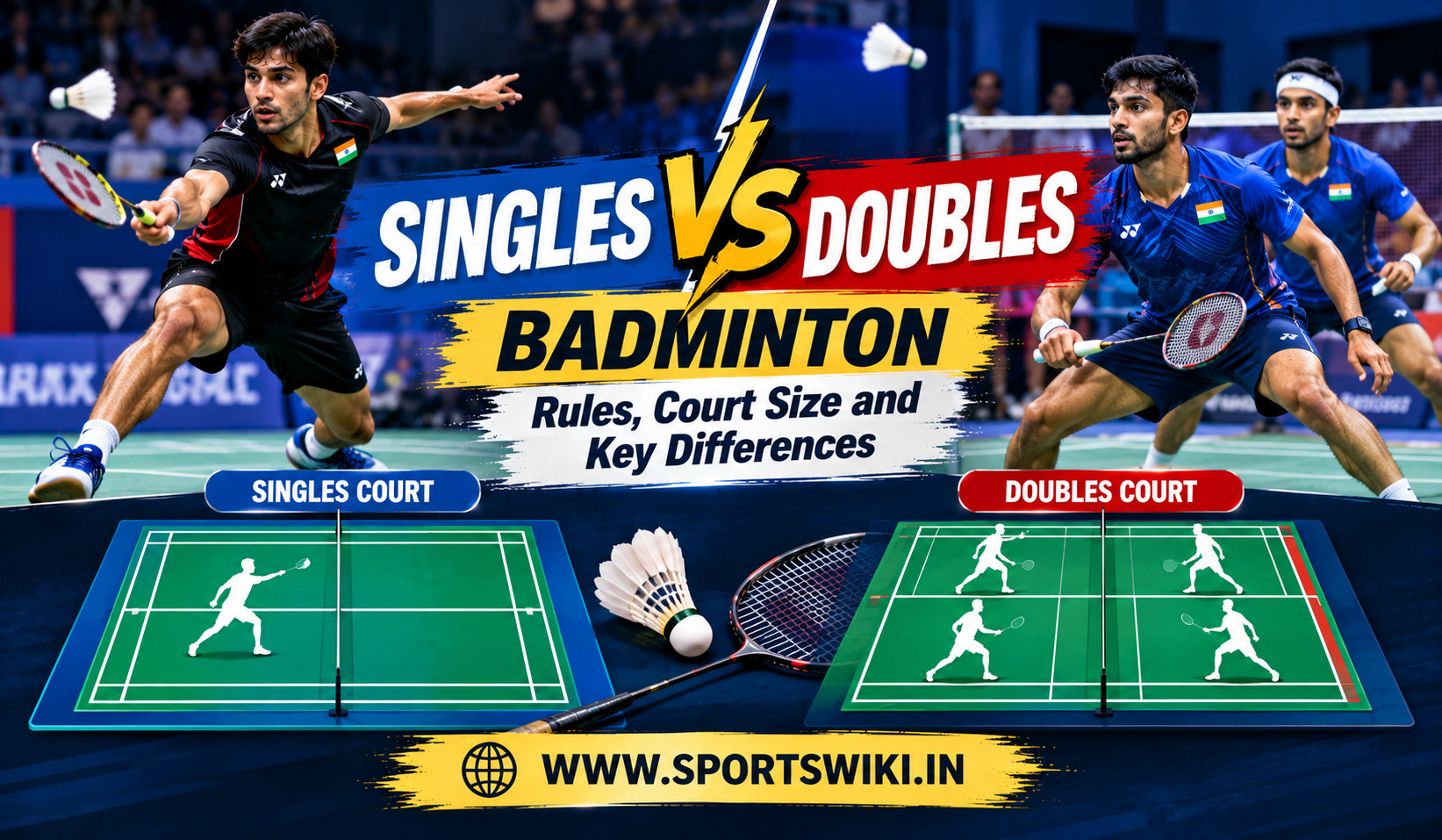
The court is 13.4 metres long in both formats. The width is not. That small change, 5.18 metres for singles and 6.1 metres for doubles, reshapes everything. Singles vs doubles badminton looks like the same game at first glance. Yet the serve, the lines and the tactics all shift once a partner joins you.
This guide compares the two formats side by side. We’ll cover court size, serve rules, scoring and strategy. We’ll also look at how elite players and Indian stars show the contrast. Because both formats follow BWF laws, many rules stay the same. The differences, however, matter a lot.
Singles vs Doubles Badminton: The Quick Comparison
Here’s the short version. Singles pits one player against one. Doubles puts two against two. Scoring is identical, but the court, the serve and the pace are not. A singles match tests stamina and shot variety, while doubles rewards speed, teamwork and quick reflexes.
Side-by-Side Snapshot
- Players on court: two in singles, four in doubles
- Court length: 13.4 metres in both formats
- Court width: 5.18 metres for singles and 6.1 metres for doubles
- Scoring: rally points, best of three games, each to 21
- Long service line: the back boundary in singles, closer to the net in doubles
The width gap is 0.92 metres. That’s the two side strips, one on each side, used only in doubles. Those strips are small, but they change how players defend. A doubles pair covers a wider court, yet each player guards only half of it.
Court Size and Lines
Both formats use the same marked court. Different lines come into play, though. For singles, the inner side lines are the boundary. For doubles, the outer side lines count. So a shot that lands in the side strip is out in singles but in during a doubles rally.
The back line works differently for serves. In singles, the long service line is the back boundary, so a deep serve is legal. In doubles, the long service line sits just under 80 centimetres inside the back line. That makes the doubles serve short and wide. Because of this, big, deep serves are rare in doubles.
Net and Short Service Line
The net stays the same in both formats. It stands 1.55 metres high at the posts and 1.524 metres in the middle. The short service line is also the same. Even so, its role changes, because doubles serves hug the net to stay low and tight.
Serve Rules Compared
Serve rules start the same way. The shuttle goes diagonally, and it must be struck below 1.15 metres. The racket head points downward, and both feet stay still. For more on those basics, read our guide to badminton rules and scoring.
In singles, the server’s score picks the court. An even score means the right court, and an odd score means the left. In doubles, the same rule applies to the serving side. A side keeps its courts until it wins a point on serve. Then the two partners swap. That swap adds a layer of order, and it’s a common source of confusion for new players.
Scoring Is the Same, but the Feel Isn’t
Both formats use rally point scoring. Each game goes to 21, with a two-point lead needed. At 29-all, the 30th point wins. So the numbers match exactly. Still, a doubles game often feels faster, because the shuttle is in the air for shorter bursts. Players hit flatter and attack sooner.
Singles rallies run longer and spread over the whole court. Players use clears, drops and lifts to stretch an opponent. Because there’s no partner to cover gaps, fitness matters a lot. A long singles match can test the legs as much as the racket skills.
Strategy: Length vs Angles
Singles tactics focus on length. Players try to push opponents to the back, then drop short to the net. Variation is the key. A smart singles player mixes high clears with sharp drops to make the opponent run.
Doubles tactics focus on attack and teamwork. Pairs use two main formations. In front-and-back, one player guards the net while the other covers the rear. In side-by-side, each takes a half of the court. Pairs switch based on the shot. As a result, communication and trust matter as much as power.
Mixed Doubles
Mixed doubles adds another twist. One man and one woman play together, so pairs often split roles. Strategy varies by pair, yet the court and the rules stay the same. It’s often the most tactical of the five main disciplines.
Positioning and Footwork
Movement differs a lot between the formats. A singles player covers the whole court alone. So the base position sits near the centre, and every shot sends the player to a corner and back. Footwork patterns, such as lunges and split steps, are the foundation. Stamina decides many close games, especially in the third.
A doubles player moves less but reacts faster. Each partner guards a zone, so quick steps and sharp reflexes matter more. Because the shuttle travels flatter, players often have less than a second to respond. Even so, the shared court brings its own pressure. A missed zone gives the opponents an easy point.
Faults Unique to Doubles
Some faults only appear in doubles. Partners can’t both hit the same shuttle in one stroke. A player also can’t hit twice in a row, though either partner may take any shot after the serve. In addition, the order of serving and receiving must follow the rules. If a pair serves or receives from the wrong court, the umpire calls a fault.
These small rules shape how pairs communicate. Players call “mine” or “yours” and agree on who takes the middle. That middle area, between the two partners, is the weak spot. Opponents aim there, so pairs rehearse coverage again and again. As a result, a good doubles pair trains like a team, not like two singles players.
Elite Examples From India
India’s best-known stars show both sides. PV Sindhu is a singles champion. She won the BWF World Tour Finals women’s singles in 2018, the only Indian to do so. Satwiksairaj Rankireddy and Chirag Shetty, meanwhile, shine in men’s doubles. In 2025, they topped their Finals group unbeaten and reached the semifinals.
Our BWF World Tour Finals 2026 preview shows how both formats play out at the top. It also lists the Indian names chasing a place in Hangzhou. Because both singles and doubles run side by side, fans can compare the styles in one week.
Para Badminton: Where the Court Changes
Para badminton adds more variation. Wheelchair singles use a reduced court, and SL3 singles uses a half court. Doubles for standing classes use the full court. Our explainer on para badminton classification covers each class and its court.
That variation shows how flexible the format is. The same basic structure adapts to many athletes. So whether you watch singles, doubles or para events, the core ideas stay in place. Only the court and the tactics shift.
Which Format Should You Play?
It depends on your goals. Singles builds fitness and shot variety. You control every point, so wins and losses feel personal. Doubles builds quickness and teamwork. It’s also easier on the legs, since two players share the court. Beginners often start with doubles for that reason.
Here’s a short opinion, framed as one. Try both. Singles teaches you the full range of shots, while doubles teaches you timing and positioning. Together, they make you a more complete player.
Tips for Choosing Your Format
New players often ask where to start. A good first step is to match the format to your fitness and your group. If you have a regular partner, doubles is easy to organise and gentle on the legs. If you play alone, singles lets you practise every stroke. Either way, a coach can help you build sound footwork first.
Club players often mix the two. They warm up with singles, then switch to doubles for match play. That blend keeps training fresh and builds a wider skill set. Over time, you’ll notice that doubles sharpens your reactions, while singles builds your patience and shot control.
Key Takeaways
- Court width: 5.18 metres for singles and 6.1 metres for doubles, with the same 13.4-metre length.
- Serve: Singles allows a deep serve, while the doubles serve is short and wide.
- Scoring: Both formats use rally points to 21, with a 30-point cap.
- Tactics: Singles favours length and fitness, while doubles favours attack and teamwork.
- India: Sindhu represents singles success, and Satwik and Chirag represent doubles.
FAQs
What is the main difference between singles and doubles badminton?
Singles uses a narrower court with one player per side, while doubles uses a wider court with two.
How wide is a badminton court for singles and doubles?
A singles court is 5.18 metres wide, and a doubles court is 6.1 metres wide.
Is the scoring different in singles and doubles?
No, both formats use rally points to 21 with a 30-point cap.
Is the long service line the same in singles and doubles?
No, it’s the back boundary in singles and just under 80 centimetres inside it in doubles.
Which is harder, singles or doubles badminton?
Singles demands more stamina, while doubles demands faster reactions and teamwork.
Conclusion
Singles vs doubles badminton comes down to space, speed and strategy. The court is 0.92 metres wider for doubles, the serve changes, and the tactics shift from length to angles. The scoring system stays the same. Whichever format you prefer, knowing the differences makes every match easier to follow.