Para Badminton Classification Explained: WH1, SL3, SU5 & SH6
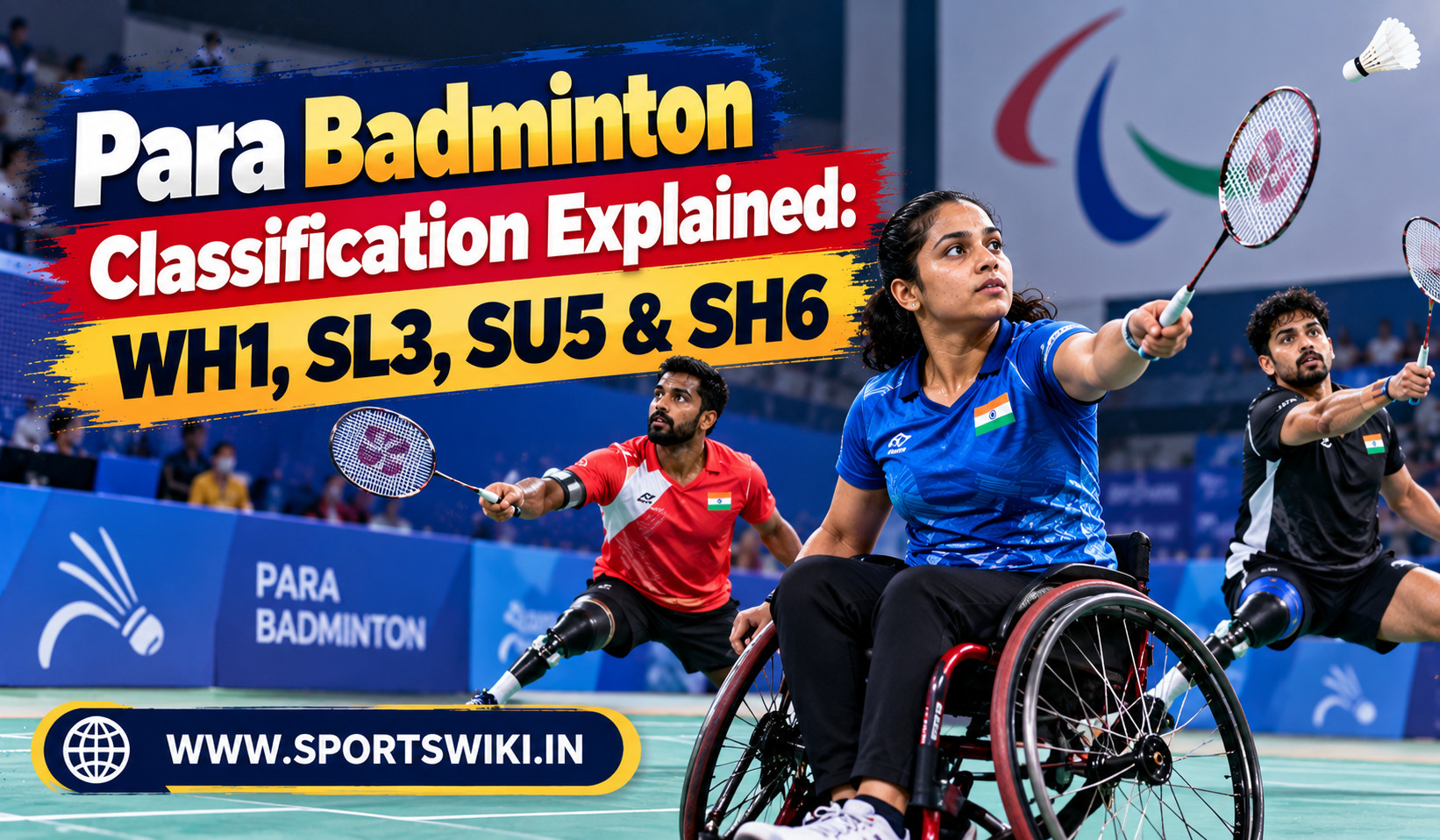
Six sport classes. Two wheelchair groups, three standing groups and one for short stature. That’s the framework behind para badminton classification, and it decides who plays whom. Codes like WH1, SL3, SU5 and SH6 can look like puzzles. Yet each one tells a clear story about how an athlete’s impairment affects play.
So this guide explains each class in simple terms. We’ll cover court sizes, how events are named, and which Indian athletes compete in which class. Para badminton follows the same core rules as the main game, but with a few changes. Facts are current as of October 21, 2026, during the Asian Para Games in Japan.
Para Badminton Classification: Why It Exists
First, classification keeps competition fair. That way, athletes with similar levels of activity limitation compete against each other. Without it, a player with a severe impairment might face one with a mild impairment, and that wouldn’t be fair. So classes group athletes by how their impairment affects badminton movement, grip and reach.
The Badminton World Federation has governed para badminton since June 2011. Before then, the Para Badminton World Federation ran the sport. Today, BWF materials list six sport classes, and each name has a letter and a number. Each name has a letter prefix and a number. The prefix hints at the group, and the number points to the level.
Reading the Codes
- WH: wheelchair classes, numbered 1 and 2
- SL: standing, lower-limb impairment, numbered 3 and 4
- SU: standing, upper-limb impairment, numbered 5
- SH: short stature, numbered 6
The Wheelchair Classes: WH1 and WH2
Wheelchair players compete in two classes. WH1 athletes have impairments in both lower limbs and in trunk function. They need a wheelchair to play. WH2 athletes have impairments in one or both lower limbs, with minimal or no trunk impairment. They also use a wheelchair.
In practice, WH1 players have less trunk control. That affects balance and reach when they swing. Meanwhile, WH2 players can use their trunk more freely. Even so, both classes are often combined in events, such as WH1-WH2 doubles. The wheelchair singles court is a reduced, half-width layout, because reach is limited.
The Standing Lower-Limb Classes: SL3 and SL4
These classes cover players who stand to play but have lower-limb impairments. SL3 players have impairment in one or both lower limbs and poor walking or running balance. SL4 players have similar impairments but with minimal balance problems. In other words, SL4 players move better than SL3 players.
Because of this, the difference shapes the court. In singles, SL3 players use a half court, split lengthwise. The area in front of the short service line is out of bounds for them. Yet SL4 players use the standard singles court. In doubles, both classes use the full court, so the SL3 half-court rule applies only to singles.
SU5: The Upper-Limb Class
SU5 covers players with upper-limb impairments. Examples include a missing thumb that limits grip and power, or the loss of an arm. These athletes stand and move well, but the stroke itself is affected. They play on the standard court, so there’s no reduced layout.
Still, racket control makes the class special. Some players adapt their grip or technique to cope with the limit. As a result, SU5 matches often show unusual footwork and creative shot choices. The net stays at the same height for every class, so the challenge comes from the athlete’s own adaptation.
SH6: Short Stature
SH6 is for players with short stature, caused by achondroplasia or other genetic conditions. These athletes stand and run freely. However, a lower reach changes how they cover the net and defend the back court. They use the standard singles court, since reach is the main issue.
Because SH6 is a separate class, SH6 players don’t face taller opponents. Instead, they compete in SH6 singles and SH6 mixed doubles events. That keeps the match balanced, and it highlights tactics such as quick footwork and steep attack angles.
How Athletes Get Classified
Of course, athletes don’t pick their own class. Trained classifiers assess each player before they compete. The assessment looks at the impairment and at how it affects badminton skills. After that, the athlete gets a sport class. Reviews can happen later, so a class isn’t always permanent. Because of this, results in a given class always carry the stamp of that process.
Para Badminton on the Biggest Stage
Para badminton joined the Paralympic programme at Tokyo 2020. Then Paris 2024 followed with its own set of events. Those include WH1-WH2 doubles, SL3-SU5 mixed doubles and SH6 singles. The sport also appears at regional events, such as the Asian Para Games. India’s strong record there makes the classes familiar to many fans.
Court Size by Class
- WH1 and WH2 singles: reduced, half-width court
- SL3 singles: half court, lengthwise, with the front area out of bounds
- SL4, SU5 and SH6 singles: standard singles court
- Standing doubles (all classes): standard doubles court
For the full-court measurements, see our guide to badminton rules and scoring. It explains the 13.4-metre length and the singles and doubles widths. Para badminton uses the same scoring, so a game still goes to 21 points. The same serve rules apply as well, with small changes for wheelchair players.
How Events Are Named
Event names combine class codes. Singles events use one class, while doubles can mix classes. Doubles events can combine classes, so you’ll see WH1-WH2 doubles and SL3-SU5 doubles. At the Paris 2024 Paralympics, the events included men’s and women’s doubles WH1-WH2. There were also mixed doubles for SL3-SU5 and for SH6.
Still, that naming has a purpose. Combining classes lets organisers fill a draw while keeping matches fair. Plus, a pair’s combined class must stay within the allowed mix. In short, the code on the draw sheet tells you exactly who’s on court. Para badminton classification, in other words, works as a quick guide to every match. Meanwhile, our explainer on singles vs doubles badminton shows why doubles tactics differ so much.
Indian Athletes by Class
Meanwhile, India has stars across several classes. Here’s a quick map, based on recent coverage.
- Pramod Bhagat: SL3, with a men’s singles semifinal place at the 2026 Asian Para Games
- Manisha Ramdass: SU5, who partners Pramod in SL3-SU5 mixed doubles
- Suhas Yathiraj: SL4, a Paris 2024 silver medallist in men’s singles
- Krishna Nagar: SH6, a Tokyo 2020 gold medallist
- Nithya Sre Sivan: SH6, a Paris 2024 bronze medallist
- Thulasimathi Murugesan: SU5, a Paris 2024 silver medallist
India’s depth showed at the 2023 Asian Para Games, where badminton produced 21 medals. That included four golds, four silvers and 13 bronzes. Pramod and Manisha won mixed doubles bronze in the SL3-SU5 class. In 2026, they’ve also won a mixed doubles match in Japan. So the program keeps delivering, and fans can expect more medals ahead.
How Classes Shape Tactics
So each class pushes players toward different styles. SL3 players on a half court often rely on placement. They have less ground to cover, so they pick spots carefully. SL4 players can use more movement, so they mix attack and defence. SU5 players adapt their strokes, which can produce odd angles. Wheelchair players depend on chair speed and quick turns.
Here’s a short opinion, framed as one. Watching a few matches in different classes is the fastest way to learn the codes. After two or three rallies, the logic becomes clear, because the court tells the story. Soon you’ll see why a half-court rally feels like chess. A standard-court exchange feels more like a sprint.
Why Classification Matters for Fans
Once you know the codes, watching gets easier. Then you can tell at a glance what a player’s challenge is. A half-court SL3 match looks different from an SL4 match, and the footwork tells a story. Wheelchair rallies show remarkable chair control and wrist work. Each class brings its own rhythm.
It also helps you follow big tournaments. At events like the Asian Para Games, the draw sheets also list classes beside every player. To see the sport’s top level, read our BWF World Tour Finals 2026 preview. It shows how the same federation runs the wider game.
Key Takeaways
- Six classes: WH1, WH2, SL3, SL4, SU5 and SH6.
- Wheelchair: WH1 has trunk and lower-limb impairment, while WH2 has less trunk impairment.
- Standing lower limb: SL3 has poorer balance than SL4, and SL3 singles uses a half court.
- Upper limb and short stature: SU5 and SH6 play on the standard court.
- India: Pramod Bhagat competes in SL3, and Suhas Yathiraj in SL4.
FAQs
What does WH1 mean in para badminton?
WH1 is a wheelchair class for athletes with impairment in both lower limbs and trunk function.
What is the difference between SL3 and SL4?
SL3 players have poorer walking and running balance, while SL4 players have minimal balance problems.
What does SU5 stand for in para badminton?
SU5 is the standing upper-limb class for players with impairments in their upper limbs.
Which class is for short stature?
SH6 is the class for players with short stature.
Do all para badminton classes use the same court?
No, wheelchair singles and SL3 singles use reduced courts, while the other classes use the standard court.
Conclusion
Para badminton classification looks complex, yet it follows a clear pattern. Six classes sort athletes by how their impairment affects play. That keeps matches fair and shows off real skill. Once you learn WH1, SL3, SU5 and SH6, every draw sheet becomes easy to read.