Golf Rules and Scoring Explained: Par, Birdie, Eagle and Bogey
In golf, the lowest score wins. A player who finishes four under par beats a player who finishes two over, so fewer strokes is always better. That twist confuses newcomers, which is why golf scoring needs a clear guide. Here’s a simple walk through par, birdie, eagle and bogey, plus the rules behind them.
What Is Par?
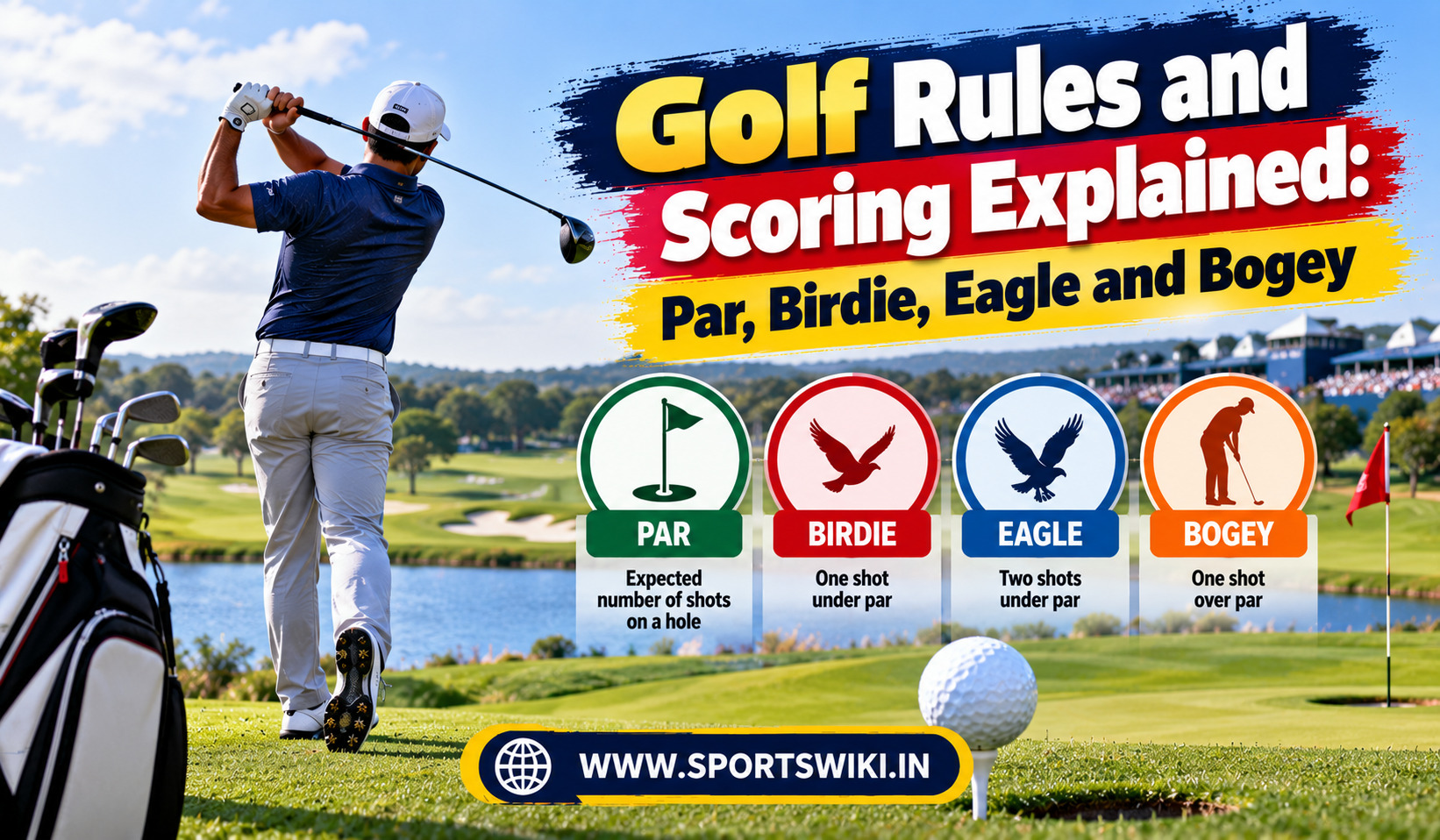
Par is the number of strokes a skilled golfer is expected to need on a hole. Courses set a par of 3, 4 or 5 for each hole, because length and difficulty differ. Since every hole has a par, golf scoring becomes a comparison rather than a raw count. So a score of four on a par-4 is simply “par”.
Most full courses have 18 holes, so the total par usually lands at 70 to 72. As a result, a round at 72 is called even par on a par-72 course. Meanwhile, anything lower means the golfer beat the course. That’s why golf scoring on scoreboards shows numbers like minus four or plus two instead of total strokes.
The Names for Every Score
Golf has a name for each score, which makes the commentary lively. In golf scoring, the names show how many strokes a player took compared with par. Because the terms of golf scoring repeat on every hole, they quickly become familiar. Here’s the full list, from best to worst.
- Albatross: Three strokes under par, a rare feat on a par 5.
- Eagle: Two strokes under par.
- Birdie: One stroke under par.
- Par: The expected number of strokes.
- Bogey: One stroke over par.
- Double bogey: Two strokes over par.
A hole-in-one is a different thing, because it describes how the hole was finished. For instance, an ace on a par 3 is also a score of two under par. So a hole-in-one can count as an eagle at the same time. Still, golfers celebrate it far more than any ordinary eagle.
How Stroke Play Works
Stroke play is the most common format for golf scoring, so it’s the best place to start. In it, a golfer counts every stroke across the round, and the lowest total wins. Because each swing counts, a single bad hole can hurt for the rest of the day. That’s why steady golf often beats flashy golf in this format.
Professional events usually run over 72 holes, played as four rounds of 18. Because the scores add up, a player’s total matters more than one great day. Meanwhile, the leaderboard shows each golfer’s score against par. For instance, a player at minus ten is ten strokes better than par for the event.
How Match Play Works
Match play works differently in golf scoring, since it counts holes rather than strokes. On each hole, the player with the lower score wins that hole, while a tie means the hole is halved. Then the winner is whoever leads by more holes than remain.
That means a match can end early, because the lead may be too big to catch. For instance, a player who leads by three holes with two left has won. Because of that, golfers take more risks in match play. After all, a disaster on one hole costs only that hole, not the whole round. In other words, hole-by-hole thinking matters more than the total.
How Stableford Scoring Works
Stableford is a points system popular with club golfers. Instead of counting strokes, players earn points on each hole. A par earns two points, and a birdie earns three. While an eagle earns four, a bogey earns one. Yet a double bogey or worse earns nothing.
This format of golf scoring rewards good holes and softens bad ones, so it suits casual rounds. As a result, a golfer who has a terrible hole can recover quickly. Because the points are simple, the format also speeds up play. Meanwhile, social rounds often use it, since it keeps everyone interested until the last hole.
Core Rules of Play
A few basic golf rules apply almost everywhere. Players must play the ball as it lies, so they can’t improve their position without a reason. Meanwhile, a player may carry no more than 14 clubs in a round. The hole itself is 4.25 inches, or 108 mm, across, so the target is small. Because governing bodies share the rules, they stay consistent worldwide.
Golf also leans on honesty, since players often keep their own scores. They mark each other’s cards, and in casual play nobody calls a referee for every small point. So integrity is part of the etiquette of the game. That tradition is one reason golf feels different from most sports.
Penalties in Golf Scoring
Mistakes cost strokes, and the penalty scale is simple. Hitting a ball into water or another penalty area normally costs one stroke. Likewise, declaring a ball unplayable costs one stroke. Because these penalties add to the score, careful play often pays off in golf scoring.
Out of bounds is harsher, because the player takes a one-stroke penalty and must replay from the original spot. That’s known as stroke and distance, so it effectively costs two shots. A lost ball follows the same idea. So a single wild drive can ruin a good round, which explains why golfers value accuracy.
Why Golf Scoring Uses Handicaps
Golfers don’t all play at the same level, so the sport uses handicaps. A handicap is a number that reflects a player’s ability. Because it adjusts scores, a beginner can compete fairly against a more skilled friend. I haven’t covered the full maths here, since systems differ by country.
The idea is still easy to grasp. A better player gives strokes to a weaker one, while the weaker player gets help on harder holes. As a result, a friendly match stays close. At the same time, handicaps keep golf scoring fun for people of every level, which helps the sport grow.
A Worked Example
A short example shows how golf scoring works. Imagine a player takes four strokes on a par 4, then three on a par 3. Both holes are pars, so the player is still level. Then the player takes four on a par 5, which is a birdie. After three holes, the player is one under par.
Now suppose the player scores six on the next par 4. That’s a double bogey, so the total moves to one over par. This shows how quickly a score can swing. Because golf scoring compares each hole with par, every result is easy to track. In short, you simply add or subtract from zero as the round goes on.
Reading a Golf Scoreboard
Golf scoring can look cryptic on a scoreboard at first, so a quick key helps. A number with a minus sign means the player is under par, while a plus sign means over par. The letter E stands for even par, so it’s the middle point. Because leaderboards use these marks, fans can see the race at a glance.
If you enjoy learning how different sports count points, try table tennis rules for a simple rally-based system. Meanwhile, gymnastics scoring mixes difficulty with execution. For a look at fairness in para sport, see para table tennis classification. Each sport solves the same problem in a different way.
Key Takeaways
- Par: The expected number of strokes on a hole, usually 3, 4 or 5.
- Under par: Birdie is one under, eagle is two under and albatross is three under.
- Over par: Bogey is one over and double bogey is two over.
- Stroke play: The lowest total across the round wins.
- Match play: Players win or halve each hole.
- Penalties: Most cost one stroke, and out of bounds means stroke and distance.
FAQs
What does par mean in golf scoring?
Par is the number of strokes a skilled golfer is expected to take on a hole.
What is the difference between a birdie and an eagle?
A birdie is one stroke under par, while an eagle is two strokes under par.
What is a bogey in golf?
A bogey is a score of one stroke over par on a hole.
Does a low score win in golf?
Yes, the player with the lowest score wins in stroke play.
How many clubs can a golfer carry?
A golfer can carry a maximum of 14 clubs in a round.
Conclusion
Golf scoring looks odd at first, yet it follows a clear idea. Every hole has a par, while every result is measured against it. So once you know the names, the formats and the penalties, any leaderboard makes sense. With this guide to golf scoring, you can follow a round with confidence.