Gymnastics Scoring Explained: D-Score and E-Score Simplified
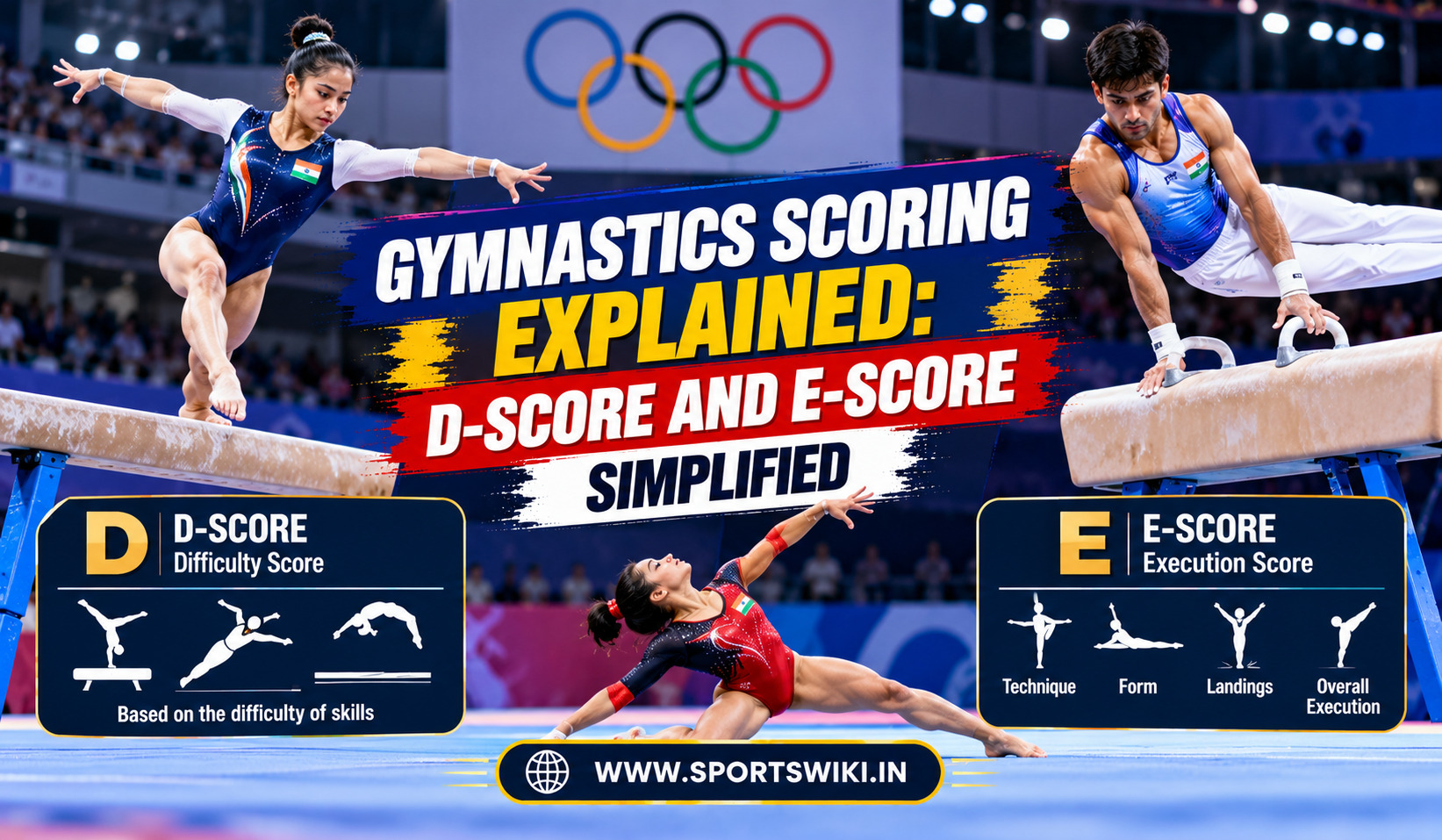
At the 2004 Athens Olympics, South Korea’s Yang Tae-young missed gold by 0.1 points. Judges had given him the wrong start value on one apparatus, yet his appeal was rejected. That scandal helped end the old perfect-10 system, so gymnastics scoring changed for good. Here’s a simple guide to the D-score and E-score, because together they decide every routine. It also explains how the two marks combine into one final number.
How Gymnastics Scoring Changed After 2004
After the Athens judging row, the sport’s governing body dropped the old scale for gymnastics scoring. In its place came the Code of Points in 2006, which allowed a more open-ended system of gymnastics scoring. Because of that, the perfect 10 no longer caps the total score. However, a gymnast can still earn a 10.0 for execution alone.
The change had a clear goal. Officials wanted to separate how hard a routine is from how well it’s performed. So gymnastics scoring now uses two marks, which are then added together. That way, a bold routine and a clean routine can both be rewarded, while errors still cost points.
The Basic Formula
The idea is simple, even if the details run deep. So the final score equals the D-score plus the E-score, minus any neutral deductions. In short, difficulty and execution add up, while penalties come off the top. Because the maths is the same on every apparatus, fans can learn gymnastics scoring once and use it everywhere.
Scores under the current gymnastics scoring system usually land between 13 and 16 points, according to common Olympic primers. For instance, NBC’s Paris 2024 guide put typical totals in the 14 to 16 range. So a mark of 14.5 is solid, while 15.5 is outstanding. Meanwhile, anything far below that usually signals a major error.
What Is the D-Score?
The D-score measures difficulty, so it rewards risk. It starts at zero and builds up as the gymnast performs skills. Each skill has a set value in the Code of Points. Because the scale is open-ended, a gymnast can in theory earn unlimited points. In practice, though, only a set number of skills counts, which keeps routines realistic.
Skills are rated from A to I. An A skill is the simplest and earns 0.1 points, while an I skill is the hardest and earns 0.9. Beyond skill values, the D-score also rewards connections between elements. For men, element groups add credit too, so composition matters. As a result, smart routine building is a skill in itself, and that’s why coaches plan every routine carefully.
How Many Skills Count?
Only a gymnast’s hardest skills count towards the D-score, so quantity alone doesn’t help. For women, the eight most difficult skills are counted, while for men the ten most difficult count. Because of that, adding a ninth or eleventh skill won’t help if it’s easy. The extra element would only add risk, since it adds nothing to the score.
Vault works differently, so it needs its own note. Each vault has a fixed difficulty value in the Code of Points, so the D-score is known in advance. That’s why vault scoreboards often show the start value before the gymnast even runs. Meanwhile, on other apparatus, the D-score is only confirmed once judges finish reviewing the routine.
What Is the E-Score?
The E-score measures execution, meaning how well the routine is performed. It starts at 10.0, and judges then take away points for errors, so every fault matters. Because it starts at a perfect mark, a flawless routine keeps all ten points. However, every wobble, bent knee or poor landing chips away at the total.
Judges also consider artistry, composition and technique under the execution mark. So the E-score isn’t just about avoiding mistakes, because it also rewards style and control. Even so, most of the visible drama comes from the deductions, since a single fall can swing a medal.
The Deduction Ladder
The deduction scale is short and easy to remember, so fans pick it up fast. A small error costs 0.1 points, and a medium error costs 0.3. A large error costs 0.5, while a fall costs a full 1.0. Because the steps are fixed, fans can follow along at home with a little practice. Here’s a quick guide to the ladder.
- Small error: 0.1, such as a slight step on landing.
- Medium error: 0.3, such as a clear technical fault.
- Large error: 0.5, such as a major break in form.
- Fall: 1.0, such as dropping off the apparatus.
Because small errors add up in gymnastics scoring, a routine with ten tiny faults loses a full point. That’s why elite gymnasts train landings so hard. As a result, a clean “stuck” landing often gets a loud cheer from the crowd.
Neutral Deductions
Some penalties come off the final score rather than the E-score, and these are known as neutral deductions. For example, going out of bounds can cost 0.1, according to NBC’s guide. Likewise, time violations can bring penalties. Because they sit outside execution, they apply after the D and E marks are added.
This split keeps the system tidy, because each mark has one job. The E-score judges the quality of the performance, while neutral deductions handle rules of conduct. So a gymnast with a beautiful routine can still lose points for going out of bounds. In other words, control of the space matters as much as control of the body.
A Worked Example
A simple example shows how it all fits. Imagine a gymnast earns a D-score of 6.0 and an E-score of 8.5. Then the two marks add up to 14.5. If the gymnast also goes out of bounds, a 0.1 deduction applies, so the final score becomes 14.4.
This is only an illustration, so real numbers will vary by event and level. Still, the logic holds in every case. Because the E-score starts at 10.0, it can only go down. Meanwhile, the D-score starts at zero and can only go up. That contrast is the heart of gymnastics scoring.
Judges, Ties and Rotations
Judging panels split the work of gymnastics scoring, since one group judges difficulty while another judges execution, which keeps each panel focused. At the Olympics, nine judges are drawn from a pool approved by the sport’s governing body, according to common primers. Because panels are large, a single harsh or generous mark has less effect.
Ties follow a clear rule, because the higher E-score wins when two athletes finish level. So execution decides close contests, which rewards clean routines. Team events also differ by gender, since the women’s team final has four rotations and the men’s has six. If you enjoy learning how sports count points, read about table tennis rules or golf scoring. For a para sport comparison, see para table tennis classification.
Why Gymnastics Scoring Still Divides Fans
Here’s the thing: not everyone loves the open-ended system. Critics have argued that the code pushes gymnasts to pile on one skill after another to lift the D-score. In fact, a former federation president once suggested halving the points for difficulty. That said, supporters like the way the system rewards bold routines.
My own view is that the split into two marks is easier for fans to follow than the old scale. Because the D-score shows ambition and the E-score shows polish, each routine tells two stories. So debates about gymnastics scoring will probably continue, while the core formula stays the same.
Key Takeaways
- Formula: Final score equals D-score plus E-score, minus neutral deductions.
- D-score: Measures difficulty, starts at zero and is open-ended.
- E-score: Measures execution, starts at 10.0 and only goes down.
- Deductions: 0.1 for small errors, 0.3 for medium, 0.5 for large and 1.0 for a fall.
- Skills counted: Eight for women and ten for men.
- Tiebreak: The higher E-score wins.
FAQs
What does the D-score measure in gymnastics scoring?
The D-score measures the difficulty of the skills and connections in a routine.
What does the E-score measure?
The E-score measures execution and starts at 10.0, with deductions for errors.
How much is a fall worth in deductions?
A fall costs 1.0 point.
Is a perfect 10 still possible?
Yes, a gymnast can earn a 10.0 execution score, but total scores are no longer capped at 10.
What decides a tie in gymnastics scoring?
The higher E-score decides a tie.
Conclusion
Gymnastics scoring looks complex, yet it follows a simple pattern. Difficulty goes up from zero, while execution comes down from ten. Then neutral deductions trim the final total. So once you know the D-score and E-score, every routine tells a clearer story. With this guide to gymnastics scoring, you can follow any meet with confidence.