Tennis Court Surface Adaptations: Clay To Grass Fast
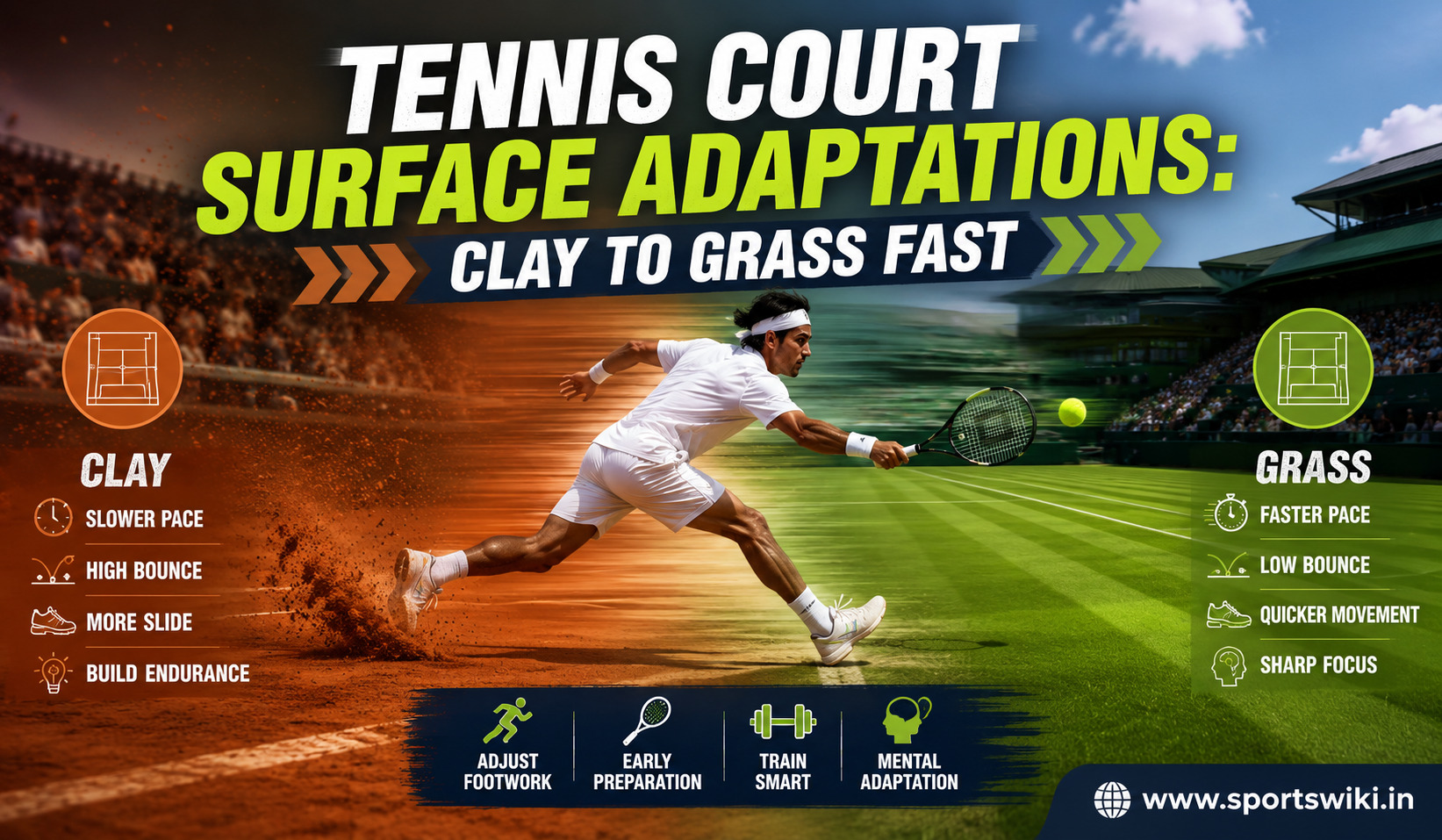
Roland Garros ends in early June. Wimbledon begins about three weeks later. In that short window, the best players on earth have to completely rewire how they move, how they hit, and how they think, all while their bodies are still recovering from the most physically grueling stretch of the season. Tennis court surface adaptations from clay to grass may be the single hardest transition in professional sport.
Why Clay To Grass Is Tennis’s Hardest Transition
Clay and grass sit at opposite ends of the tennis spectrum. Clay slows the ball down, produces a high, predictable bounce, and rewards players willing to grind out long rallies built on heavy topspin. Grass does almost the exact opposite. The ball skids low and fast off the surface, points end quickly, and the margin for error on footwork and timing shrinks dramatically.
Since the Open Era began, only a handful of players have managed to win both the French Open and Wimbledon in the same year, a feat known as the Channel Slam. That short list, Rod Laver, Bjorn Borg, Rafael Nadal, Roger Federer, Novak Djokovic, and Carlos Alcaraz, says everything about how difficult this particular set of tennis court surface adaptations actually is.
The Physical Adjustments Players Must Make
Winning on both surfaces in the same season requires more than just confidence. It requires a genuine physical reset, often completed in a matter of days rather than weeks.
Footwork: From Sliding To Split-Stepping
On clay, players slide into shots, using the surface itself to help control momentum and change direction mid-rally. That same sliding motion on grass is not just ineffective, it is dangerous, since grass offers far less predictable traction. Players instead have to shift toward smaller, quicker adjustment steps and a lower center of gravity, planting more firmly before each shot rather than gliding through it. Coaches often describe this shift as relearning how to simply stand on a tennis court.
Shot Selection: Shorter Points, Lower Bounces
Clay court tennis rewards patience. Grass court tennis punishes it. Because the ball stays low and skids through the court rather than kicking up, players have to shorten their backswings, take the ball earlier, and commit to finishing points faster rather than settling into extended baseline rallies. Slice becomes a far more valuable weapon on grass, since a well-placed slice skids even lower and disrupts an opponent’s timing in a way that simply does not translate on the higher-bouncing clay. Serve-and-volley tactics, largely abandoned as a primary strategy on clay, become genuinely viable again on faster grass courts.
The Short Grass Season Window
Part of what makes this transition so brutal is simply the calendar. Following Roland Garros, players historically had only two weeks before Wimbledon began, a window that was extended to roughly three weeks starting in 2015 specifically to give players more time to adjust. Even with that extra week, three weeks remains an incredibly tight turnaround to relearn an entirely different sport within the same sport.
Warm-Up Tournaments That Matter Most
Most top players use one grass court tournament as a tune-up before Wimbledon, rarely more than that given the short window. Events like Halle in Germany, Queen’s Club in London, and Eastbourne on the English south coast serve as the primary proving grounds, giving players just a handful of competitive matches to rebuild their grass instincts before the year’s third major begins. Some players, particularly those still deep in clay-season fatigue, choose to skip warm-up events entirely and adjust in practice instead, a riskier approach that occasionally backfires with an early Wimbledon exit.
The Channel Slam: Proof It Can Be Done
Despite how difficult this transition sounds, a select group of champions have proven it is possible to master both surfaces in the same season. Rafael Nadal, a player built almost entirely around clay court dominance, still managed to complete the Channel Slam twice, in 2008 and 2010, adjusting his heavy topspin game just enough to survive grass’s faster conditions. Roger Federer, whose game was arguably built in reverse, tuned for grass first, completed his own Channel Slam in 2009. Novak Djokovic pulled off the same feat in 2021, and Carlos Alcaraz became the most recent player to join this list in 2024, proving that even a player still early in his career can master both ends of the surface spectrum in the same short window.
What ties these players together is not one single technique, but an unusual level of movement versatility. Each of them built a game that could compress or expand depending on what the surface demanded, rather than relying on a single rigid style that only worked in one set of conditions.
How Modern Players Speed Up The Adjustment
Today’s top players treat the clay-to-grass shift as a structured process rather than something that simply happens on its own once the calendar changes. A few approaches have become increasingly common across the tour:
- Reduced net height practice drills, where players spend early grass sessions specifically working on low volleys and half-volleys to recalibrate their hands to the faster, lower bounce
- Shortened rally patterns in practice, deliberately training points to end faster than clay court habits would normally allow
- Footwear and equipment changes, switching to grass-specific outsoles designed for traction on a surface that behaves completely differently underfoot than clay
- Mental resets built into scheduling, with some players intentionally taking a few days of complete rest after Roland Garros specifically to separate the two mindsets before grass training begins
Jannik Sinner’s recent Wimbledon success, including his 2025 and 2026 titles, has been built partly on exactly this kind of disciplined, compressed preparation, arriving at grass events with a clear technical checklist rather than hoping his clay-honed instincts simply transfer on their own.
FAQ: Tennis Court Surface Adaptations
Why is switching from clay to grass so difficult?
Clay produces a slow, high bounce that rewards long rallies, while grass produces a fast, low bounce that rewards quick, decisive points. Players have to change their footwork, shot selection, and overall rhythm in a very short window between tournaments.
How much time do players have between the French Open and Wimbledon?
The gap has been roughly three weeks since 2015, up from just two weeks in earlier years, though this remains one of the shortest transition windows between any two Grand Slams.
What is the Channel Slam?
The Channel Slam refers to winning both the French Open and Wimbledon in the same calendar year. Only a small handful of men, including Rod Laver, Bjorn Borg, Rafael Nadal, Roger Federer, Novak Djokovic, and Carlos Alcaraz, have accomplished it in the Open Era.
Which tournaments do players use to prepare for grass season?
Halle, Queen’s Club, and Eastbourne are the most commonly used warm-up events, giving players a small number of competitive matches on grass before Wimbledon begins.