What Is Squash? Rules, Scoring and Court Size Explained
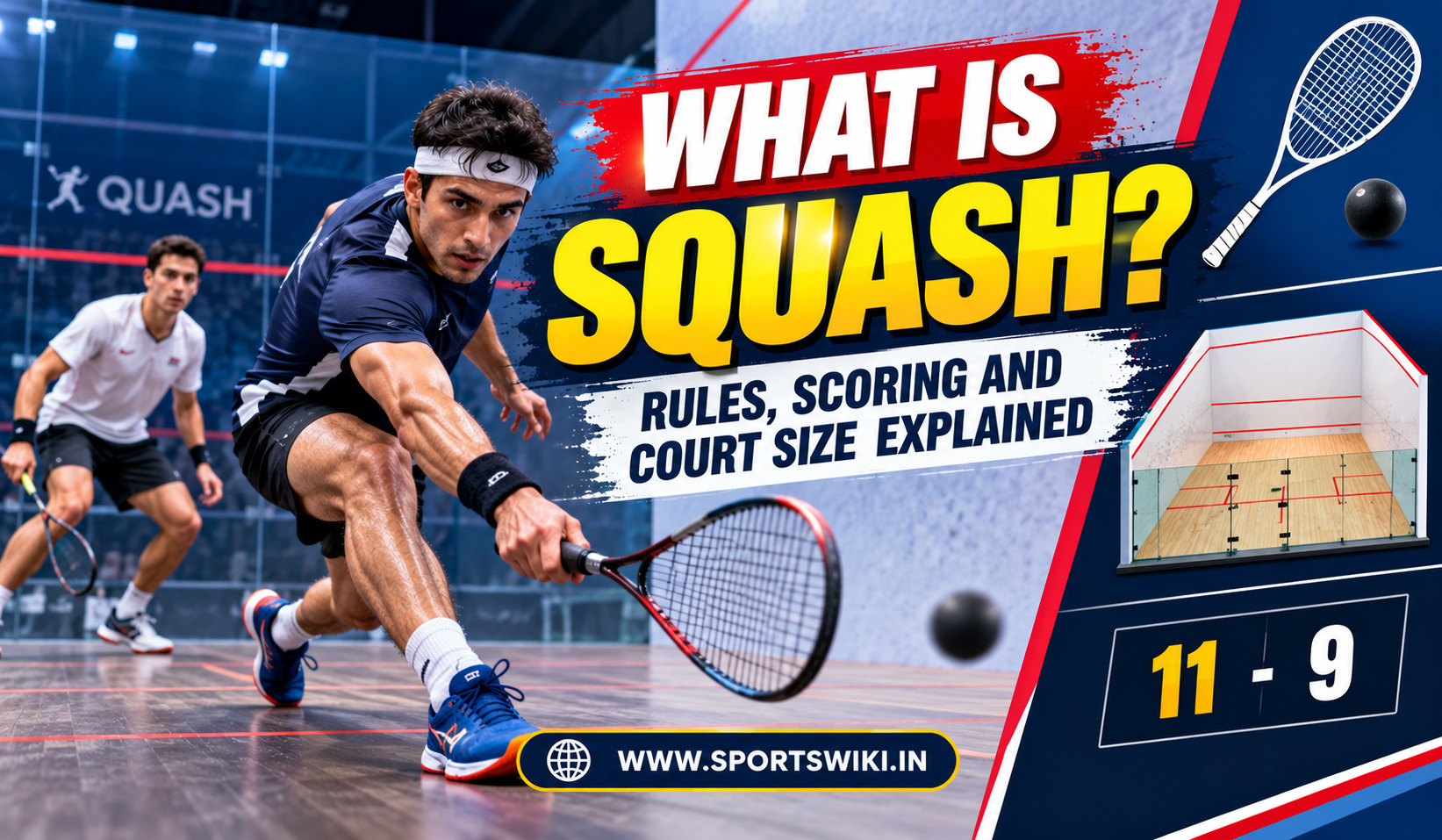
Two players share a court that’s just 9.75 metres long and 6.4 metres wide. Once a rally starts, neither of them gets much time to breathe. So, what is squash? It’s an indoor racket sport where players take turns hitting a small rubber ball against the same front wall.
Because squash makes its Olympic debut in 2028, plenty of new fans want a simple starting point. This guide covers the rules, the scoring system and the court size in plain language. Along the way, you’ll see where the sport is heading and why India has a real stake in it. Even if you’ve never held a racket, you’ll be able to follow a match by the end.
What Is Squash? The Basic Idea
Squash is played by two people, with one racket each and one ball between them. Because there’s no net, both players share the same space and fight for the same patch of floor. Every shot must hit the front wall above a metal board at the bottom and below a line at the top. So the ball goes forward, rebounds, and the other player has to chase it down.
A player has to hit the ball before it bounces twice on the floor. Since the ball can touch the side and back walls first, rallies often swirl around the whole court. That’s why fans compare squash to chess played at sprint speed. Even so, the core goal never changes: make your opponent miss.
The game has deep roots in England. It grew out of an older sport called rackets, which students played at Harrow School in the 1800s. Before long, players noticed that a softer ball made for longer rallies in tighter spaces. From there, the sport spread through clubs across the world, and today it’s played in well over a hundred countries.
Court Size and Markings
Let’s start with the numbers. A standard court is 9.75 metres long and 6.4 metres wide. The front wall stands 4.57 metres high, while the back wall is lower at 2.13 metres. Because the room is fully enclosed, the ball never leaves play for long.
Next, the floor lines matter just as much. A short line runs across the court, and a half-court line splits the back area into two boxes. Together they form the service boxes, one on each side. Meanwhile, the spot where the lines cross becomes the most valuable square metre in the sport.
Here’s the thing about the size: it shapes the whole sport. A smaller space means shorter distances, so points come quickly and mistakes get punished. Compared with a tennis court, a squash court is tiny. Even so, players cover more ground per minute than many fans expect, since every shot sends them somewhere new. Put simply, what is squash if not a fight for the middle of a small box?
Walls and Glass Courts
Traditional courts have solid walls, but many top events now use glass. A see-through back wall lets the crowd watch from right behind the players. In fact, reports say the Olympic event will be played on a single glass court. As a result, spectators will see every dive and lunge up close.
Equipment: Rackets, Balls and Eyewear
Modern rackets are built light, with a small, round head. Rules cap their length at 686 millimetres, which means every player works with similar tools. Even so, small differences in balance can change how a shot feels. For that reason, serious players test several frames before they commit.
The ball is hollow rubber, about 40 millimetres across. A small dot on it shows how much it bounces. Professionals use the double yellow dot, which is the slowest and lowest-bouncing option. Because a cold ball barely bounces, players hit it hard in the warm-up to wake it up.
Eye protection matters, too, since the ball moves fast in a small space. Goggles are strongly recommended at every level. Plenty of clubs insist on them for juniors. So a new player should buy a pair before anything else. After all, a bruised ego heals faster than a damaged eye, and nobody enjoys learning that lesson the hard way.
How a Rally Works
Every rally starts with a serve. The server needs at least one foot inside a service box when the ball is struck. Then the ball must hit the front wall above the service line and land in the opposite back quarter. If it doesn’t, the receiver wins the point.
After the serve, players hit alternate shots until someone can’t return the ball. Returns can bounce off the side or back walls first, but they must reach the front wall. Because the ball is quick, both players want to own the T, the spot where the court lines cross. From there, they can reach every corner in a step or two.
The player who wins a rally serves the next one. That keeps the pressure on whoever is behind. Still, a good server can’t relax, since a poor return gives the point straight back.
Smart players don’t just hit hard. Instead, they mix short drops with deep drives that cling to the side wall. A deep shot pushes the opponent to the back corner, which means the front of the court opens up. Then a soft drop just above the board finishes the job. That’s why a rally can look slow for ten shots and then end in a flash.
Scoring: How Points and Games Work
Modern squash uses point-a-rally scoring. That means every rally ends with a point for one player, no matter who served. A game goes to 11 points. However, a player must also lead by two, so a 10–10 game keeps going until someone pulls ahead.
For example, 11–7 wins a game, but 11–10 doesn’t. Instead, play continues until the score reaches 12–10 or beyond. Most professional matches are best of five games, so the first to win three takes the match. Some club events use best of three to save time.
Those long matches explain why fitness is such a big part of squash. Players sprint, lunge and recover again within seconds, often for an hour or more. Because the court is small, there’s no room to hide when your legs get heavy. As a result, strong players train as hard on their stamina as on their strokes.
Lets, Strokes and Fouls
Squash has no net, so contact and blocked shots are part of the game. Referees handle them with three calls: let, stroke and no let. A let means the rally is replayed. A stroke gives the point to the player who was blocked, while a no let means play simply stands.
For instance, imagine you’re about to hit a clean winner, but your opponent stands in the way. A stroke might be awarded in that case. Meanwhile, if you couldn’t have reached the ball anyway, the call is often a let. At top events, players can also ask for a video review of some decisions.
Why Squash Is in the Spotlight
Squash will debut at the Los Angeles Games in 2028, with men’s and women’s singles draws of 16 players each. For the full format and qualification route, read our guide to squash at the 2028 Olympics. Meanwhile, newcomers often ask how it differs from other racket sports. That’s where a breakdown of squash vs badminton vs tennis helps.
India has a proud story here, too. Players such as Joshna Chinappa and Anahat Singh helped the country win medals at the 2026 Asian Games. Our profile of the top Indian squash players tells that story in full. So the sport’s profile is rising fast at home as well as abroad. For a casual viewer, what is squash worth watching for? Quick rallies, big lunges and plenty of tactical twists.
Key Takeaways
- Court size: A standard court measures 9.75 metres by 6.4 metres, with a 4.57-metre front wall.
- Scoring: Games go to 11 points with a two-point lead needed, and most pro matches are best of five.
- Ball: Professionals play with the slow, low-bouncing double yellow dot ball.
- Referee calls: A let replays the rally, while a stroke awards the point to the blocked player.
- Olympic debut: Squash joins the Los Angeles 2028 programme with 16-player men’s and women’s draws.
FAQs
How big is a squash court?
A standard court is 9.75 metres long and 6.4 metres wide.
How many points do you need to win a squash game?
A player needs 11 points and must lead by two clear points.
Does squash use a net?
No, because both players share one court and hit the ball against the front wall.
How many games are in a professional squash match?
Most professional matches are best of five games, so three wins take the match.
What is a let in squash?
A let is a referee call that replays the rally after the players got in each other’s way.
Conclusion
So, what is squash at its heart? It’s a fast, tactical duel in a small glass or wall-lined box, where fitness and shot choice matter equally. Once you know the court size, the point-a-rally scoring and the let and stroke calls, matches get far easier to follow. With the Olympic debut in 2028 on the horizon, there’s never been a better time to learn the rules.